Orders of Chivalry: History, Evolution, and Classification
An order of chivalry, also known as an order of knighthood or an equestrian order, is a society or fellowship of knights. These institutions were typically founded during or inspired by the original Christian military orders of the Crusades (c. 1099–1291) and are deeply intertwined with medieval ideals of chivalry.
Beginning in the 15th century, these orders evolved from ad hoc creations into formal dynastic orders established by royal courts. While many retained the structure of a confraternity or association, others transitioned into purely honorific systems consisting of medal decorations. This evolution eventually paved the way for the modern-day orders of merit used by sovereign states today.
Key Facts
- Origins: Rooted in the military orders of the Crusades (1099–1291).
- Evolution: Shifted from military fellowships to courtly dynastic orders and eventually to honorific orders of merit.
- Classification: Orders are categorized by time of foundation (Medieval vs. Modern), religion (Catholic, Orthodox, Protestant), and purpose (Monarchical, Confraternal, Fraternal, or Votive).
- Modern Use: Many current orders are merit-based, though some still confer titles of nobility.
Terminology and Classifications
Defining these societies requires a look at various scholarly perspectives. The Italian scholar Francesco Sansovino (1521–1586) distinguished between Knights of Collar (dynastic orders) and Knights of the Cross (religious military orders). Later, D'Arcy Jonathan Dacre Boulton expanded these categories to include monarchical, confraternal, fraternal, votive, and honorific orders.
Categorization by Foundation and Purpose
- Medieval vs. Modern: Medieval orders were founded during the Middle Ages or Renaissance, while modern orders appeared after 1789.
- Religious Affiliation: Orders may be exclusively Catholic, blessed by Orthodox heads, or blessed by Protestant heads.
- Purpose-Driven:
- Monarchical: Founded by a monarch acting as a fount of honour.
- Confraternal: Founded by high or low nobility.
- Fraternal: Created for a specific, singular purpose.
- Votive: Established for a limited time by members taking a vow.
- Self-styled: Imitation orders lacking official statutes.
The Role of the Holy See
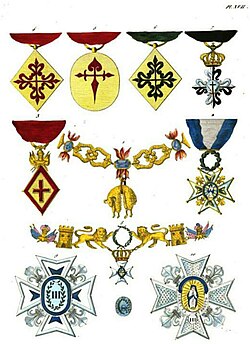
The Holy See manages pontifical equestrian orders through two primary methods: collazioni diretti, which are conferred directly by the Pope, and subcollazioni, which are orders under the protection of the Holy See, such as the Teutonic Order and the Order of the Holy Sepulchre.
Historical Evolution of Orders
Military-Monastic and Early Monarchical Orders
The earliest forms were military-monastic orders (c. 1100–1291), exemplified by the Order of Saint John of Jerusalem. By 1330, monarchical orders began to emerge, such as the Order of Saint George in the Kingdom of Hungary. Over the 15th and 16th centuries, many monastic orders transitioned into this monarchical category.
Notable Medieval and Post-Medieval Foundations
The late medieval period saw a surge in prestigious foundations, including the Order of the Garter (England, 1348) and the Order of the Golden Fleece (Burgundy, 1430). Following the medieval era, other significant orders were established, such as the Order of the Holy Spirit (1578) and the Order of the Thistle (1687).
Orders of Non-Reigning Monarchs
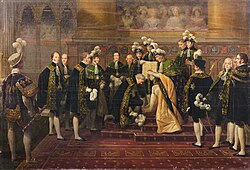
Some orders continue to be bestowed even after the founding monarch no longer reigns. Examples include the Austrian branch of the Order of the Golden Fleece, the Order of the Holy Spirit, and various Imperial Orders of the House of Ethiopia, such as the Imperial Order of Solomon.
Modern Orders of Merit
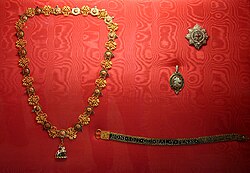
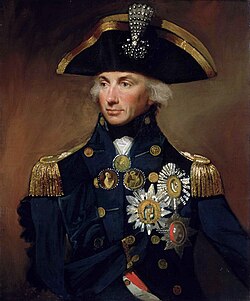
Since the late 17th century, most new orders have ceased to be fellowships with a common mission and have instead become tools for governments to honor deserving individuals. While they often retain the rituals and structures of medieval chivalry, they are essentially orders of merit.
In some monarchies, these orders still confer titles of nobility. In contrast, republican honors—such as the Legion of Merit in the United States or the Order of Merit of the Federal Republic of Germany—avoid traditional chivalric structures entirely.
Summary of Order Classifications and Ranks
| Category/Class | Common Titles/Examples | Key Characteristic |
|---|---|---|
| Class I | Grand Cross, Grand Collar | Highest rank of insignia |
| Class II | Grand Officer, Knight Commander | Senior leadership rank |
| Class III | Commander, Companion | Intermediate rank |
| Class IV | Officer, Knight 1st Class | Junior officer rank |
| Class V | Knight, Chevalier, Member | Entry-level knighthood |
| Monarchical | Order of the Garter | Founded by a sovereign |
| Confraternal | Order of Saint Catherine | Founded by nobility |
Frequently Asked Questions
What is the difference between a chivalric order and an order of merit?
Chivalric orders were originally societies of knights with a common mission or religious purpose, often rooted in the Crusades. Orders of merit are modern honorific systems used by states to reward individuals for their achievements, often retaining only the outward rituals of chivalry.
Which are some of the oldest surviving orders?
The Order of the Holy Sepulchre (c. 1099) and the Sovereign Military Order of Malta (founded as the Order of St. John of Jerusalem in 1048) are among the oldest original military orders still in existence.
Can an order still be awarded if the monarchy has fallen?
Yes. Some orders are maintained by the head of a former ruling house who continues to act as a fount of honour, such as the House of Savoy with the Order of the Most Holy Annunciation.
What are self-styled orders?
Self-styled orders are imitation organizations that claim to be orders of chivalry but lack official statutes, legal recognition, or restricted membership requirements.
What is the role of the Pope in equestrian orders?
The Pope can confer orders directly (collazioni diretti) or provide protection to existing orders (subcollazioni), such as the Order of the Holy Sepulchre.