Olympia Academy: The Intellectual Circle of Albert Einstein
Long before he became a global icon of theoretical physics, Albert Einstein was a young patent clerk in Bern, Switzerland, seeking intellectual stimulation. In 1902, he co-founded the Olympia Academy (German: Akademie Olympia), an informal gathering of friends dedicated to the rigorous discussion of philosophy and physics. These meetings, typically held at Einstein's apartment, served as a crucible for ideas during a pivotal era of his intellectual growth.
The Academy's formation was an unexpected result of Einstein's financial needs. In 1901, prior to securing his position at the patent office, Einstein placed a newspaper advertisement offering private lessons in mathematics and physics. Maurice Solovine, a Romanian student of philosophy, responded to the ad. While the formal tutorials and payments never materialized, the two discovered a profound shared interest in the intersection of science and philosophy, leading to regular meetings.
The circle expanded when Conrad Habicht, a mathematician and neighbor of Einstein from Schaffhausen, joined the group. Together, the trio officially named themselves the Akademie Olympia in 1902. Although other friends occasionally attended, the core of the Academy remained these three men until Solovine and Habicht left Bern in 1904 and 1905, respectively.
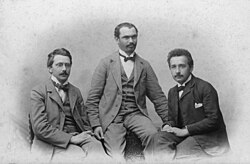
Key Facts
- Founded: 1902 in Bern, Switzerland.
- Core Members: Albert Einstein, Maurice Solovine, and Conrad Habicht.
- Purpose: To debate books and theories in physics and philosophy.
- Timeline: Active until 1904–1905, preceding Einstein's 1905 "miracle year."
- Legacy: Einstein credited the group with influencing his later scientific career.
Intellectual Pursuits and Influences
The Olympia Academy was not merely a social club but a disciplined study group. The members selected challenging texts to analyze, beginning with Karl Pearson's The Grammar of Science. Their discussions spanned a wide array of foundational works that shaped their understanding of logic, sensation, and the nature of reality.
Scientific and Philosophical Texts
The group engaged deeply with the following authors and works:
- Ernst Mach: Analyse der Empfindungen (Analysis of Sensations).
- Henri Poincaré: La Science et l'Hypothèse (Science and Hypothesis).
- John Stuart Mill: A System of Logic.
- David Hume: Treatise of Human Nature.
- Baruch Spinoza: Ethics.
Beyond the rigors of science, the members also explored literature, including Miguel de Cervantes' Don Quixote, demonstrating a holistic approach to intellectual inquiry.
Members and Associates
While the Academy was driven by its three founders, several other individuals were associated with the group or present during their discussions.
| Name | Role/Profession | Relationship to Academy |
|---|---|---|
| Albert Einstein | Physicist / ETH Zurich Graduate | Founder, Host, and Chairman |
| Maurice Solovine | Philosophy Student | Core Member |
| Conrad Habicht | Mathematician | Core Member |
| Mileva Marić | ETH Zurich Student | Observer (Einstein's first wife) |
| Marcel Grossmann | Mathematician | Friend and Classmate |
| Michele Besso | Mechanical Engineer | Associate |
| Lucien Chavan | Electrical Engineer | Associate |
| Paul Habicht | - | Brother of Conrad Habicht |
Frequently Asked Questions
What was the primary purpose of the Olympia Academy?
The Olympia Academy was a small intellectual circle formed to discuss and debate books and theories regarding physics and philosophy.
How did the group come to be formed?
It began when Maurice Solovine responded to a newspaper advertisement Einstein had placed for private mathematics and physics lessons. Instead of formal tutoring, the two began meeting to discuss their shared intellectual interests and were later joined by Conrad Habicht.
Did Mileva Marić participate in the discussions?
According to Maurice Solovine, Mileva Marić observed the discussions but did not actively participate in them.
When did the Olympia Academy dissolve?
The group essentially ended between 1904 and 1905 when Maurice Solovine and Conrad Habicht left Bern.
Did the Academy influence Albert Einstein's work?
Yes, Einstein later stated that the experiences and discussions within the Olympia Academy had a lasting effect on his subsequent scientific career.