Maurice Solovine: The Philosopher and Companion of Albert Einstein
Maurice Solovine (1875–1958) was a distinguished Romanian philosopher and mathematician whose life was marked by a profound intellectual partnership with one of the greatest minds in history: Albert Einstein. Beyond his own academic contributions, Solovine served as a vital bridge between German scientific thought and the French-speaking world.
Key Facts
- Born: May 21, 1875, in Iași, Romania.
- Died: February 13, 1958, in Paris, France.
- Primary Role: Philosopher, mathematician, and principal French translator for Albert Einstein.
- Notable Association: Co-founder of the Akademie Olympia.
- Key Collaborators: Albert Einstein and mathematician Conrad Habicht.
The Formation of the Akademie Olympia
The relationship between Solovine and Einstein began in Bern, where Solovine, then a philosophy student, responded to an advertisement to study physics. Einstein was immediately impressed by Solovine's intellect, noting that formal lessons were unnecessary and inviting him instead to engage in high-level discussions regarding the contemporary problems of physics.
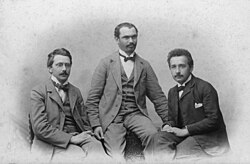
This intellectual synergy evolved when Solovine proposed that they read and debate the works of great authors. This initiative led to the creation of the Akademie Olympia (Olympia Academy), a private intellectual circle that eventually included the mathematician Conrad Habicht. The trio frequently met in Einstein's flat, often engaging in rigorous debates that lasted until the early morning hours.
A Playful Intellectual Bond
The bond between the members of the Akademie Olympia was characterized by both deep respect and mischievous camaraderie. In one famous instance, Solovine skipped a meeting to attend a concert, leaving his friends a meal of hard-boiled eggs and a Latin note: "Amicis carissimis ova dura et salutem" (To my beloved friends, hard-boiled eggs and greetings).
In retaliation, Einstein and Habicht turned Solovine's flat upside down, scattering books and furniture and filling the rooms with pipe and cigar smoke. They left their own Latin response: "Amico carissimo fumum spissum et salutem" (To our dearest friend, thick smoke and greetings). Despite the playful chaos and Einstein's mock-outrage—calling Solovine a "barbarian" and "idiot" for prioritizing a violin concert over the Academy—the friendship remained steadfast.
Professional Life and Legacy in France
In November 1905, Solovine moved to Lyon to continue his studies before eventually settling in Paris. Between 1908 and 1919, he contributed to the publication of the Revue philosophique and established himself as a freelance editor and translator of classic European philosophy and contemporary mathematics.
Solovine became the principal translator of Albert Einstein's works from German to French. Beyond translation, he managed Einstein's financial interests and publishing agreements within France, receiving a percentage fee for his services. Their correspondence spanned nearly five decades, with letters exchanged from May 3, 1906, until February 27, 1955.
In addition to his work with Einstein, Solovine published French translations of Greek philosophers, including the works of Heraclitus of Ephesus, further cementing his legacy as a scholar of classical thought.
| Category | Details |
|---|---|
| Nationality | Romanian |
| Academic Focus | Philosophy and Mathematics |
| Key Group | Akademie Olympia (with Einstein and Habicht) |
| Major Contribution | Principal French translator for Albert Einstein |
| Career Locations | Bern, Lyon, and Paris |
Frequently Asked Questions
How did Maurice Solovine meet Albert Einstein?
Solovine met Einstein in Bern after responding to an advertisement to study physics while he was a philosophy student.
What was the Akademie Olympia?
The Akademie Olympia was an informal intellectual circle consisting of Maurice Solovine, Albert Einstein, and Conrad Habicht, who met to read and debate the works of great authors.
What was Solovine's professional relationship with Einstein?
Solovine served as Einstein's principal translator from German to French and managed his publishing agreements and financial interests in France.
Where did Maurice Solovine spend the latter part of his life?
Solovine lived and worked in Paris, where he contributed to the Revue philosophique and translated Greek philosophers before his death in 1958.
Did Solovine and Einstein maintain a long-term friendship?
Yes, they remained in close contact for nearly 50 years, as evidenced by their correspondence dating from 1906 to 1955.