Nuremberg Laws: The Legal Foundation of Nazi Persecution
The Nuremberg Laws were a set of antisemitic and racist statutes introduced in Nazi Germany on September 15, 1935. Proclaimed during a special session of the Reichstag at the annual Nazi Party rally in Nuremberg, these laws transformed prejudice into state policy, systematically stripping Jewish people of their rights and dignity.
These laws did not emerge in a vacuum; they were the result of escalating tensions and a desire by the Nazi regime to institutionalize racial discrimination. By creating a legal framework for persecution, the state moved from sporadic violence to a structured system of exclusion that paved the way for the Holocaust.
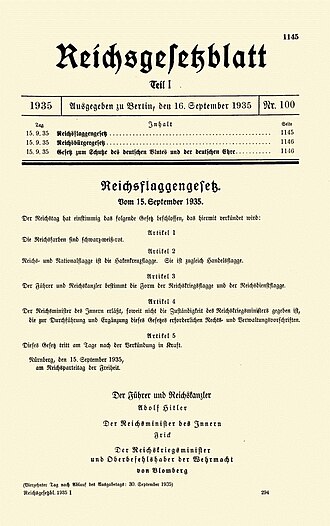
Key Facts
- Date of Enactment: September 15, 1935.
- Primary Laws: The Reich Citizenship Law and the Law for the Protection of German Blood and German Honour.
- Core Purpose: To isolate Jews from German society and prevent "racial defilement."
- Scope: Later extended to include Romani people ("Gypsies") and Black people.
- Outcome: Stripped Jews of citizenship and prohibited marriages between Jews and non-Jews.
The Path to Legislation
By 1935, members of the SA (Sturmabteilung), the Nazi paramilitary wing, were increasingly frustrated by what they perceived as a slow pace in removing Jews from German society. This led to a surge in "bottom-up" violence, including assaults, vandalism, and boycotts.
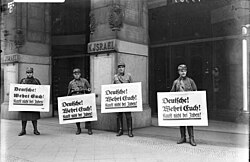
While the general public often viewed this violence with concern for their own safety, many still favored tougher antisemitic measures. However, high-ranking officials like Economics Minister Hjalmar Schacht warned that this chaos damaged the German economy and international reputation. To appease the radicals within the party while maintaining economic order, Adolf Hitler decided to replace individual violent actions with state-mandated legislation.
![The SA had nearly three million members at the start of 1934.[29]](/images/c4/88/c488c3e50f4a1bda4bdac1236a196ae88fa2dce450886bab773bd8554de2a5ec.jpg)
The Two Pillars of the Nuremberg Laws
The legislation consisted of two primary measures designed to separate the "Aryan" population from those deemed "enemies of the race-based state."
The Law for the Protection of German Blood and German Honour
This law focused on maintaining racial "purity." It prohibited marriages and sexual relations between Jews and Germans. Additionally, it barred Jewish households from employing German women under the age of 45.
![Page from the Nuremberg Laws signed by Hitler, 15 September 1935[92]](/images/31/5b/315ba5ae5cff37360a3c91f897787a5b08339e3ba285ef864c6e66b45ec91795.jpg)
The Reich Citizenship Law
This law redefined the concept of citizenship. It restricted full citizenship to those of "German or related blood." Those who did not meet this criteria, primarily Jews, were reduced to "state subjects," meaning they remained residents of the state but were stripped of their political rights, including the right to vote.
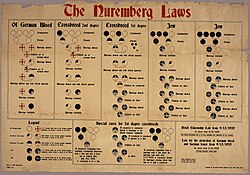
Defining the "Jew": Classifications and Decrees
Because the initial laws were vague, a supplementary decree issued on November 14, 1935, established the legal definitions of who was considered Jewish based on ancestry:
- Jewish: Individuals with three or more Jewish grandparents.
- Mischlinge (Mixed-race): Individuals with one or two Jewish grandparents. Those with two grandparents were considered Jewish if they practiced the faith or had a Jewish spouse.
On November 26, 1935, these restrictive measures were extended to include Romani people and Black people, further expanding the regime's definition of racial enemies.
Social and Economic Impact
The Nuremberg Laws devastated the Jewish community. Social and commercial ties between Jews and non-Jews withered, and many Jewish-owned businesses were forced to close through Aryanisation—the forced transfer of Jewish businesses to non-Jewish owners at prices far below market value.
Professionals such as doctors and teachers were excluded from their fields, forcing many into menial labor. Those who violated the marriage laws faced imprisonment and, by 1938, were frequently sent to concentration camps by the Gestapo.
Emigration became the only hope for many, but the regime obstructed this through the Reich Flight Tax, which could seize up to 90% of an emigrant's assets. As the 1930s progressed, few countries were willing to accept refugees, and plans for mass resettlement, such as the Madagascar Plan, failed.
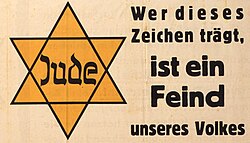
![Beginning in 1941, Jews were required by law to self-identify by wearing a yellow badge on their clothing.[64]](/images/a9/c2/a9c286e7edfeb2d9f40608f5bbef3791f92a9552c70a686a8675f5021c2f0c98.jpg)
By 1941, the regime transitioned from exclusion to systematic extermination, known as the Final Solution. This resulted in the murder of an estimated 5.5 to 6 million Jews and between 150,000 and 1.5 million Romani people.
Summary of the Nuremberg Laws
| Law/Decree | Primary Objective | Key Restriction |
|---|---|---|
| Law for the Protection of German Blood | Prevent "racial defilement" | Banned marriages/sexual relations between Jews and Germans |
| Reich Citizenship Law | Define national identity | Stripped Jews of citizenship and voting rights |
| Supplementary Decree (Nov 14) | Legal classification | Defined "Jew" based on grandparentage |
| Supplementary Decree (Nov 26) | Expand persecution | Extended laws to Romani and Black populations |
International Influence
The precedent set by Nazi Germany influenced other nations. For example, Hungary passed laws in 1938 and 1939 banning Jews from various professions, followed by a 1941 law that mirrored the Nuremberg definitions of ancestry and prohibited intermarriage.
Frequently Asked Questions
What was the primary goal of the Nuremberg Laws?
The primary goal was to legally isolate Jewish people from German society by stripping them of their citizenship and prohibiting biological "mixing" through the ban on intermarriage and sexual relations.
Who were the Mischlinge?
Mischlinge were people of mixed ancestry. Those with three or more Jewish grandparents were classified as Jewish, while those with one or two were considered Mischlinge. The legal status of those with two Jewish grandparents depended on their religious practice or marital status.
How did the laws affect the economy?
The laws accelerated Aryanisation, where Jewish businesses were forcibly sold to non-Jews at drastically reduced prices. Jews were also barred from civil service and regulated professions like medicine and teaching.
Did the Nuremberg Laws apply to people other than Jews?
Yes. While initially targeting Jews, a decree on November 26, 1935, extended these racial laws to include Romani people ("Gypsies") and Black people.
What happened to those who broke the marriage laws?
Individuals convicted of violating the laws regarding "racial defilement" were imprisoned. Starting in March 1938, many were re-arrested by the Gestapo and sent to concentration camps.