Nuclear Weapons: Technology, History, and Global Strategy

Nuclear Weapons: Technology, History, and Global Strategy

Nuclear weapons represent some of the most destructive tools ever created by humanity, utilizing the fundamental forces of the atom to release immense energy. From the secretive laboratories of the Manhattan Project to the strategic tensions of the Cold War and the modern era of disarmament, these weapons have fundamentally altered global geopolitics and military strategy.

The development of these weapons began with the discovery of nuclear fission—the process where the nucleus of a heavy atom splits into smaller parts, releasing a massive amount of energy. This scientific breakthrough led to the first successful detonation of a nuclear device, marking a turning point in human history.
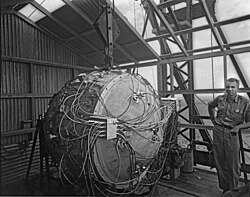
The final iteration of the Gadget nuclear device prior to its successful test on July 16, 1945, the culmination of the United States' three-year Manhattan Project's research and development of nuclear weapons

Key Facts

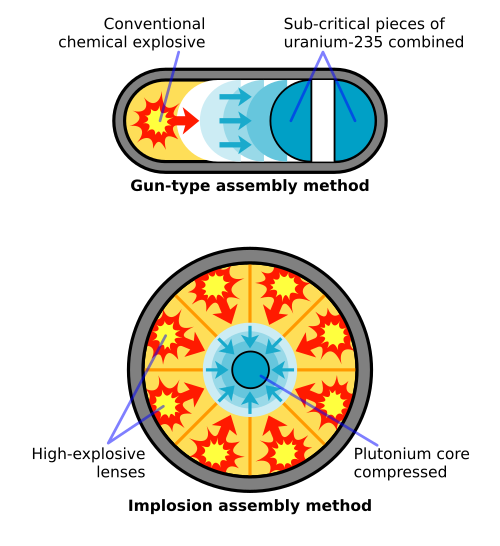
The two basic fission weapon designs
  • Primary Materials: Uranium-235 and Plutonium-239 are the most common fissile materials used.
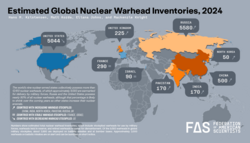
  • Global Stockpiles: As of early 2019, Russia and the United States owned more than 90% of the world's 13,865 nuclear weapons.
  • Delivery Systems: Weapons are delivered via gravity bombs, land-based Intercontinental Ballistic Missiles (ICBMs), and Submarine-Launched Ballistic Missiles (SLBMs).
  • Testing History: Over 2,000 nuclear explosions have been conducted globally across a dozen different sites.
  • Strategic Impact: The introduction of MIRVs (Multiple Independently Targetable Reentry Vehicles) allowed a single missile to strike multiple targets.

The Science of Nuclear Explosions
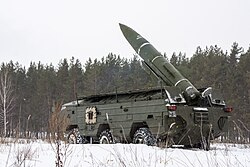
Soviet OTR-21 Tochka missile. Capable of firing a 100-kiloton nuclear warhead a distance of 185 km

Fission Weapons

Fission weapons, often called atomic bombs, rely on the splitting of atoms. In this process, a fissile atom (such as enriched uranium) absorbs a thermal neutron, becomes unstable, and splits into two new atoms. This reaction releases energy and additional neutrons, which can trigger further fissions in a self-sustaining nuclear chain reaction.
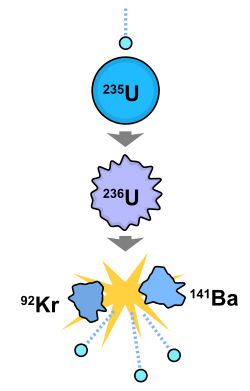
In nuclear fission, the nucleus of a fissile atom (in this case, enriched uranium) absorbs a thermal neutron, becomes unstable and splits into two new atoms, releasing some energy and between one and three new neutrons, which can perpetuate the process.

Fusion Weapons

Fusion weapons, known as hydrogen bombs or H-bombs, are significantly more powerful than fission weapons. They utilize the Teller–Ulam design, where a primary fission bomb is used to create the extreme heat and pressure necessary to compress and fuse isotopes of hydrogen into helium, releasing far greater energy.
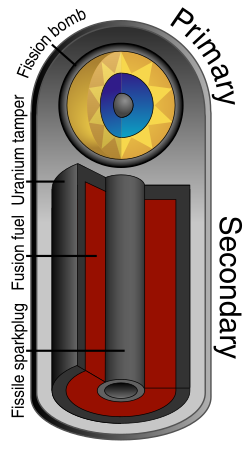
The basics of the Teller–Ulam design for a hydrogen bomb: a fission bomb uses radiation to compress and heat a separate section of fusion fuel.

While fission weapons were the first to be developed, fusion technology allowed for the creation of multi-stage weapons capable of yields exceeding one megaton.
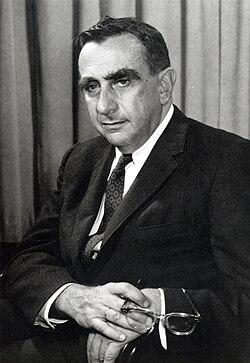
Edward Teller, often referred to as the "father of the hydrogen bomb"

Weapon Delivery and Strategic Deployment
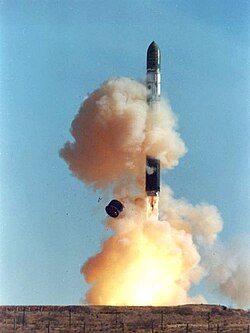
A demilitarized, commercial launch of the Russian Strategic Rocket Forces R-36 ICBM; also known by the NATO reporting name: SS-18 Satan. Upon its first fielding in the late 1960s, the SS-18 remains the single highest throw weight missile delivery system ever built.

The effectiveness of a nuclear weapon depends heavily on its delivery method. Early weapons were gravity bombs, large devices that required heavy bomber aircraft for transport.
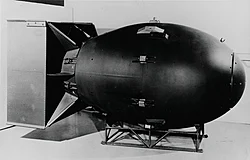
The first nuclear weapons were gravity bombs, such as the "Fat Man" weapon dropped on Nagasaki, Japan. They were large and could only be delivered by heavy bomber aircraft

Missile Systems

The evolution of delivery shifted toward missiles for greater speed and range. This includes tactical missiles for shorter distances and ICBMs for intercontinental strikes. A significant advancement was the development of MIRVs, which allow a single missile to carry multiple warheads, each aimed at a different target, making missile defense significantly more difficult.
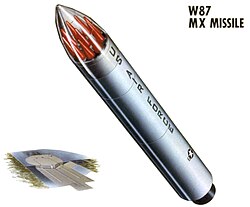
The now decommissioned United States' Peacekeeper missile was an ICBM developed to replace the Minuteman missile in the late 1980s. Each missile, like the heavier lift Russian SS-18 Satan, could contain up to ten nuclear warheads (shown in red), each of which could be aimed at a different target. A factor in the development of MIRVs was to make complete missile defense difficult for an enemy country.

The Nuclear Triad

Nuclear powers often maintain a "triad" of delivery options to ensure a second-strike capability: land-based missiles, strategic bombers, and ballistic missile submarines. Submarines are particularly critical because they can hide from reconnaissance satellites and launch weapons with virtual impunity.
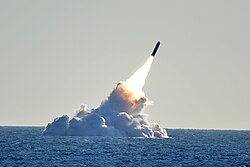
Ballistic missile submarines have been of great strategic importance for the United States, Russia, and other nuclear powers since they entered service in the Cold War, as they can hide from reconnaissance satellites and fire their nuclear weapons with virtual impunity.

Global Development and Testing
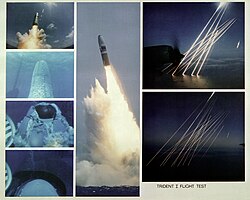
Montage of an inert test of a United States Trident SLBM (submarine launched ballistic missile), from submerged to the terminal, or re-entry phase, of the multiple independently targetable reentry vehicles

The race for nuclear capability began in the 1940s and expanded throughout the Cold War. The United States conducted the first test (Trinity) in 1945, followed by the Soviet Union in 1949. Other nations, including the UK, France, China, India, Pakistan, and North Korea, eventually developed their own capabilities.

The Trinity test of the Manhattan Project was the first detonation of a nuclear weapon, which led J. Robert Oppenheimer to recall verses from the Hindu scripture Bhagavad Gita: "If the radiance of a thousand suns were to burst at once into the sky, that would be like the splendor of the mighty one" ... "I am become Death, the destroyer of worlds".[17]

Testing has taken various forms, from atmospheric tests that created iconic mushroom clouds to underground detonations. However, these tests have left a legacy of radioactive fallout and health crises for those exposed to the radiation.
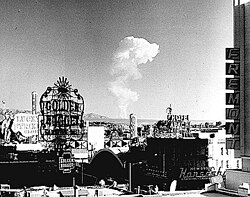

This view of downtown Las Vegas shows a mushroom cloud in the background. Scenes such as this were typical during the 1950s. From 1951 to 1962 the government conducted 100 atmospheric tests at the nearby Nevada Test Site.

A photograph of Sumiteru Taniguchi's back injuries taken in January 1946 by a US Marine photographer

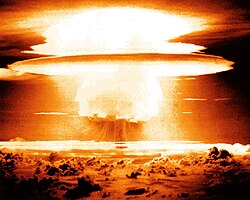
Mushroom cloud from the explosion of Castle Bravo, the largest nuclear weapon detonated by the US, in 1954

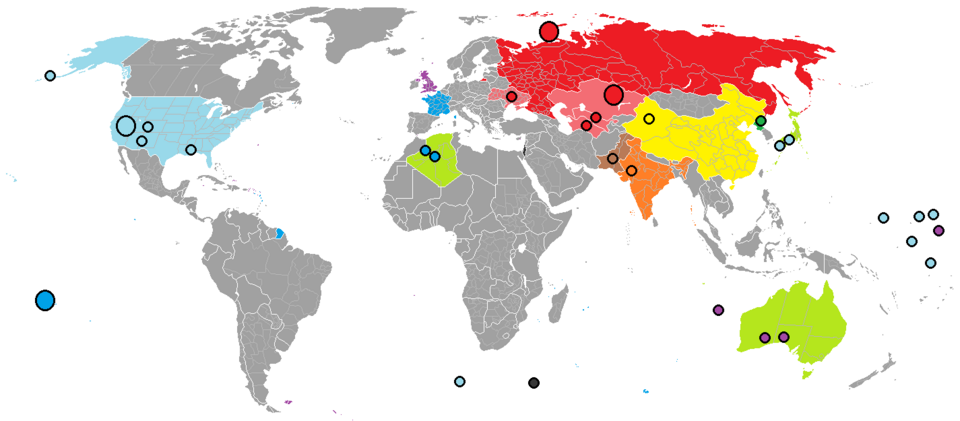
More than 2,000 nuclear explosions have been conducted in more than a dozen different sites around the world. Red Russia/Soviet Union, blue France, light blue United States, violet Britain, yellow China, orange India, brown Pakistan, green North Korea and light green (territories exposed to nuclear bombs). The black dot indicates the location of the Vela incident.

Nuclear Testing Timeline

First Nuclear Tests by Design and Country
Country Fission (Year) Boosted Fission (Year) Multi-stage (Year) Multi-stage >1MT (Year)
United States 1945 1951 1951 1952
Soviet Union 1949 1953 1955 1955
United Kingdom 1952 1956 1957 1957
France 1960 1966 1968 1968
China 1964 1966 1966 1967

Governance, Law, and Disarmament

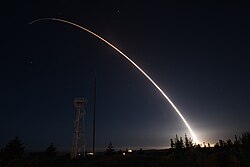
A Minuteman III ICBM test launch from Vandenberg Space Force Base, United States. MIRVed land-based ICBMs are considered destabilizing because they tend to put a premium on striking first.

Due to their catastrophic potential, nuclear weapons are subject to strict command and control. Authority typically rests with the head of state or a designated national command authority. International efforts, such as the Treaty on the Prohibition of Nuclear Weapons, aim to eliminate these arsenals entirely.
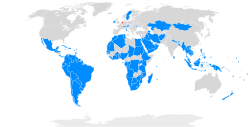
UN vote on adoption of the Treaty on the Prohibition of Nuclear Weapons on July 7, 2017 Yes No Did not vote

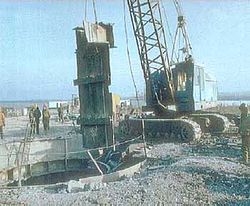
Following the end of the Cold War in 1991, there was a precipitous drop in total nuclear stockpiles. Former Soviet republics, such as Ukraine, relinquished their stockpiles to Russia to reduce the risk of proliferation.
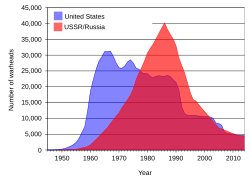
The USSR and United States nuclear weapon stockpiles throughout the Cold War until 2015, with a precipitous drop in total numbers following the end of the Cold War in 1991.

Ukrainian workers use equipment provided by the US Defense Threat Reduction Agency to dismantle a Soviet-era missile silo. After the end of the Cold War, Ukraine and the other non-Russian, post-Soviet republics relinquished Soviet nuclear stockpiles to Russia.

Risks and Controversies

The number of nuclear warheads by country in 2024, based on an estimation by the Federation of American Scientists

The history of nuclear weapons is marked by "Broken Arrows"—accidents involving nuclear weapons that do not result in war but pose significant risks. Examples include the 1950 crash of a B-36B in British Columbia and the 1965 loss of a one-megaton B43 bomb in the Philippine Sea.

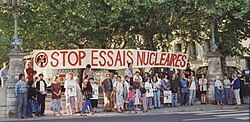
Public opposition has grown since the 1980s, with global protests highlighting the ethical concerns of nuclear deterrence and the potential for total human extinction through nuclear war or subsequent nuclear famine.
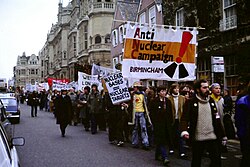

Anti-nuclear weapons protest march in Oxford, 1980

Protest in Bonn against the nuclear arms race between the US/NATO and the Warsaw Pact, 1981

Demonstration against nuclear testing in Lyon, France, in the 1980s

Frequently Asked Questions

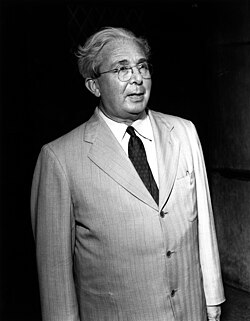
Leo Szilard, pictured in about 1960, invented the electron microscope, linear accelerator, cyclotron, nuclear chain reaction and patented the nuclear reactor

What is the difference between a fission bomb and a fusion bomb?

A fission bomb (atomic bomb) releases energy by splitting heavy nuclei like uranium or plutonium. A fusion bomb (hydrogen bomb) releases energy by fusing light nuclei, such as hydrogen isotopes, and requires a fission bomb as a trigger to create the necessary heat and pressure.

What is a MIRV?

MIRV stands for Multiple Independently Targetable Reentry Vehicle. It is a missile payload containing several nuclear warheads, each capable of being directed toward a different target independently.

What does the term "Broken Arrow" mean?

A "Broken Arrow" is a US military term for an accident involving a nuclear weapon that does not create a risk of nuclear war, such as a crash, loss, or theft of a weapon.

Which countries currently possess nuclear weapons?

The primary nuclear-armed states include the United States, Russia, China, France, the United Kingdom, India, Pakistan, and North Korea. Israel is also widely believed to possess nuclear capabilities.

How are nuclear weapons delivered?

They are delivered via three primary methods: gravity bombs dropped from aircraft, land-based Intercontinental Ballistic Missiles (ICBMs), and Submarine-Launched Ballistic Missiles (SLBMs).