John von Neumann: The Polymath Who Shaped Modern Computing and Mathematics
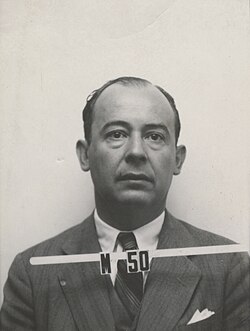
Few individuals in history have left an imprint on as many disparate fields as John von Neumann. A Hungarian-born American mathematician, physicist, and computer scientist, von Neumann was a true polymath whose work provided the theoretical foundations for the digital age, the strategic frameworks of modern economics, and the mathematical rigor of quantum mechanics.
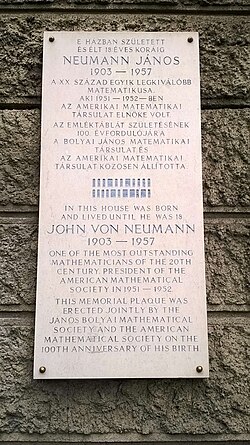
Born as Neumann János Lajos in Budapest in 1903, he was recognized as a child prodigy long before entering formal higher education. His academic journey took him through Pázmány Péter University, the University of Berlin, and ETH Zürich, where he studied under some of the greatest minds of the era, including David Hilbert and Hermann Weyl.
Key Facts
- Born: December 28, 1903, in Budapest, Hungary.
- Died: February 8, 1957, at age 53.
- Major Contributions: Pioneer of game theory, von Neumann architecture for computers, and the mathematical foundations of quantum mechanics.
- Public Service: Member of the United States Atomic Energy Commission (1955–1957).
- Notable Awards: Bôcher Memorial Prize, Medal for Merit, and the Enrico Fermi Award.
Mathematical Foundations and Set Theory
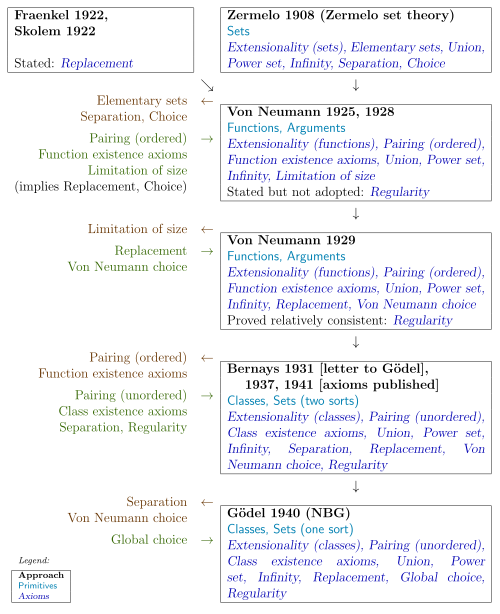
Von Neumann's early career was marked by a drive to bring axiomatic rigor to mathematics. He made significant contributions to set theory—the study of collections of objects—and proof theory. His work on the axiomatic construction of general set theory helped resolve paradoxes that had plagued the field.
Beyond set theory, he excelled in functional analysis, operator algebras, and ergodic theory (the study of the long-term average behavior of systems). His ability to intuitively grasp the logical structure of new theories allowed him to move seamlessly between abstract mathematics and practical application.
Quantum Mechanics and Physics
In the realm of physics, von Neumann is credited with providing the first rigorous mathematical framework for quantum mechanics. He introduced the density matrix and the von Neumann measurement scheme, which helped explain how quantum systems interact with measuring devices.
His work extended into fluid dynamics and the theory of detonation waves, the latter of which became critical during his involvement in national defense. He also explored von Neumann entropy, a concept that bridges quantum mechanics and information theory.
The Birth of Modern Computing
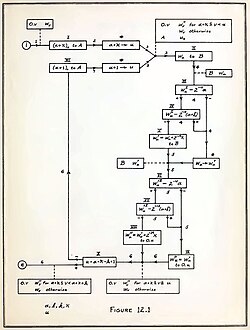
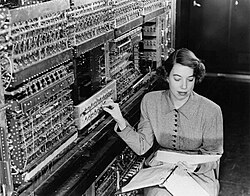
Perhaps his most enduring legacy is in computer science. Von Neumann described a computer architecture where program data and instruction data are stored in the same memory—a design known as the von Neumann architecture, which remains the basis for most modern computers.
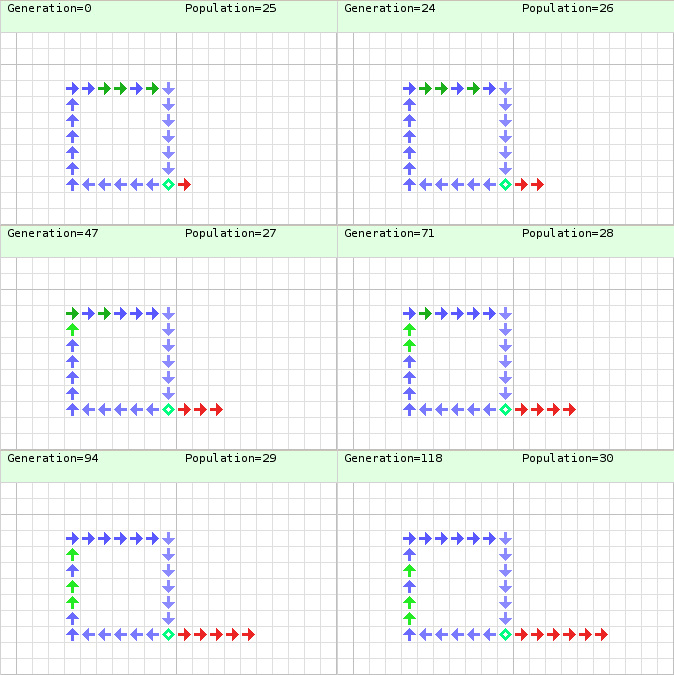
He was instrumental in the development of the IAS machine and wrote early algorithms for electronic computing instruments. Later in life, he turned his attention to cellular automata—discrete models consisting of a regular grid of cells—and proposed the concept of a universal constructor, a machine capable of building any other machine, including a copy of itself.
![The first implementation of von Neumann's self-reproducing universal constructor.[284] Three generations of machine are shown: the second has nearly finished constructing the third. The lines running to the right are the tapes of genetic instructions, which are copied along with the body of the machines.](/images/05/05/0505bd9507e30edfe0ce0552a7b9b19cfe87079613e19da1054bc9b9c11ca369.png)
Economics and Game Theory
Von Neumann fundamentally changed the social sciences by co-creating game theory. By analyzing strategic interactions between rational decision-makers, he provided tools that are now essential in economics, political science, and military strategy. His work on linear programming and mathematical economics provided a quantitative way to analyze growth and resource allocation.
Defense Work and Public Service
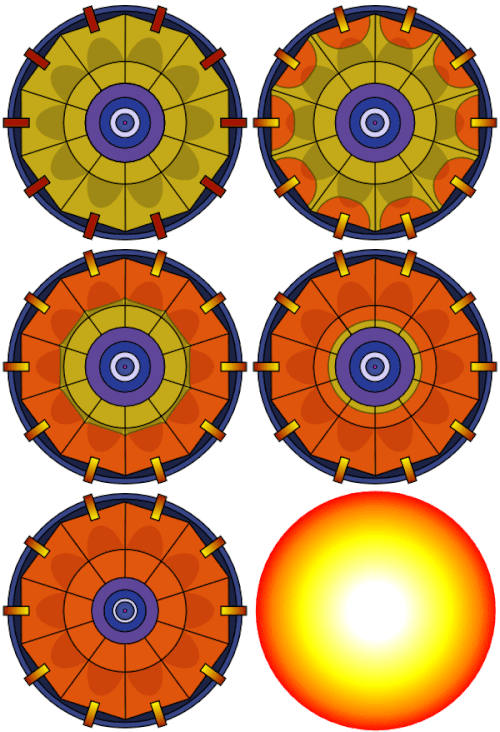
During World War II, von Neumann played a pivotal role in the Manhattan Project at the Los Alamos Laboratory, where he worked on the implosion mechanism for the atomic bomb. Following the war, he continued to advise the U.S. government on defense and served as a member of the United States Atomic Energy Commission under President Dwight D. Eisenhower.
Summary of Contributions
| Field | Key Contribution | Impact |
|---|---|---|
| Computer Science | Stored-program architecture | Foundation of modern PC and server design |
| Mathematics | Axiomatic set theory & Operator algebras | Increased rigor in mathematical foundations |
| Physics | Quantum measurement & Density matrix | Mathematical formalization of quantum theory |
| Economics | Game Theory | New framework for strategic decision-making |
| Defense | Implosion mechanism | Critical to the development of nuclear weapons |
Legacy and Final Years
Known for his eidetic memory (the ability to recall images or text with high precision) and staggering mental speed, von Neumann was often viewed as a human calculator. Despite his brilliance, he faced personal struggles and illness toward the end of his life, passing away in 1957 at the age of 53.
Frequently Asked Questions
What is the von Neumann architecture?
It is a computer design where the CPU is separate from the memory, and both program instructions and data are stored in the same memory space. This allows the computer to be reprogrammed easily by changing the software rather than the hardware.
What is game theory?
Game theory is the mathematical study of strategic interaction between rational agents. It analyzes how individuals or groups make decisions when the outcome depends on the actions of others.
What was von Neumann's role in the Manhattan Project?
He contributed essential mathematical calculations and physics expertise, specifically focusing on the implosion mechanism required to detonate the plutonium core of the atomic bomb.
What is a universal constructor?
A universal constructor is a theoretical machine described by von Neumann that can create any possible machine, including a replica of itself, based on a set of genetic-like instructions.
What is von Neumann entropy?
It is an extension of Gibbs entropy to quantum mechanics, used to describe the degree of disorder or uncertainty in a quantum state represented by a density matrix.