Einstein–Szilard Letter: The Catalyst for the Manhattan Project
In the summer of 1939, a single piece of correspondence altered the course of human history. The Einstein–Szilard letter, signed by Albert Einstein and delivered to President Franklin D. Roosevelt, served as the urgent warning that sparked the United States' entry into the nuclear arms race. This letter did not just suggest a scientific inquiry; it set in motion the machinery that would eventually lead to the Manhattan Project and the deployment of atomic weapons in Hiroshima and Nagasaki.
The Scientific Spark: Nuclear Fission
The road to the letter began with a breakthrough in nuclear physics. In early 1939, Otto Hahn and Fritz Strassmann reported the discovery of nuclear fission—the process of splitting a heavy atomic nucleus—in uranium. Lise Meitner further identified this phenomenon in the journal Nature, igniting intense interest across the global scientific community.
Hungarian physicist Leo Szilard recognized the terrifying potential of this discovery. He theorized that a nuclear chain reaction—where one fission event triggers multiple subsequent reactions—could release vast amounts of energy. While Szilard had conceptualized this as early as 1933, it required a specific environment to work. Collaborating with Enrico Fermi at Columbia University, Szilard explored the use of a neutron moderator (a material used to slow down neutrons to increase the likelihood of fission). While water captured too many neutrons, Szilard suggested carbon as a more effective moderator.
The Race Against Nazi Germany
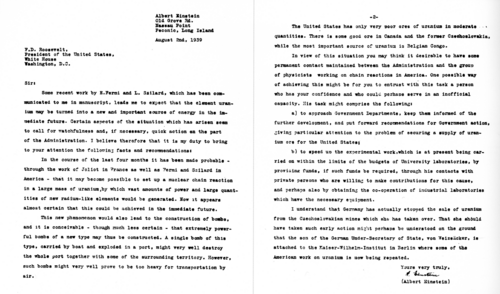
By mid-1939, Szilard became deeply concerned that German scientists were pursuing the same goals. The publication of articles by Siegfried Flügge on nuclear energy and Germany's decision to halt uranium sales from Czechoslovakian mines suggested that the Third Reich was actively seeking the means to build an atomic weapon.
To warn the U.S. government, Szilard and fellow physicist Eugene Wigner sought the endorsement of Albert Einstein. Because of Einstein's immense global prestige and his connections to the Belgian royal family (crucial for accessing uranium ore in the Belgian Congo), he was the ideal figure to lend authority to the warning.
Drafting the Warning
On July 12, 1939, Szilard and Wigner visited Einstein on Long Island. Upon learning of the possibility of atomic bombs, Einstein admitted he had not considered it. He dictated a letter in German, which was later translated into English by a stenographer at Columbia University. The final letter, dated August 2, 1939, warned President Roosevelt that "extremely powerful bombs of a new type" could be constructed, potentially destroying entire ports and surrounding territories.
Delivery and Presidential Action
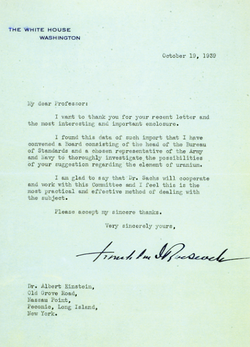
The letter reached Roosevelt via Alexander Sachs, an economist with access to the White House. Due to the outbreak of World War II following Germany's invasion of Poland, the formal meeting between Sachs and Roosevelt was delayed until October 11, 1939.
Initially, Roosevelt was hesitant. However, during a follow-up breakfast on October 12, Sachs used a historical analogy about Napoleon Bonaparte ignoring Robert Fulton's steamship invention to illustrate the danger of lacking imagination in the face of new technology. This persuasion worked; Roosevelt famously declared, "Pa, this requires action!"
From Committee to Combat
Roosevelt responded by establishing the Advisory Committee on Uranium, chaired by Lyman James Briggs. While this committee initially focused on theoretical research and small-scale experiments, it laid the groundwork for more aggressive programs. By 1942, this evolved into the Manhattan Project, a massive secret operation managed by the U.S. Army Corps of Engineers.
| Year | Entity/Event | Primary Focus |
|---|---|---|
| 1939 | Advisory Committee on Uranium | Theoretical physics and initial uranium purchase |
| 1940 | National Defense Research Committee | Expanded research coordination |
| 1941 | Office of Scientific Research and Development | Strategic scientific development |
| 1942 | Manhattan Project | Full-scale weapon development and production |
Key Facts
- Authorship: The letter was conceived and written by Leo Szilard and signed by Albert Einstein.
- Date: The letter is dated August 2, 1939.
- Primary Warning: It alerted FDR that Germany might develop atomic bombs using nuclear fission.
- Einstein's Role: Despite signing the letter, Einstein was denied security clearance for the Manhattan Project due to his pacifist views.
- Outcome: The letter led to the creation of the Advisory Committee on Uranium, the precursor to the Manhattan Project.
Frequently Asked Questions
Did Albert Einstein help build the atomic bomb?
No. While his signature on the letter prompted the U.S. government to start the program, Einstein did not work on the Manhattan Project. He was denied the necessary security clearance in 1940 because of his celebrity status and pacifist leanings.
Why was Leo Szilard the one to write the letter?
Szilard was the physicist who first realized that a neutron-driven chain reaction could be used to create an atomic bomb. He was driven by the fear that Nazi Germany would achieve this capability first.
How did the U.S. government initially react to the letter?
The reaction was cautious. President Roosevelt did not immediately commit to a weapon program but instead formed a small advisory committee to investigate the possibilities of uranium research.
Did Einstein regret signing the letter?
Yes. According to Linus Pauling, Einstein later regretted the decision because it led to the use of atomic bombs in combat, though he maintained that the risk of Germany developing the bomb first justified the action at the time.
What was the role of Alexander Sachs?
Sachs acted as the intermediary who delivered the letter to President Roosevelt and used a persuasive historical anecdote to convince the President that immediate action was necessary to prevent the Nazis from gaining a nuclear advantage.