North Frisian: The Endangered Language of Germany's Coast
North Frisian is a minority language spoken in the North Frisia region of Germany. As part of the West Germanic Frisian language family, it serves as a linguistic bridge to the past, though it currently faces a precarious future. Spoken by approximately 10,000 people (according to 1976 data), the language is a complex tapestry of 10 distinct dialects divided between the mainland and the islands.
Closely related to Saterland Frisian in northwest Germany and West Frisian in the Netherlands, North Frisian is also a close relative of English. Together, these form the Anglo-Frisian group within the broader Ingvaeonic languages, which also includes Low German.
Key Facts
- Status: Classified as "Severely Endangered" by the UNESCO Atlas of the World's Languages in Danger.
- Location: Primarily spoken in the Nordfriesland district and on Heligoland in Schleswig-Holstein, Germany.
- Structure: Comprises 10 dialects split into insular and mainland groups.
- Official Status: Recognized for official use in the Nordfriesland district and Heligoland since December 2004.
- Regulation: The language is regulated by the Nordfriisk Instituut.
Dialectal Divisions and History
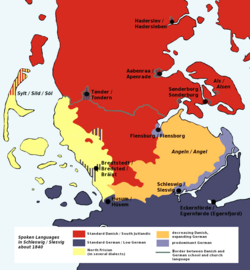
The divergence of North Frisian dialects is rooted in the timing of settlement. The insular dialects were shaped by immigrants arriving around AD 800, while the mainland was settled later, around AD 1100. This chronological gap, combined with geographic isolation, prevented the development of a single lingua franca (a common bridge language) or a dominant cultural center.
Insular North Frisian
The island dialects include:
- Sylt Frisian (Söl'ring)
- Föhr–Amrum Frisian (Fering and Öömrang)
- Heligolandic Frisian (Halunder)
Mainland North Frisian
The mainland group is more fragmented, consisting of:
- Wiedingharde Frisian (Wiringhiirder)
- Bökingharde Frisian (Mooringer)
- Karrharde Frisian (Karrharder)
- Goesharde Frisian (including Northern, Central, and the now-extinct Southern variety)
- Halligen Frisian (Halifreesk), which is spoken on islands but linguistically grouped with the mainland.
Linguistic Influences and Phonology
External languages have heavily influenced the local dialects. Danish (South Jutlandic) influence is strongest on Sylt, Föhr, Amrum, and in Wiedingharde. Conversely, Low German has had a predominant influence on Heligoland and the rest of the mainland.
Phonologically, North Frisian is distinguished from Standard German by a more diverse system of diphthongs and a unique line of palatalizations (the modification of sounds toward the hard palate), which is rare among Germanic languages. While insular dialects possess a complex consonantal system, mainland dialects offer a wider variety of vowels.
| Dialect | Father | Mother | Sister | Brother |
|---|---|---|---|---|
| Söl'ring | Faađer | Mooter | Sester | Bröđer |
| Fering | aatj | mam | saster | bruler |
| Öömrang | - | - | - | bruder |
| Halligen | baabe | mäm | soster | bröör |
| Halunder | Foor | Mem | Söster | Bruur |
| Wiedingharder | tääte | määm | - | broor |
| Bökingharde | taatje | mam | - | brouder |
The Struggle for Survival
The language is currently in a state of decline. Southern Goesharde Frisian became extinct in the early 1980s, and other mainland dialects are facing similar fates. Historically, economic shifts—such as the wealth of Eiderstedt—led speakers to abandon Frisian in favor of Low German during the 17th and 18th centuries. Natural disasters, like the Burchardi flood, also displaced populations, eroding the linguistic base on the island of Strand.
Today, the most resilient communities are found on Föhr and Amrum, where approximately 3,500 speakers remain. Efforts to preserve the language include the Öömrang Skuul on Amrum and the Risum Skole on the mainland. Modern technology is also playing a role; in 2025, the AI-based translator halunder.ai was developed to document and mediate the Heligolandic dialect.
Frequently Asked Questions
How many people still speak North Frisian?
Official estimates range from 8,000 to 10,000 speakers, though some linguists suggest lower numbers, perhaps around 6,500 to 7,000 total speakers inside and outside North Frisia.
Is North Frisian the same as West Frisian?
No. While they are closely related and both belong to the Frisian language group, North Frisian is spoken in Germany, whereas West Frisian is spoken primarily in the northern Netherlands.
Why are there so many different dialects?
The variety is due to different waves of immigration (AD 800 for islands vs. AD 1100 for the mainland) and a lack of a central cultural hub, which prevented the dialects from merging into a single standard version.
What is the official status of the language in Germany?
North Frisian is protected by the European Charter for Regional or Minority Languages and has been recognized for official use in the Nordfriesland district and on Heligoland since 2004.
Which dialects are the most endangered?
While most are at risk, Karrharde, Central Goesharde, and Halligen Frisian are considered seriously endangered. Southern Goesharde Frisian is already extinct.