Yiddish: The History, Linguistics, and Global Legacy of Judeo-German
Yiddish, also known as Judeo-German, is a rich and resilient language native to Central, Eastern, and Western Europe. Primarily spoken by Ashkenazi Jews, it serves as a profound cultural bridge, blending Germanic roots with Hebrew, Aramaic, and Slavic influences. While its native speaker population has declined to approximately 600,000 as of 2021, Yiddish remains a vital symbol of Jewish identity and a subject of intense linguistic study.
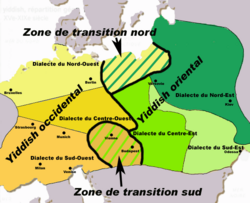
The language belongs to the Indo-European family, specifically the West Germanic branch. It evolved from High German, diverging into two primary dialect groups: Eastern and Western Yiddish. Today, it is spoken across Europe, Israel, North and South America, and other regions with significant Jewish populations.
Key Facts
- Language Family: Indo-European > Germanic > West Germanic > High German.
- Writing System: Primarily the Hebrew alphabet, occasionally the Latin alphabet.
- Primary Dialects: Eastern Yiddish and Western Yiddish.
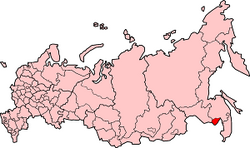
- Official Status: Official in the Jewish Autonomous Oblast (Russia); recognized minority language in Israel, Belarus, Netherlands, Poland, Sweden, Ukraine, Romania, and Russia.
- De Facto Regulator: YIVO (Yidisher Visnshaftlekher Institut).
Linguistic Structure and Phonology
Yiddish phonology is characterized by a complex system of consonants and vowels. Its consonant inventory includes labials, dentals, alveolars, postalveolars, palatals, and velars/uvulars. A notable feature is the use of the Hebrew alphabet for orthography, which adapts traditional Hebrew letters to represent Germanic sounds.
Vowel Systems and Dialectal Variation
Standard Yiddish utilizes a range of front, central, and back vowels. However, significant variation exists between regional dialects. For example, the Polish, Lithuanian, and Netherlandic dialects exhibit different reflexes for Middle High German vowels. These shifts often determine how a word is pronounced across different Jewish communities.
Comparison with German and Hebrew
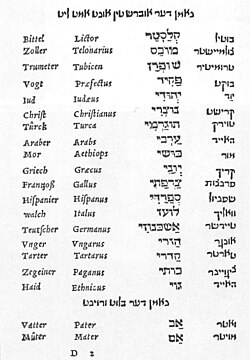
Because of its origins, Yiddish shares a close relationship with German. For instance, the word for "tree" in Standard German is Baum, while in Standard Yiddish, it is בױם (boym). Similarly, Yiddish integrates Hebrew elements, adapting Tiberian vocalization to fit its own phonetic structure, which allows for a seamless blend of secular Germanic and sacred Hebrew terminology.
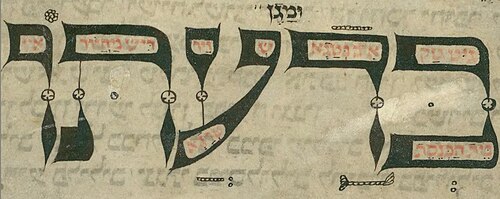
Historical Evolution and Secularization
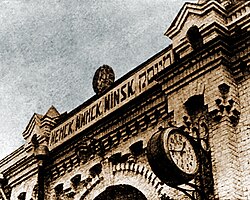
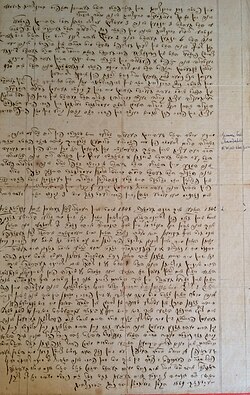
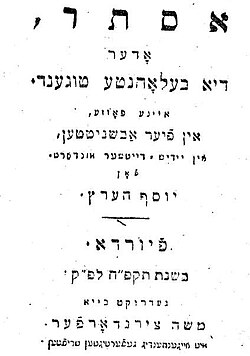
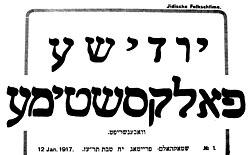
The written evidence of Yiddish spans centuries, moving from early religious texts to a wide array of secular literature. In the 19th century, the language saw a surge in secularization, appearing in plays and newspapers. An example is the 1828 Purim play Esther, oder die belohnte Tugend from Fürth, Bavaria.
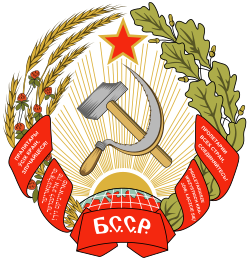
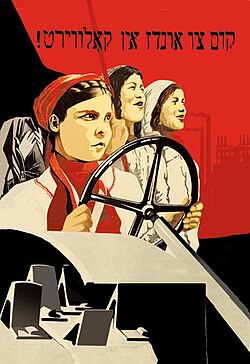
By the early 20th century, Yiddish became a language of political and social mobilization. In the Soviet Union, it was used in official capacities during the NEP era and featured on state emblems of the Byelorussian SSR, often alongside Russian, Belarusian, and Polish.
Global Distribution and Modern Status
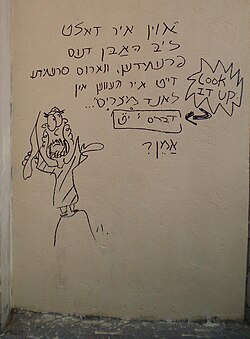
The 20th century brought dramatic shifts to the Yiddish-speaking world. The Holocaust, followed by assimilation and migration, severely impacted the number of native speakers. In Ukraine, for example, Yiddish was an official language of the Ukrainian People's Republic (1917–1921), but today only about 3,100 native speakers remain in the country.
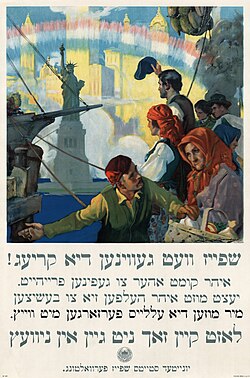
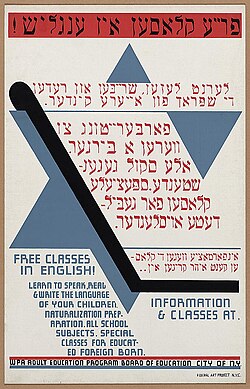
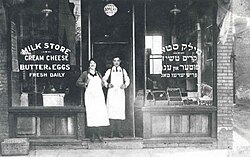
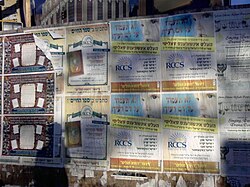
In the United States, Yiddish became the tongue of millions of immigrants. In the early 1900s, it was common to see bilingual signage in cities like New York and Toronto. By the 1930s, the city of New York offered free English classes to Yiddish speakers to help them integrate while preserving their heritage.
Yiddish in the Modern Era
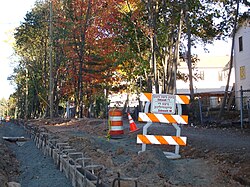
Today, Yiddish persists in several forms. It is spoken in Haredi religious communities, particularly in New York (such as the Monsey hamlet), and is studied in universities like Columbia. The digital age has also breathed new life into the language, with the introduction of Yiddish into Google Translate and Duolingo.
| Category | Details |
|---|---|
| Native Speakers | ≤ 600,000 (2021) |
| Primary Regions | Europe, Israel, North America, South America |
| Writing Systems | Hebrew alphabet (primary), Latin alphabet (occasional) |
| Key Dialects | Eastern (Litvish, Poylish, Ukrainish) and Western |
| Official Status | Official in Jewish Autonomous Oblast, Russia |
Frequently Asked Questions

Is Yiddish the same as Hebrew?
No. While Yiddish uses the Hebrew alphabet and incorporates many Hebrew words, it is a Germanic language. Hebrew is a Semitic language. Yiddish is essentially a fusion of High German with Hebrew, Aramaic, and Slavic elements.
Where is Yiddish still spoken today?
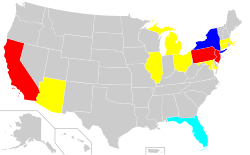
Yiddish is spoken in Israel, parts of Europe, and the Americas. In the U.S., significant populations of speakers are found in New York, Florida, New Jersey, California, and Pennsylvania, often within Orthodox Jewish communities.
What is the difference between Eastern and Western Yiddish?
Eastern Yiddish is the more widely known variety, spoken in Eastern Europe and later in the Americas. Western Yiddish was historically spoken in Central and Western Europe (such as Germany and the Netherlands) and is now considered endangered.
Does Yiddish have an official governing body?
There is no formal government body that regulates the language, but YIVO (the Yidisher Visnshaftlekher Institut) serves as the de facto authority for standardization and research.
How did Yiddish spread to the Americas?
Yiddish spread primarily through the mass migration of Ashkenazi Jews from Eastern Europe to the United States and Canada during the late 19th and early 20th centuries.