Noether's Theorem: The Deep Link Between Symmetry and Conservation Laws
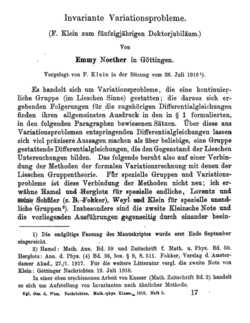
In the realm of theoretical physics, few discoveries are as profound as the connection between the geometry of the universe and the laws that govern it. Noether's theorem, published by mathematician Emmy Noether in 1918, provides the mathematical proof for this connection. It reveals that every continuous symmetry of a physical system's action—provided the forces are conservative—corresponds to a specific conservation law.
To understand this, one must first understand the action of a physical system. In physics, the action is the integral over time of a Lagrangian function (a function that summarizes the dynamics of a system). According to the principle of least action, a system will follow the path that makes this action stationary. Noether's theorem applies to continuous and smooth symmetries of physical space, making it a cornerstone of classical mechanics, high-energy physics, and statistical mechanics.
Key Facts
- Core Principle: Every continuous symmetry of the action of a physical system with conservative forces leads to a corresponding conservation law.
- Origin: Published by Emmy Noether in 1918 while collaborating with Felix Klein and David Hilbert on general relativity.
- Scope: Applies to classical mechanics and field theory, but does not apply to dissipative systems (e.g., those with a Rayleigh dissipation function).
- Impact: Shifted the focus of modern theoretical physics toward the study of symmetries.
Foundational Concepts and History
Before Noether's work, physicists in the 18th and 19th centuries sought systematic ways to find invariants. A major leap occurred in 1788 with the development of Lagrangian mechanics. This approach allowed the state of a system to be described by generalized coordinates, removing the need for a strict Cartesian coordinate system. Later, William Rowan Hamilton introduced canonical transformations and the Hamilton–Jacobi equation to further refine the search for conserved quantities.
Emmy Noether's breakthrough began in 1915. While assisting Felix Klein and David Hilbert with Albert Einstein's theory of general relativity, she identified the fundamental relationship between invariance and conservation. By March 1918, she had formalized the ideas that would redefine theoretical physics.
How the Theorem Works
Informally, the theorem suggests that if a system's laws of motion remain unchanged (invariant) under a specific continuous transformation, there is a quantity associated with that transformation that does not change over time.
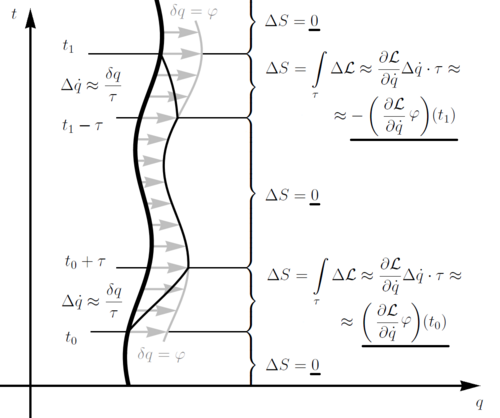
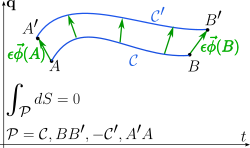
Consider a trajectory that satisfies the laws of motion. If we apply a symmetry flow—a transformation that leaves the action unchanged—the trajectory remains stationary. This invariance implies that a specific mathematical quantity, derived from the Lagrangian, remains constant throughout the system's evolution.
Mathematical Expression
In its simple form using perturbations, if there are $N$ symmetry transformations that leave the action unchanged, Noether showed that there are $N$ corresponding constants of motion. These are derived from the generator of time evolution and the coordinate transformations.
Practical Examples of Symmetries
The power of Noether's theorem is best seen through its most famous applications in the physical world:
- Time Invariance: If a Lagrangian does not depend explicitly on time (meaning the laws of physics are the same today as they were yesterday), the conserved quantity is total energy.
- Translational Invariance: If a system is invariant under spatial translation (meaning the laws of physics are the same here as they are one meter to the left), the conserved quantity is linear momentum.
- Rotational Invariance: If a system is invariant under rotation (meaning the laws of physics do not change based on the direction you are facing), the conserved quantity is angular momentum.
| Symmetry Type | Physical Meaning | Conserved Quantity |
|---|---|---|
| Time Translation | Laws of physics are constant over time | Energy |
| Space Translation | Laws of physics are the same at all positions | Linear Momentum |
| Rotation | Laws of physics are independent of orientation | Angular Momentum |
| Gauge Symmetry | Invariance under local phase transformations | Electric Charge |
Field Theory and Advanced Applications
While the basic version applies to point particles, the field theory version is more common in modern physics. It deals with continuous fields in four-dimensional space-time. In this context, the theorem states that continuous transformations of fields lead to conserved current densities.
Two primary examples include:
- The Stress-Energy Tensor: Derived from the invariance of the action under spacetime translations.
- Electric Charge: Derived from the invariance of the Lagrangian under a specific phase transformation (gauge symmetry).
Frequently Asked Questions
Does Noether's theorem apply to all physical systems?
No. It only applies to systems with continuous symmetries and conservative forces that can be modeled with a Lagrangian. It does not apply to dissipative systems, such as those with friction or a Rayleigh dissipation function.
What is the difference between a continuous symmetry and a discrete symmetry?
A continuous symmetry is one that can be changed by an infinitesimal amount (like rotating an object by 0.1 degrees), whereas a discrete symmetry involves distinct jumps (like reflecting an object in a mirror). Noether's theorem specifically applies to continuous symmetries.
Why is this theorem important for modern physics?
It shifted the paradigm of physics from searching for individual conservation laws to searching for the underlying symmetries of nature. This approach is fundamental to the Standard Model of particle physics and general relativity.
Who was Emmy Noether?
Emmy Noether was a groundbreaking mathematician whose work in abstract algebra and theoretical physics provided the mathematical foundation for much of 20th-century science, most notably through her work on invariance and conservation.