Gauge Theory: The Mathematical Foundation of Fundamental Forces
In the realm of theoretical physics, a gauge theory is a specialized type of field theory where the dynamics of a system—defined by its Lagrangian—remain unchanged under local transformations. These transformations are governed by smooth families of operations known as Lie groups. Essentially, gauge theory provides the mathematical framework that allows physicists to describe how elementary particles interact through the fundamental forces of nature.
The term "gauge" refers to the mathematical formalism used to manage redundant degrees of freedom within a physical system's Lagrangian. When these transformations occur, they form a symmetry group (or gauge group). Every generator of this group's associated Lie algebra necessitates a corresponding gauge field, typically a vector field. To maintain gauge invariance—the requirement that the Lagrangian remains unchanged under local transformations—these fields must be integrated into the theory. When quantized, the particles resulting from these fields are known as gauge bosons.
Depending on the nature of the symmetry group, these theories are categorized as either abelian (commutative) or non-abelian (non-commutative). The most prominent example of a non-abelian gauge theory is the Yang–Mills theory.
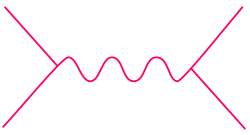
Key Facts
- Gauge Invariance: The property where a system's Lagrangian remains invariant under local transformations.
- Gauge Bosons: The quanta of gauge fields that mediate forces between particles.
- Abelian vs. Non-Abelian: Abelian theories (like QED) have commutative symmetry groups; non-abelian theories (like Yang-Mills) do not.
- The Standard Model: A unified non-abelian gauge theory describing electromagnetism, the weak force, and the strong force.
- Symmetry Groups: The Standard Model utilizes the symmetry group U(1) × SU(2) × SU(3).
The Evolution of Gauge Theory
Early Conceptual Roots
The concept originated with Hermann Weyl in 1918. Weyl attempted to generalize general relativity to include electromagnetism, suggesting that Eichinvarianz (invariance under a change of scale) might be a local symmetry. He coined the term "gauge" from a Latin word for standard cask sizes. Following the rise of quantum mechanics, Weyl, Vladimir Fock, and Fritz London evolved this scale factor into a change of phase, establishing the U(1) gauge symmetry that explains how electromagnetic fields affect the wave functions of charged particles.
The Rise of Yang-Mills and the Standard Model
In 1954, Chen Ning Yang and Robert Mills expanded these ideas to describe the binding of atomic nuclei. They generalized gauge invariance by using the non-abelian SU(2) symmetry group to act on the isospin doublet of protons and neutrons. This Yang–Mills theory became the blueprint for resolving complexities in particle physics.
This framework eventually led to the development of the electroweak theory (unifying electromagnetism and the weak force) and quantum chromodynamics (QCD). QCD uses the SU(3) group to describe the strong interaction among quarks, characterized by a phenomenon called asymptotic freedom. Together, these form the Standard Model.
Impact on Mathematics
Beyond physics, gauge theory has profoundly influenced mathematics. In the 1980s, Simon Donaldson used Yang–Mills equations to reveal that the differentiable classification of smooth 4-manifolds differs from their classification by homeomorphism. Later, Edward Witten and Nathan Seiberg introduced supersymmetric gauge-theoretic techniques to calculate topological invariants, known as Seiberg–Witten invariants.
Technical Framework and Formalism
Global vs. Local Symmetry
A global symmetry occurs when a transformation is applied identically at every point in space and time. For example, rotating a coordinate system globally does not change the local rate of change of a quantity. In contrast, a local symmetry allows the transformation to vary from point to point. To maintain invariance under local transformations, a "bare" derivative must be replaced by a covariant derivative, which introduces the gauge field to cancel out the correction terms caused by the varying symmetry parameter.
Mathematical Components
In mathematical terms, gauge theories are described using fiber bundles. A gauge connection defines a principal bundle, yielding a covariant derivative. When a local frame is chosen, this is represented by the gauge potential (a Lie algebra-valued 1-form). The curvature form, which is an intrinsic quantity, is derived from this connection and represents the field strength.
| Theory | Symmetry Group | Gauge Boson(s) | Force Mediated |
|---|---|---|---|
| Quantum Electrodynamics (QED) | U(1) | Photon | Electromagnetism |
| Electroweak Theory | SU(2) × U(1) | W+ , W− , Z bosons, Photon | Weak & Electromagnetic |
| Quantum Chromodynamics (QCD) | SU(3) | Gluons (8) | Strong Nuclear |
Frequently Asked Questions
What is the difference between a gauge field and a gauge boson?
A gauge field is the continuous mathematical field (often a vector field) included in the Lagrangian to ensure gauge invariance. A gauge boson is the quantized particle (the quantum) of that field, such as the photon or gluon.
Why is the Standard Model considered a non-abelian gauge theory?
The Standard Model incorporates the SU(2) and SU(3) symmetry groups. Because these groups are non-commutative (the order of operations matters), the theory is classified as non-abelian.
What is a gauge anomaly?
A gauge anomaly is a quantum-level violation of a classical symmetry. For a physical theory to be consistent, these anomalies must cancel out. In the electroweak theory, this cancellation requires an equal number of quarks and leptons.
How does gauge theory relate to General Relativity?
General relativity can be viewed as a gauge theory of gravity. Both involve extending a global symmetry to a local one and utilize the concept of a connection to maintain invariance across spacetime.