Bosons: The Force Carriers of the Subatomic Universe
In the complex landscape of particle physics, every observed subatomic particle falls into one of two fundamental categories: fermions or bosons. While fermions act as the building blocks of ordinary matter, bosons serve a distinct and vital purpose. They are the particles that mediate forces and provide the mechanism for mass, acting as the "glue" that holds the universe together.
A boson is defined by its spin quantum number, which is always an integer value (such as 0, 1, or 2). This mathematical property distinguishes them from fermions, which possess half odd-integer spins (such as 1/2, 3/2, or 5/2). The term was coined by physicist Paul Dirac to honor Satyendra Nath Bose, an Indian physicist whose pioneering work on the indistinguishable nature of photons led to the development of Bose-Einstein statistics.
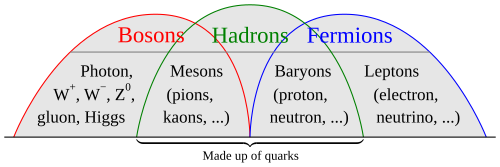
Key Facts
- Integer Spin: Bosons always have a spin quantum number of 0, 1, 2, etc.
- Force Mediation: Most elementary bosons act as force carriers between other particles.
- No Occupancy Limit: Unlike fermions, an unlimited number of bosons can occupy the same quantum state.
- Mass Generation: The Higgs boson is responsible for the phenomenon of mass via the Higgs mechanism.
- Composite Nature: Bosons can be elementary particles or composite structures made of an even number of fermions.
The History and Science of Bose-Einstein Statistics
The theoretical foundation of bosons began with Satyendra Nath Bose while he was a professor at the University of Dhaka. Bose achieved a breakthrough by treating photons as identical and indistinguishable particles, allowing him to derive Planck's law without relying on classical physics. After Bose shared his manuscript with Albert Einstein, Einstein translated and endorsed the work, leading to the formalization of Bose-Einstein statistics and the prediction of the Bose-Einstein condensate.
Elementary Bosons in the Standard Model
According to the Standard Model of Particle Physics, there are five known elementary bosons. These are categorized by their spin and their specific role in the universe.
The Scalar Boson
The Higgs boson is the only scalar boson (spin = 0). It is unique because it does not carry a force; instead, it contributes to the phenomenon of mass through the Higgs mechanism.
The Vector Bosons (Gauge Bosons)
Vector bosons have a spin of 1 and act as force carriers. These include:
- Photon (γ): The carrier of the electromagnetic field.
- Gluons (g): Eight different types of particles that mediate the strong force.
- Z boson: A neutral weak boson that mediates the weak force.
- W bosons: Two types of charged weak bosons that also mediate the weak force.
The Hypothesized Tensor Boson
Physicists have hypothesized a second-order tensor boson (spin = 2) called the graviton. This particle is theorized to be the force carrier for gravity, though it has not yet been incorporated into the Standard Model.
Composite Bosons and Quasiparticles
Not all bosons are elementary. Composite bosons are particles made of smaller constituents. Because spin is additive, any composite particle consisting of an even number of fermions results in an integer spin, making it a boson.
Common examples of composite bosons include all types of mesons and stable atomic nuclei with even mass numbers, such as helium-4 (the alpha particle), carbon-12, and lead-208. In condensed matter physics, certain quasiparticles—which are emergent phenomena that behave like particles—also follow Bose-Einstein statistics. These include Cooper pairs in superconductors, as well as plasmons and phonons.
| Category | Examples | Spin | Primary Role |
|---|---|---|---|
| Scalar Boson | Higgs boson | 0 | Mass generation |
| Vector Bosons | Photon, Gluon, W & Z | 1 | Force mediation |
| Tensor Boson | Graviton (Hypothetical) | 2 | Gravity mediation |
| Composite Bosons | Mesons, Helium-4 nucleus | Integer | Structural/Nuclear |
Macroscopic Quantum Phenomena
The unique nature of bosons allows them to exhibit extraordinary behavior at high densities or temperatures near absolute zero. Because there is no restriction on how many bosons can occupy a single quantum state, they can condense into a low-energy state.
This leads to the creation of a superfluid, such as when helium-4 atoms are cooled to near absolute zero and their kinetic energy becomes negligible. Similarly, superconductivity occurs when Cooper pairs (composite bosons) behave in this characteristic manner, allowing electricity to flow without resistance.
Frequently Asked Questions
What is the main difference between a boson and a fermion?
The primary difference is their spin quantum number: bosons have integer spins (0, 1, 2...), while fermions have half odd-integer spins (1/2, 3/2...). This difference dictates how they occupy quantum states and their role in the universe.
Can a particle be both a boson and a fermion?
No. Every observed subatomic particle must be either a boson or a fermion. However, a composite particle's classification depends on its constituents; if it is made of an even number of fermions, it is a boson.
What does it mean for a boson to be a "force carrier"?
Force carriers, or gauge bosons, are particles that mediate the fundamental forces of nature. For example, the photon carries the electromagnetic force, while gluons carry the strong nuclear force.
Why is the Higgs boson different from other bosons?
Unlike the vector bosons that mediate forces, the Higgs boson is a scalar boson that interacts with other particles to give them mass via the Higgs mechanism.
What is a Bose-Einstein condensate?
It is a state of matter that occurs when a gas of bosons is cooled to temperatures very close to absolute zero, causing the particles to collapse into the lowest possible quantum state and behave as a single entity.