Translational Symmetry and Invariance in Physics and Mathematics
In the realms of physics and mathematics, translational symmetry refers to a property where a system, equation, or object remains unchanged (invariant) when shifted in space. This concept is fundamental to how we understand the laws of nature and the geometric structure of the universe.
There are two primary types of translational symmetry: continuous translational symmetry, where a system is invariant under any translation regardless of distance, and discrete translational symmetry, where invariance occurs only at specific, fixed intervals.
Key Facts
- Physical Laws: Laws of physics are translationally invariant if they do not distinguish between different points in space.
- Conservation: According to Noether's theorem, spatial translational symmetry is equivalent to the law of momentum conservation.
- Operators: An operator is translationally invariant if applying it to a function yields the same result regardless of whether the function was first translated.
- Geometry: Translational symmetry implies that an object is infinite in at least one direction.
- Lattices: In higher dimensions, multiple independent translation vectors can form a lattice, defining a repeating pattern across space.
Translational Invariance in Physics and Operators
When we speak of an operator A acting on functions, we say it is translationally invariant if the result of the operation does not change when the argument function is translated. This means the operator's effect is independent of the function's position in space.
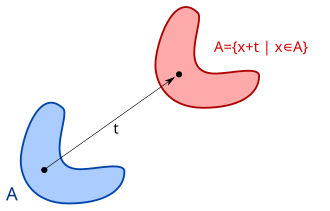
In physics, this principle is a cornerstone of theoretical frameworks. If the laws of physics are translationally invariant, it means that an experiment performed in one location will yield the same results as the same experiment performed elsewhere, provided all other conditions are identical.
Geometric Implications and Fundamental Domains
From a geometric perspective, translational symmetry implies that an object extends infinitely in at least one direction. For any point p, the symmetry creates an infinite discrete set of points defined by p + na (where n is an integer and a is the translation vector).
To describe such an infinite object, mathematicians use a fundamental domain—the smallest region that can be shifted to recreate the entire object. Depending on the dimensions, this domain takes different forms:
- 1D: A line segment.
- 2D: An infinite strip.
- 3D: A slab.
These domains do not necessarily have to be perpendicular to the translation vector; they simply must be defined such that the vector starting on one side ends on the opposite side.

Higher Dimensions and Lattices
In spaces with more than one dimension, multiple independent translation vectors may exist. When the number of these vectors equals the dimension of the space, the object is infinite in all directions, and the set of all translations forms a lattice.
A lattice can be generated by different bases of translation vectors. Two bases generate the same lattice if one can be transformed into the other via a matrix with integer coefficients and a determinant with an absolute value of 1. The absolute value of this determinant represents the covolume (the hypervolume of the n-dimensional parallelepiped subtended by the vectors), which serves as the fundamental region of the symmetry.
Practical Examples in 2D
In two dimensions, a parallelogram defined by vectors a and b often serves as the fundamental domain. However, other shapes, such as rectangles, can also define the object if their sides are parallel to one translation vector and the other vector connects opposite sides.
Consider a tiling of rectangular tiles with asymmetric patterns. If the tiles are arranged in rows with a consistent fractional shift, the system exhibits translational symmetry (specifically wallpaper group p1). If the pattern on the tile itself has rotational symmetry of order two, it becomes wallpaper group p2.
Summary of Translational Concepts
| Field | Application | Key Result/Concept |
|---|---|---|
| Physics | Spatial Symmetry | Momentum Conservation (Noether's Theorem) |
| Mathematics | Operators | Invariance of results under function translation |
| Geometry | Lattices | Fundamental domains and covolumes |
| Analysis | Measures | Lebesgue measure (complete translation-invariance) |
Examples of Translation-Invariant Systems
- Frieze patterns: Decorative borders that repeat a pattern along a single axis.
- Fourier Transform: The computation of absolute values following a Fourier transform is a translation-invariant operator.
- Polynomials: The mapping that determines the degree of a polynomial function is a translation-invariant functional.
- Lebesgue Measure: A standard way of assigning a length, area, or volume to subsets of Euclidean space.
Frequently Asked Questions
What is the relationship between translational symmetry and momentum?
According to Noether's theorem, the translational symmetry of a physical system in space is directly equivalent to the law of conservation of momentum.
What is a fundamental domain in geometry?
A fundamental domain is the smallest unique region of an object that, when shifted by the symmetry's translation vectors, can perfectly reconstruct the entire infinite object.
How does a lattice differ from a simple translation?
While a simple translation involves a single shift in one direction, a lattice occurs in higher dimensions when multiple independent translation vectors exist, creating a grid-like repeating structure in multiple directions.
What is a translation-invariant operator?
A translation-invariant operator is one where the output remains the same regardless of whether the input function was shifted (translated) before the operator was applied.
Can a fundamental domain be something other than a parallelogram?
Yes. While parallelograms are common in 2D lattices, other shapes like rectangles can serve as fundamental domains as long as they satisfy the requirement that the translation vector connects opposite sides of the shape.