NicaraguaCentral AmericaManaguaNicaraguan historyBosawás Biosphere Reserve

Nicaragua: The Land of Lakes and Volcanoes

Nicaragua: The Land of Lakes and Volcanoes Nicaragua, the largest country in Central America, is a land of dramatic contrasts and breathtaking natural beauty. Known colloquially as the "l...

Nicaragua: The Land of Lakes and Volcanoes

Nicaragua, the largest country in Central America, is a land of dramatic contrasts and breathtaking natural beauty. Known colloquially as the "land of lakes and volcanoes," it is a nation where colonial history, indigenous roots, and a turbulent political past converge. From the bustling capital of Managua to the serene Caribbean lowlands, Nicaragua offers a rich tapestry of cultural and geographical diversity.

The country's identity is deeply tied to its landscape, featuring massive freshwater lakes and a chain of volcanoes that shape both the terrain and the spirit of its people. Whether it is the legacy of the Mestizaje (the blending of European, Indigenous, and African ancestries) or its world-renowned coffee, Nicaragua remains a pivotal point of interest in the Western Hemisphere.
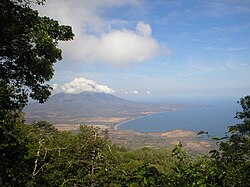
Nicaragua is known as "the land of lakes and volcanoes"; pictured is Concepción volcano, seen from Maderas volcano.

Key Facts

Location of Nicanahuac, the Indigenous name for Gran Nicoya [es], an area in western Nicaragua and northwestern Costa Rica inhabited by the Nahuas
  • Capital: Managua (the largest city).
  • Official Language: Spanish, with recognized regional languages including English, Miskito, Rama, Sumo, and others.
  • Geography: Characterized by the Pacific lowlands, North-central highlands, and Caribbean lowlands.
  • Economy: Heavily reliant on agriculture, with coffee being one of the largest exports.
  • Demographics: Approximately 69% Mestizo, 17% White, 9% Black, and 5% Indigenous.
  • Biodiversity: Home to the Bosawás Biosphere Reserve, the second-largest rainforest in the Western Hemisphere.

Geography and Natural Wonders
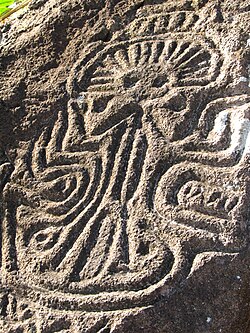
An ancient petroglyph on Ometepe Island

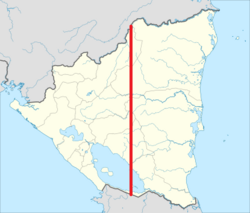
Nicaragua's topography is divided into three primary regions. The Pacific lowlands are characterized by volcanic activity and fertile soil, while the North-central highlands provide the ideal climate for the country's agricultural heartland. The Caribbean lowlands comprise 57% of the land area but house only 15% of the population, creating a vast, wild expanse of rainforests and coastlines.
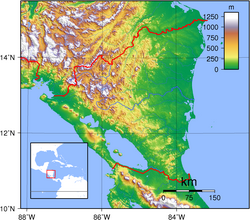
Topographic map
Topographic map

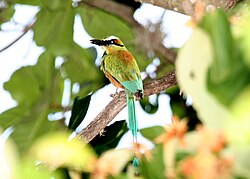
The nation is a biodiversity hotspot. The Bosawás Biosphere Reserve stands as a testament to this, protecting an immense area of rainforest. The country is also home to unique wildlife, such as the Guardabarranco, the national bird.
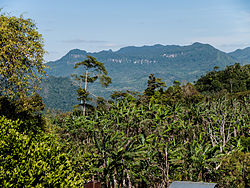
Peñas Blancas, part of the Bosawás Biosphere Reserve and located northeast of Jinotega in northeastern Nicaragua, is the second-largest rainforest in the Western Hemisphere after the Amazonian Rainforest in Brazil.

Water defines the landscape. Lake Nicaragua and Lake Managua are central to the country's identity. In the lake regions, one can find the Solentiname Islands, a haven for birdwatchers with 76 recorded species, and the Apoyo Lagoon Natural Reserve.
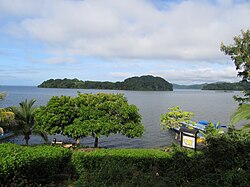
The Solentiname Islands, tropical islands in Lake Nicaragua, which are home to 76 bird species and are a growing ecotourism destination

A Journey Through History

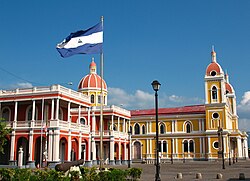
The colonial city of Granada near Lake Nicaragua, one of the most visited sites in Central America

Before the arrival of Europeans, the region was inhabited by various groups, including the Nahuas in the area known as Nicanahuac. Evidence of early human presence is preserved in the "Huellas de Acahualinca," 2,100-year-old footprints set in volcanic mud.
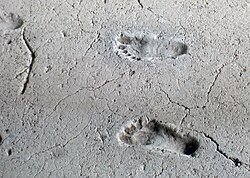
2,100-year-old human footprints, called "Huellas de Acahualinca" and preserved in volcanic mud near Lake Managua

The Spanish colonial era began in 1523, leaving a lasting mark on the architecture and culture of cities like León and Granada. Nicaragua gained independence from Spain in 1821, later separating from the First Mexican Empire in 1823 and the Federal Republic of Central America in 1838.
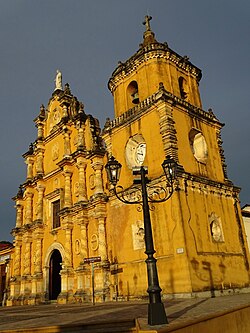
The Colonial city of León

The 20th century was marked by significant political upheaval. Following a period of United States occupation (1909–1933), the Somoza dynasty ruled for decades until the Nicaraguan Revolution of 1979. This era saw the rise of the Sandinistas and a subsequent conflict with the Contras during the 1980s. In 1990, Violeta Chamorro made history as the first democratically elected woman president in the Americas.
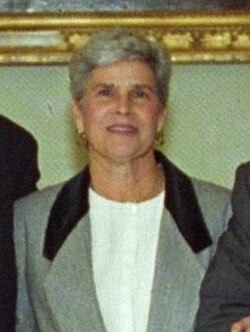
In 1990, after the Contra war, Violeta Chamorro became the first woman president democratically elected in the history of the Americas.

Culture and Society

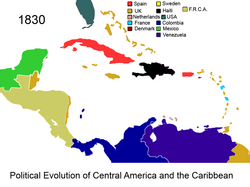
The Mosquito Coast in 1830

Nicaraguan culture is a vibrant fusion of influences. In literature, Rubén Darío is celebrated as the founder of the modernismo movement, which revolutionized Spanish-language poetry. In the performing arts, El Güegüense stands as a signature folkloric masterpiece, blending music, dance, and theater to satirize colonial rule.
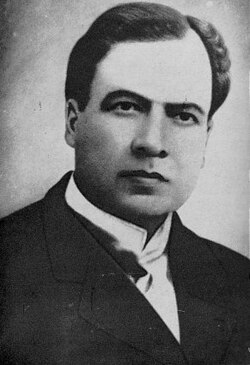
Rubén Darío, founder of Latin America's modernismo literary movement

The culinary tradition is centered on staples like Gallo pinto (rice and beans) and Vigorón (boiled yuca with fried pork and cabbage salad). These dishes reflect the agricultural abundance of the land.
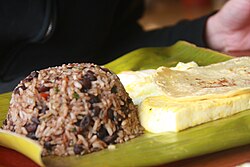
Gallo pinto, a traditional Nicaraguan dish made with rice and beans

Economy and Infrastructure

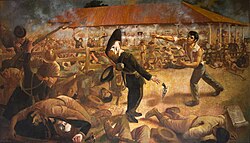
A portrait of the Battle of San Jacinto during the Filibuster War

Nicaragua's economy is largely agrarian. Coffee is a primary export, grown in regions such as Jinotega and Matagalpa and purchased by global brands like Starbucks and Nestlé. Tourism also plays a growing role, with visitors flocking to colonial cities, volcanic landscapes, and beaches like San Juan del Sur.
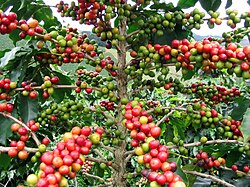
Coffee is one of the Nicaragua's largest exports. It is grown in Jinotega, Esteli, Nueva Segovia, Matagalpa, and Madriz, and exported worldwide through North America, Latin America, Europe, Asia, and Australia. Nestlé and Starbucks buy Nicaraguan coffee.

Nicaragua National Overview
Category Detail
Total Area 130,375 km²
Estimated Population (2026) 7,097,329
Currency Córdoba (NIO)
GDP per capita (Nominal 2026 est.) $3,559
Human Development Index (2023) 0.706 (High)

Frequently Asked Questions

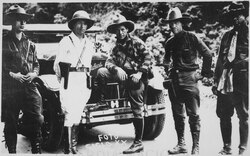
Rebel leader Augusto César Sandino (center) in June 1929
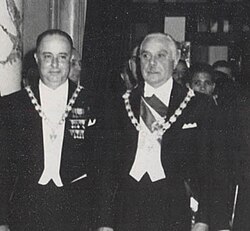
President Anastasio Somoza García (left) with Dominican President Rafael Trujillo in 1952
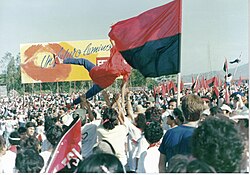
Celebrations of the 10th anniversary of the Nicaraguan Revolution in Managua in 1989
A group of Contras in the former Zelaya Department on Nicaragua's west coast on the Caribbean Sea. Women commonly joined the Contras as combatants.[113]
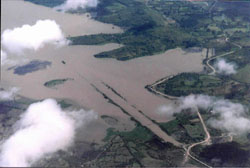
Flooding in Lake Managua after Hurricane Mitch in 1998
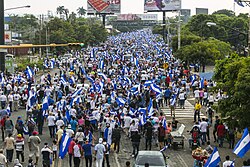
Nicaraguan protests in May 2018
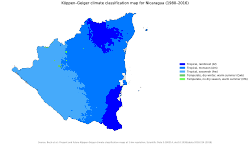
A Köppen climate classification map of Nicaragua
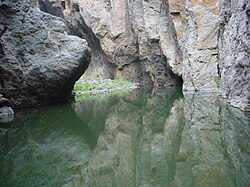
The Somoto Canyon National Monument in Somoto in the Madriz Department in northern Nicaragua
The dividing line between the Caribbean lowlands and the rest of Nicaragua. The three regions in the east make up 57% of the land area but only 15% of the population (Río San Juan, North Caribbean Coast and South Caribbean Coast Autonomous Region).
Guardabarranco ("ravine-guard") is Nicaragua's national bird.
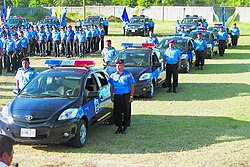
National Police of Nicaragua
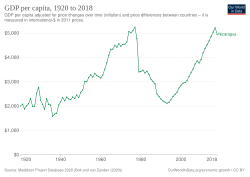
Nicaraguan GDP per capita, 1920 to 2018
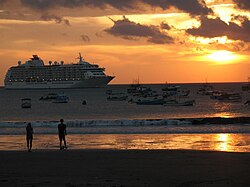
A Royal Caribbean cruise ship docked near the beach at San Juan del Sur in southern Nicaragua
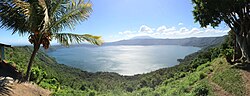
Apoyo Lagoon Natural Reserve, a nature reserve located between the departments of Masaya and Granada
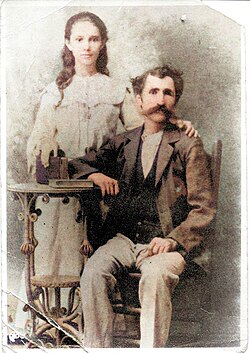
Italian immigrant family in Nicaragua (1904)
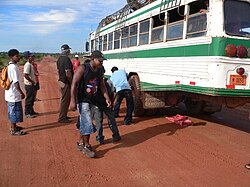
Miskito people changing a bus tire between Bilwi and Krukira, Nicaragua
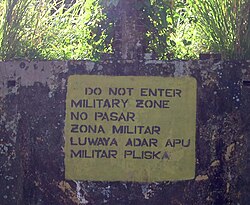
A sign in Bluefields in English (top), Nicaraguan Spanish (middle), and Miskito (bottom)
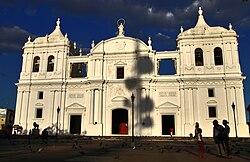
León Cathedral, one of Nicaragua's World Heritage Sites
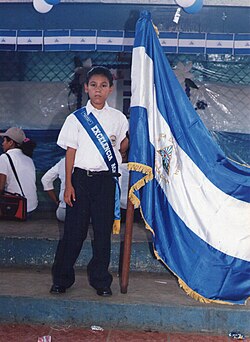
Primary school student in Nicaragua holding the national flag
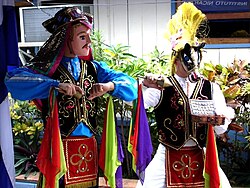
El Güegüense, a drama, was the first literary work of post-Columbian Nicaragua and is regarded as one of Latin America's most distinctive colonial-era expressions and as Nicaragua's signature folkloric masterpiece combining music, dance, and theater.
Nicaraguan women wearing the Mestizaje costume, which is a traditional costume worn to dance the Mestizaje dance. The costume demonstrates the indigenous influence upon Nicaraguan clothing.[298]
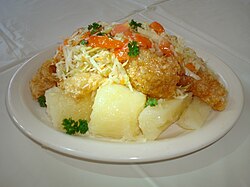
Vigorón, a Nicaraguan dish served with boiled yuca and chicharrones (fried pork with skin) and topped with a cabbage salad
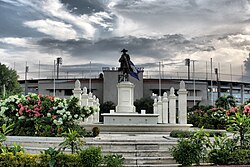
Dennis Martínez National Stadium, Nicaragua's main outdoor stadium

What is the significance of the Bosawás Biosphere Reserve?

The Bosawás Biosphere Reserve is the second-largest rainforest in the Western Hemisphere, surpassed only by the Amazon in Brazil, making it critical for global biodiversity.

Which languages are spoken in Nicaragua?

While Spanish is the official language, several regional languages are recognized, including English, Miskito, Rama, Sumo, Moskitian Creole, Garifuna, and Rama Cay Creole.

What are the main exports of Nicaragua?

Coffee is one of the largest exports, produced in the northern highlands and exported to North America, Latin America, Europe, Asia, and Australia.

Who was Rubén Darío?

Rubén Darío was a renowned poet and the founder of the modernismo literary movement, which had a profound impact on modern Spanish literature.

What is Gallo pinto?

Gallo pinto is a traditional Nicaraguan dish consisting of rice and beans, serving as a staple of the national diet.