The Mysterious World of Night Monkeys: Nature's Only Nocturnal Simians
In the dense canopies of Central and South America lives a primate that defies the typical habits of its cousins. Known as night monkeys, owl monkeys, or douroucoulis, these fascinating creatures are the only truly nocturnal monkeys in the world. While most primates rely on the sun to navigate their environment, the genus Aotus has evolved to master the darkness, filling a unique ecological niche that protects them from predators and reduces competition for food.
Key Facts
- Only Nocturnal Monkeys: They are the only members of the suborder Anthropoidea that are truly active at night.
- Social Structure: They are socially monogamous, forming strong pair bonds.
- High Paternal Care: Fathers are the primary caregivers, carrying infants up to 90% of the time.
- Vision: They possess monochromatic vision (no color vision) but have exceptional spatial resolution in low light.
- Distribution: Found across Panama and much of South America, divided by the Amazon River.
Physical Characteristics and Adaptations
The most striking feature of the night monkey is its oversized brown eyes. These large organs are an evolutionary adaptation that maximizes light capture, allowing them to see clearly in the dark. Interestingly, they are monochromats, meaning they lack color vision, which is an advantage for detecting visual cues and movement at night.
Their genus name, Aotus, translates to "earless," a reference to their ears, which are mostly hidden and difficult to see. In terms of size, there is notable variation between species. Azara's night monkey is the heaviest, weighing approximately 1,254 grams (2.765 lb), while Brumback's night monkey is the lightest, ranging between 455 and 875 grams (1.003 to 1.929 lb).
Scientists have also studied their tapetum lucidum—the reflective layer behind the retina found in many nocturnal animals. While some sources suggest they lack this layer, others indicate it is composed of collagen fibrils. Regardless, they lack the riboflavin crystal layer found in lemurs, suggesting that their nocturnality is a derived trait, meaning it evolved later from ancestors that were active during the day.
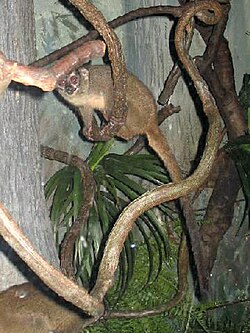
The three-striped night monkey is one example of the diverse species within this genus.
Taxonomy and Classification
The classification of night monkeys has evolved significantly. Until 1983, researchers recognized only one or two species. However, evidence from chromosome variability and morphology led to the recognition of eleven distinct species. These are generally split into two primary groups based on their geography and appearance:
- Gray-necked group (A. lemurinus): Found north of the Amazon River. This group includes the Panamanian, Gray-bellied, Gray-handed, and Three-striped night monkeys.
- Red-necked group (A. azarae): Found south of the Amazon River. This group includes Azara's, the Peruvian, Nancy Ma's, and the Black-headed night monkey.
Habitat and Distribution
Night monkeys inhabit primary forests (undisturbed by humans), secondary forests (recovering from logging), tropical rainforests, and cloud forests—areas characterized by consistent mist and moisture—at elevations up to 2,400 metres (7,900 ft). Their range spans Panama, Colombia, Ecuador, Peru, Brazil, Paraguay, Argentina, Bolivia, and Venezuela.
The Amazon River serves as a major biological barrier, separating the gray-necked species to the north from the red-necked species to the south. Some species, like the Peruvian night monkey, are endemic to specific regions like the Peruvian Andes, while others, such as the black-headed night monkey, have a wider range extending through Brazil and Bolivia.
Diet and Foraging Behavior
Night monkeys are primarily frugivorous, meaning their diet consists mainly of fruit, which they locate using olfactory (scent) cues. They also consume leaves and insects. Interestingly, females and juveniles have been observed to be more proficient at catching flying and crawling insects than adult males.
To capture prey, they typically use the palm of their hand to flatten an insect against a tree branch. During winter or periods of food scarcity, they may supplement their diet by foraging on flowers, such as Tabebuia heptaphylla.
Social Structure and Reproduction
Unlike many other primates, night monkeys are socially monogamous and form lasting pair bonds. They live in small family groups consisting of a mated pair and their immature offspring. These groups are territorial, defending their space through scent marking and a complex repertoire of vocalizations, including hoots, screams, and grunts.
Reproduction is characterized by a unique division of labor. While females are fertile year-round, the male takes on the primary role of caregiver. After the first week of life, the father carries the infant the vast majority of the time. This reduces the metabolic strain on the lactating mother and increases the infant's chance of survival. Males also share foraged food with lactating females, a rare behavior in nature that is linked to high paternity certainty.
The Science of Nocturnality
The shift to a nocturnal lifestyle provided the Aotus genus with several advantages: protection from diurnal (day-active) predators, reduced competition for food, and an escape from harsh daytime environmental conditions. They choose strategic nest sites with dense foliage to camouflage themselves from predators while maintaining a clear view of the ground.
Their activity levels are closely tied to the lunar cycle. Research shows that moonlight significantly influences their foraging; during a new moon, when light is lowest, night monkeys exhibit decreased activity. While most are strictly nocturnal, some populations of Azara's night monkey are cathemeral, meaning they exhibit irregular bursts of activity during both day and night.
Conservation Status
Night monkeys face several critical threats. Habitat loss due to mining, logging, cattle ranching, and agricultural expansion has devastated populations; for example, over 62% of the Peruvian night monkey's habitat has been degraded. They are also targeted for the illegal pet trade and bushmeat hunting.
Additionally, night monkeys are used in biomedical research. Because species like Nancy Ma's night monkey are susceptible to Plasmodium falciparum (the parasite that causes human malaria), they have been used as test subjects for malaria vaccines, sometimes with fatal results.
| Group | Primary Region | Key Species Examples | IUCN Status Examples |
|---|---|---|---|
| Gray-necked | North of Amazon River | Panamanian, Three-striped | Least Concern / Vulnerable |
| Red-necked | South of Amazon River | Peruvian, Azara's | Endangered / Vulnerable |
Frequently Asked Questions
Why are they called "earless" monkeys?
Their genus name, Aotus, means "earless" because their ears are small and mostly hidden by their fur, making them difficult to see compared to other primates.
How do night monkeys see in the dark?
They have evolved very large eyes to capture as much light as possible. Although they cannot see colors (monochromatic vision), they have excellent spatial resolution in low-light conditions.
What makes their parenting style unique?
Night monkeys exhibit an unusually high level of paternal care. The father is the primary carrier of the infant for most of its early life and shares food with the mother to support her during lactation.
Are all night monkeys endangered?
No, their status varies by species. While the Peruvian night monkey is classified as Endangered and four other species are Vulnerable, four are listed as Least Concern, and two are data deficient.
How does the moon affect their behavior?
Their activity is highly dependent on moonlight. They are generally more active when the moon is bright and show significantly lower levels of activity during a new moon.