New Territories History: The Expansion and Transfer of Hong Kong
The geography of modern Hong Kong is the result of a series of diplomatic treaties and strategic acquisitions spanning over a century. While Hong Kong Island and Kowloon were the initial focal points of British presence, the addition of the New Territories fundamentally transformed the colony's size, security, and demographic capacity.
The Path to Expansion
The British presence in the region began with the Treaty of Nanjing in 1842, which ceded Hong Kong Island following the First Opium War. This was followed by the 1860 Convention of Beijing, which ended the Second Opium War and ceded Kowloon (south of Boundary Street) and Stonecutters Island. As the colony grew, it became a magnet for Chinese and Western settlers, leading to rapid population growth and severe overcrowding.
By the 1890s, the Hong Kong government faced critical challenges. An outbreak of bubonic plague in 1894 highlighted the dangers of urban congestion, and the Qing dynasty's defeat in the First Sino-Japanese War revealed its inability to defend its territories. Strategically, Victoria City and Victoria Harbour remained vulnerable to attacks launched from the hills of Kowloon.
Seeking to secure the colony and counter the influence of other European powers—specifically France's new Guangzhouwan colony and its control of Indochina—the United Kingdom utilized a "most favoured nation" clause. In June 1898, Britain demanded an extension of Kowloon. Similarly, in July 1898, Britain secured Weihaiwei in Shandong to counter German and Russian influence in the north.
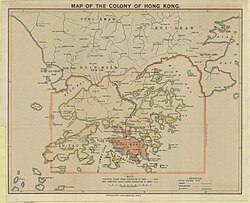
This extension, known as the New Territories, added approximately 365 square miles (950 km²) to the colony, making it 12 times larger than the existing British holdings in Hong Kong at the time.
British Assumption of Sovereignty
Although the convention was signed on June 9, 1898, and became effective on July 1, the actual takeover was a complex process. During the transition, Wilsone Black served as administrator. James Stewart Lockhart, the colonial secretary, was tasked with surveying the land to establish a formal border.
A dispute arose regarding the frontier. While Wilsone Black suggested the Sham Chun River (Shenzhen River), Lockhart argued this would split the town of Shenzhen. Despite suggestions to move the border further north to a line of hills or further south by Chinese officials, it was finally settled in March 1899 that the boundary would remain at the Sham Chun River.
The Six-Day War of 1899
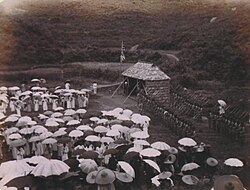
The formal takeover began on April 17, 1899, with Tai Po designated as the administrative center. However, the transition was met with violent resistance. Local clans, fearing the loss of traditional land rights, mobilized militias originally formed to fight pirates. This conflict, known as the Six-Day War, saw clan militias launch a frontal attack on the British police station in Tai Po.
The British responded with superior firepower, including artillery used against walled villages. In one significant engagement near Lam Tsuen, over 500 Chinese men were killed. The resistance collapsed, and the village of Kat Hing Wai, belonging to the Tang clan, was symbolically disarmed by the removal of its main gates.
Concessions and Long-term Impact
To prevent future uprisings, the British granted indigenous inhabitants specific concessions regarding marriage laws, land inheritance, and land use. While polygamy was eventually outlawed in the 1960s, some land-related concessions remain in effect today, occasionally causing friction between indigenous residents and other Hong Kong citizens.
Between 1907 and 1912, Governor Lord Lugard proposed a trade: returning Weihaiwei to China in exchange for the New Territories being ceded in perpetuity. The proposal was rejected, leaving the New Territories as a leased territory.
Modern Development and Sovereignty Transfer
For decades, the New Territories remained largely rural. It was not until the late 1970s that the government committed to large-scale modernization. To alleviate overcrowding in urban Kowloon and Hong Kong Island, several "new towns" were constructed. Today, these areas house over 3 million people, though the government continues to reserve large portions of the region as parkland.
As the lease approached its expiration in the 1980s, negotiations between the United Kingdom and the People's Republic of China resulted in the 1984 Sino-British Joint Declaration. This agreement stipulated that the entirety of Hong Kong, including the ceded islands and the leased New Territories, would be returned to China.
Key Facts
- Total Area: The New Territories added roughly 365 square miles (950 km²) to the colony.
- Border: The official boundary was established at the Sham Chun River.
- Conflict: The Six-Day War of 1899 saw clan militias resist British takeover, resulting in over 500 deaths.
- Administrative Hub: Tai Po was selected as the initial administrative center for the region.
- Population: Modern new towns in the New Territories now accommodate more than 3 million residents.
| Territory | Year | Legal Mechanism | Status |
|---|---|---|---|
| Hong Kong Island | 1842 | Treaty of Nanjing | Ceded |
| Kowloon (South of Boundary St) | 1860 | Convention of Beijing | Ceded |
| New Territories | 1898 | Convention of 1898 | Leased |
Frequently Asked Questions
Why did Britain want to acquire the New Territories?
Britain sought to expand the colony to accommodate a rapidly growing population and to address security concerns. Specifically, they wanted to prevent hostile forces from using the hills of Kowloon to attack Victoria City and Harbour, and to counter the influence of other European powers like France in the region.
What was the Six-Day War of 1899?
The Six-Day War was a brief conflict where local Chinese clans used armed militias to resist the British takeover of the New Territories. They were concerned about the loss of traditional land rights. The resistance was suppressed by British forces using superior weaponry and artillery.
What were the concessions given to indigenous inhabitants?
To ensure stability, the British granted indigenous residents special rights regarding land use, land inheritance, and marriage laws. Some of these land-related privileges persist into the present day.
How did the New Territories change in the late 20th century?
Starting in the late 1970s, the government developed several "new towns" to move the population away from the overcrowded urban centers of Hong Kong Island and Kowloon, though large areas were preserved as parkland.
What happened to the lease of the New Territories?
The lease was the subject of the 1984 Sino-British Joint Declaration, which agreed that the entire territory of Hong Kong, including the New Territories, would be transferred back to the People's Republic of China.