New Orleans Public Belt Railroad: Powering Port Logistics
The New Orleans Public Belt Railroad (reporting mark NOPB) serves as a critical artery for commerce in Louisiana. As a Class III railroad—a designation for short line railroads that typically handle smaller tonnages than major carriers—the NOPB provides essential switching and haulage services. By facilitating the movement of freight through the Port of New Orleans, it ensures that goods flow efficiently between the waterfront and the broader North American rail network.
Operating as a subsidiary of the Port of New Orleans, the railroad manages a strategic network of tracks that connect the port with all six of North America's Class I railroads. This unique positioning makes it a vital hub for regional and international trade.
Key Facts
- Parent Organization: Port of New Orleans.
- Network Size: 26 miles of mainline track and 75 miles of total trackage.
- Fleet: Eight lower-emission (Tier 1) EMD GP38-2 locomotives.
- Strategic Asset: Joint owner and maintainer of the Huey P. Long Bridge.
- Connectivity: Interchanges with all six North American Class I railroads.
- Operational Start: 1908.
Infrastructure and Operations
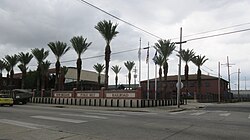
The NOPB operates a specialized network designed to reduce congestion along the riverfront. Its primary classification facility—where railcars are sorted and organized—is the Cotton Warehouse Yard, located in Uptown New Orleans near the company headquarters.
Beyond the main hub, the system includes several other key yards: Claiborne Yard and France Yard, as well as storage facilities at Pauline, Race Street, East Bridge, and South yards. This infrastructure allows the NOPB to seamlessly interchange traffic with BNSF, Canadian National, Canadian Pacific Kansas City, CSX, Norfolk Southern, and Union Pacific.
One of the railroad's most significant assets is the Huey P. Long Bridge. Jointly maintained with the Louisiana Department of Transportation and Development, this bridge is a cornerstone of American logistics; it is estimated that approximately one-third of all east-west rail freight in the United States crosses the Mississippi River via this structure.
Historical Evolution
Origins and Early Growth
The concept of a belt line railroad was first discussed in 1890 to improve port access and eliminate the need to transport railcars across the Mississippi River by barge. Formally established in 1900 and beginning operations in 1908, the railroad was designed to provide "uniform and impartial" access to the port for all rail carriers.
Expansion and Modernization
The railroad grew significantly throughout the 20th century. A major milestone occurred in 1935 when the first train crossed the newly constructed Huey P. Long Bridge. Further expansions included a 1943 interchange with the Texas and Pacific Railway and a 1956 extension to Lake Pontchartrain via France Yard.
In the late 1990s, the NOPB modernized its facilities to accommodate double-stack container trains, significantly increasing hauling capacity. In 2016, the railroad expanded its footprint beyond Orleans and Jefferson parishes by establishing an interchange with the Kansas City Southern Railway at Frellsen Junction.
Resilience and Transition
The railroad faced a massive challenge in 2005 when Hurricanes Katrina and Rita caused an estimated $450 million in damages. Despite this, the NOPB demonstrated remarkable resilience, restoring 90 percent of its lines and all six Class I interchanges by March 2006.
Control of the railroad shifted in 2018. After the City of New Orleans explored privatization to fund improvements, an agreement was reached to transfer the NOPB to the Port of New Orleans. In exchange, the port transferred the Governor Nicholls Street and Esplanade Avenue wharves to the city for riverfront park expansion.
Modern Fleet and Leadership
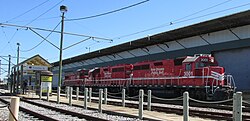
To improve environmental efficiency, the NOPB updated its fleet in 2020. The railroad now utilizes eight lower-emission (Tier 1) EMD GP38-2 locomotives, which were rebuilt by Electro-Motive Diesel and are leased from GATX.
The railroad also marked a historic milestone in 2022 when Tomeka Watson Bryant became president and CEO, becoming the first African American woman to lead a short line railroad in the United States.
| Feature | Detail |
|---|---|
| Reporting Mark | NOPB |
| Track Gauge | 4 ft 8 ½ in (1,435 mm) standard gauge |
| Mainline Length | 26 miles (42 km) |
| Total Trackage | 75 miles (121 km) |
| Locomotive Model | EMD GP38-2 (Tier 1) |
| Funding Source | Operating revenue |
Frequently Asked Questions
What is the primary purpose of the New Orleans Public Belt Railroad?
The NOPB provides switching and haulage services for freight moving through the Port of New Orleans, ensuring impartial rail access for various carriers and reducing riverfront congestion.
Which major railroads connect with the NOPB?
The NOPB interchanges with all six of North America's Class I railroads: BNSF, Canadian National, Canadian Pacific Kansas City, CSX, Norfolk Southern, and Union Pacific.
What is the significance of the Huey P. Long Bridge?
The bridge is a vital link for national logistics, as it is estimated that one-third of the United States' east-west rail freight crosses the Mississippi River at this location.
How did the NOPB recover from Hurricanes Katrina and Rita?
Despite $450 million in damages, the railroad restored 70 percent of its lines by September 2005 and reached 90 percent restoration by March 2006, including all Class I interchanges.
Who currently owns the New Orleans Public Belt Railroad?
The railroad is a subsidiary of the Port of New Orleans, following a transfer of control from the City of New Orleans on February 1, 2018.