Port of New Orleans: A Vital Hub for Global Trade and Tourism
The Port of New Orleans serves as a critical gateway for commerce and travel in the United States. Located in Louisiana, this multifaceted transport hub is the state's only international container port and a premier embarkation point for cruise passengers. Operating as a self-sustaining political subdivision of the State of Louisiana, the port generates $100 million in annual revenue without relying on tax dollars.
The port's financial stability is driven by four primary business lines: cargo (46%), rail (31%), cruise (16%), and industrial real estate (7%).
Key Facts
- Location: Situated on the Mississippi River, approximately 100 miles from the Gulf of Mexico.
- Financial Status: Self-sustaining; receives zero tax dollars.
- Container Capacity: 840,000 TEU (Twenty-foot Equivalent Units) annually.
- Cruise Standing: The sixth largest cruise port in the United States.
- Infrastructure: Nearly $1 billion invested in facilities, with another $1 billion planned via private partnerships.
Strategic Location and Trade Zones
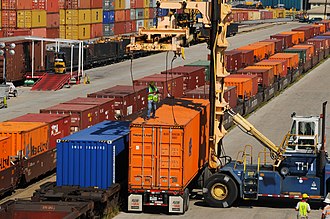
Positioned strategically on the Mississippi River, the port handles a diverse array of general cargo. This includes containerized cargo—such as food products, consumer merchandise, and plastic resins—as well as breakbulk cargo, which refers to goods that must be loaded individually rather than in containers, such as rubber, wood, paper, steel, and other metals.
A defining feature of the port is its foreign-trade zone (FTZ), established in 1946. The New Orleans FTZ is notable for having more individual sites and warehouses under its administration than any other port-administered FTZ in the United States.
Terminal Operations and Infrastructure
Containerized Cargo Capabilities
As Louisiana's sole deep-water container port, the facility is equipped to handle 10,000 TEU vessels using six gantry cranes. To expand this capacity, four additional 100-foot gauge gantry cranes were ordered in 2019. The port integrates seamlessly with land transport through the New Orleans Public Belt Railroad and the Mississippi River Intermodal Terminal, providing essential on-dock rail access and container-on-barge services.
Breakbulk and Cold Storage
The port offers 13,511 feet of berthing space across six dedicated breakbulk terminals. To support these operations, there are 1.6 million square feet of transit shed area for temporary storage and the capability to move cargo directly to or from barges. Additionally, the Henry Clay Avenue Refrigerated Terminal provides a 140,000-square-foot dockside cold storage facility for temperature-sensitive goods.
Cruise and Tourism
Beyond industrial trade, the Port of New Orleans is a major tourism driver. In 2019, the port recorded 1.20 million passenger movements and 251 vessel calls. Major lines such as Carnival and Norwegian operate weekly sailings to the Bahamas and the Eastern and Western Caribbean. Other notable operators include Disney Cruise Line and Royal Caribbean International.
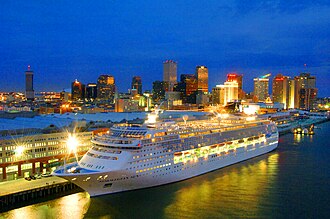
The port is also seeing growth in riverine cruises, with the American Cruise Lines and American Queen Steamboat Company offering voyages along the inland river system and the coast.
Port Specifications and Governance
| Feature | Detail |
|---|---|
| Project Depth | 45 ft. |
| Depth at Berths | 50 ft. |
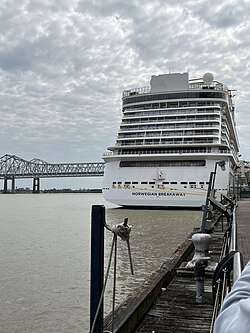
| Air Draft | 170 ft. (Restricted by Crescent City Connection bridge) |
| UN/LOCODE | USMSY |
The port is governed by the Board of Commissioners of the Port of New Orleans, consisting of seven nonsalaried commissioners serving five-year staggered terms. These members are appointed by the governor of Louisiana from nominees provided by local business, maritime, and civic groups. The board's composition reflects its three-parish jurisdiction: four members from Orleans Parish, two from Jefferson Parish, and one from St. Bernard Parish.
Frequently Asked Questions
How is the Port of New Orleans funded?
The port is a self-sustaining political subdivision of the State of Louisiana and receives zero tax dollars, generating its own revenue through cargo, rail, cruise, and real estate operations.
What is a TEU and what is the port's capacity?
TEU stands for Twenty-foot Equivalent Unit, a standard measure for container capacity. The Port of New Orleans has an annual capacity of 840,000 TEU.
What types of cargo are handled at the port?
The port handles containerized cargo (such as plastics and food) and breakbulk cargo (such as steel, wood, and rubber), as well as refrigerated goods via its cold storage facility.
Which cruise lines operate out of New Orleans?
Major operators include Carnival, Norwegian, Disney Cruise Line, and Royal Caribbean International, alongside riverine operators like American Cruise Lines and American Queen Steamboat Company.
What limits the size of ships entering the port?
The air draft is restricted to 170 feet due to the Crescent City Connection bridge.