New Guinea Community Site: A Historic Free Black Settlement in Hyde Park
Located in Hyde Park, New York, the New Guinea Community Site serves as a poignant reminder of the transient free Black communities that flourished in the United States during the decades leading up to the Civil War. Listed on the National Register of Historic Places in 2018, this settlement provided a sanctuary for African Americans seeking autonomy, security, and economic stability in an era of systemic oppression.
The Rise and Fall of a Transient Community
The New Guinea community was typical of similar settlements of its time, emerging as a haven for free persons of color and those who had self-emancipated from the South. These communities often provided a critical buffer against the dangers of the era, including the constant threat of kidnapping and illegal sale into slavery. By living in close proximity, residents could ensure collective security and mutual support.
Beyond safety, the community offered a rare path to economic independence. At a time when New York imposed strict property requirements for African Americans to exercise their right to vote, owning land within the New Guinea settlement provided a tangible means of achieving political agency and social standing.
However, the community's nature was transient. Following the conclusion of the Civil War and the national abolition of slavery, the specific incentives that drove the formation of such isolated settlements diminished, and the community gradually dissipated.
Leadership and Archaeological Insights
Central to the community's success were leaders like Primus and Elizabeth Martin. The home site of Primus Martin has become a focal point for archaeological study in Hyde Park. Excavations have uncovered ceramic fragments that suggest the Martin home was a hub of social and potentially political activity, with evidence of communal dining and tea drinking.
The residents of New Guinea balanced their independence with local employment, owning small farms while also working for the elite families residing along the Hudson River. The transition of the land began in the 1860s when John Hackett purchased land in the "Guinea" area to establish the Crum Elbow Farm, marking the beginning of the community's gradual dissolution.
Preservation and Modern Recognition
The historical significance of the site gained official state and national recognition on December 22, 2017, when Governor Andrew Cuomo announced that the New Guinea site at East Market Street was recommended for the state and national registries by the New York State Board of Historic Preservation.
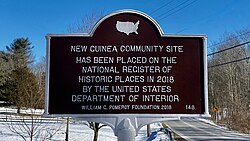
Today, a marker from the William G. Pomeroy Foundation identifies the portion of the site located within the Town of Hyde Park’s Hackett Hill park. Further research conducted by the Dutchess County Historical Society in 2022 has expanded the known boundaries of the settlement, revealing that New Guinea extended immediately west of the Hackett Hill site.
Key Facts
- Official Status: Listed on the National Register of Historic Places in 2018.
- Location: East Market Street and Hackett Hill park, Hyde Park, NY.
- Primary Residents: Free Black individuals and self-emancipated persons from the South.
- Key Figures: Primus and Elizabeth Martin, prominent community leaders.
- Economic Basis: Small-scale farming and employment with Hudson River elite families.
- Historical Record: First-person testimonies were captured in the late 19th century by historian Edward Braman.
| Feature | Details |
|---|---|
| Time Period | Pre-Civil War to post-abolition |
| Primary Drivers | Collective security, property ownership, and refuge |
| Archaeological Evidence | Ceramic fragments indicating communal social gatherings |
| Modern Recognition | National Register of Historic Places (2018) |
Frequently Asked Questions
Why was the New Guinea community formed?
The community was formed to provide collective security for free persons of color against kidnapping and illegal enslavement, to offer a refuge for self-emancipated persons from the South, and to allow African Americans to meet property requirements necessary for voting in New York.
Who were Primus and Elizabeth Martin?
Primus and Elizabeth Martin were leaders within the New Guinea community. Archaeological findings at Primus Martin's home site suggest he was a socially and potentially politically influential figure who hosted communal gatherings.
What happened to the community after the Civil War?
Following the national abolition of slavery and the end of the Civil War, the community gradually dissolved. This process was accelerated in the 1860s when land in the area was purchased by John Hackett for the Crum Elbow Farm.
How do we know about the residents' lives?
Knowledge of the community comes from two primary sources: first-person testimonies collected by local historian Edward Braman in the late 19th century and archaeological excavations of home sites, such as that of Primus Martin.
Where can the site be visited today?
A portion of the site is located within the Town of Hyde Park’s Hackett Hill park, where it is marked by a William G. Pomeroy Foundation historic marker.