Musical Beat: The Foundation of Rhythm, Meter, and Groove
In the world of music theory, the beat is the basic unit of time. It serves as the pulse—a regularly repeating event—of the mensural level. While listeners often describe the beat as the rhythm they tap their toes to, or the numbers a musician counts during a performance, these are practical interpretations of a deeper structural system. In common usage, the term "beat" is often used interchangeably with related concepts such as tempo, meter, groove, and specific rhythmic patterns.
Rhythm is defined by a repeating sequence of stressed (strong) and unstressed (weak) beats. These are organized into bars, which are governed by tempo indications and time signatures.
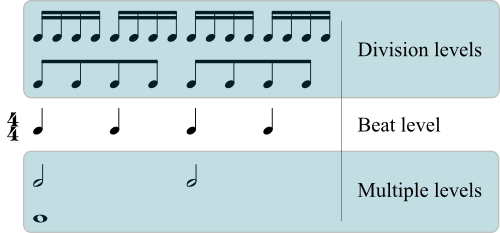
Key Facts
- The Beat: The fundamental pulse of a piece of music.
- Meter: The measurement of pulses between regularly recurring accents.
- Downbeat: The first beat of a bar (number 1), typically the strongest accent.
- Upbeat: The last beat of the preceding bar that leads into the downbeat.
- Backbeat: A syncopated accent on the "off" beats (usually 2 and 4 in 4/4 time).
- Hypermeter: A higher level of meter where entire measures act as beats.
The Mechanics of Meter and Division
Meter exists only when some pulses in a series are accented relative to others, marking them for the listener's consciousness. When pulses are counted within this metric context, they are formally referred to as beats. These beats can be categorized by their speed relative to the primary beat level: division levels are faster than the beat, while multiple levels are slower.
Simple vs. Compound Meter
The way beats are combined and divided determines the meter of a piece:
- Duple Meter: Two beats are combined.
- Triple Meter: Three beats are combined.
- Simple Meter: The beat is split into two equal parts.
- Compound Meter: The beat is split into three equal parts.
For example, simple duple is found in 2/4 or 4/4 time, while compound duple is found in 6/8. Irregular divisions, known as tuplets (such as dividing a quarter note into five equal parts), create non-standard subdivisions.
Downbeats, Upbeats, and Directionality
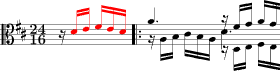
The downbeat is the first beat of the bar. In contrast, the upbeat (or anacrusis) is the final beat of the previous bar. These terms mirror the physical motion of a conductor's hand.
This directionality creates a specific emotional and energetic flow. The crusis (the beginning of a measure or phrase) propels sound forward with an "explosion" of energy. The anacrusis serves as the preparation, pushing the music up toward that impact. In many compositions, an anticipatory note or phrase occurring before the first barline is called a "pickup" or an upbeat figure.
On-Beat vs. Off-Beat
In standard Western 4/4 time, the first and third beats are generally the strongest and are considered on-beats. The second and fourth beats are weaker, known as off-beats. Subdivisions that fall between these pulses, such as eighth notes, are even weaker.
When a musician emphasizes the weak even beats instead of the strong odd beats, it is called syncopation. This technique is a cornerstone of African polyrhythm and heavily influenced Western popular music. In genres like ska and rock and roll, emphasizing the off-beat is a defining characteristic.
!["Skank" guitar rhythm[8]Playⓘ. Often referred to as "upbeats", in parallel with upstrokes.](/images/6b/43/6b43454274ff04e2beb98222899fc1f12e197ff83ceac3a2dd72c56420f59f55.png)
The Backbeat
A backbeat is a specific type of syncopated accent on the off-beats (beats 2 and 4 in a simple 4/4 rhythm). This rhythmic drive is central to R&B, rock and roll, and rockabilly.
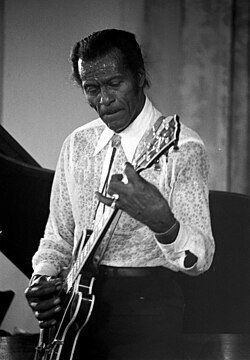
Historically, the backbeat evolved through various styles. Early examples appear in 1930s country western slap bass and 1940s boogie tunes. In modern music, the snare drum typically carries the backbeat, though hand claps or hi-hats are also used. Some variations include:
- Double Backbeat: One off-beat is played as two eighth notes instead of one quarter note (e.g., early Beatles tracks).
- Delayed Backbeat: The snare hit is slightly postponed to create a relaxed feel, common in 1960s-70s soul and rock (e.g., The Rolling Stones or Booker T. & the M.G.'s).
Advanced Rhythmic Concepts
Cross-beats and Hyperbeats
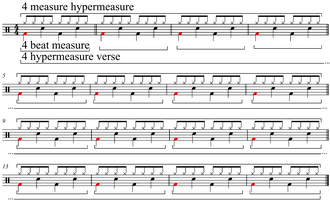
A cross-beat (or cross-rhythm) occurs when the prevailing meter is contradicted by a conflicting pattern of accents, rather than a simple momentary displacement. On a larger scale, hypermeter treats entire measures as beats. A hyperbeat is thus one unit of hypermeter, typically a single measure.
Beat Perception and Cultural Variations
Beat perception is the human ability to extract a periodic time structure from music, allowing us to synchronize our body movements to a pulse. Research indicates that while infants show rhythmic responses, the ability to accurately match movements to an auditory beat typically develops between ages 2.5 and 4.5 years.
Different genres manipulate the beat to create unique grooves:
- Reggae: Often uses the "one drop," where the first beat of the cycle is completely de-emphasized or silent.
- Funk: James Brown famously shifted the emphasis "on the one" (the downbeat) to create a powerful, distinctive groove, moving away from the standard R&B backbeat.
Summary of Rhythmic Terms
| Term | Definition | Typical Example/Context |
|---|---|---|
| Downbeat | The first beat of a measure | Beat 1 in 4/4 time |
| Upbeat | The beat preceding the downbeat | The "pickup" note before a verse |
| Backbeat | Accent on the weak beats | Snare hits on 2 and 4 in Rock |
| Syncopation | Shifting stress to unexpected beats | Jazz and African polyrhythms |
| Hypermeter | Meter where measures act as beats | Large-scale structural phrasing |
Frequently Asked Questions
What is the difference between a beat and a pulse?
While often used interchangeably, the pulse is the steady, underlying heartbeat of the music. A beat is a pulse that has been placed within a metric context, meaning some pulses are accented more than others to create a sense of meter.
What is an anacrusis?
An anacrusis, commonly known as a pickup or upbeat, is one or more unstressed notes that occur before the first full measure (the downbeat) of a piece or phrase.
How does a backbeat differ from a regular beat?
A regular beat follows the natural strong-weak-strong-weak pattern of a meter. A backbeat intentionally reverses or emphasizes the "weak" beats (usually 2 and 4), creating the driving feel characteristic of rock and R&B.
What is the "one drop" in reggae?
The "one drop" is a drumming style where the first beat of the measure (the downbeat) is left silent or completely de-emphasized, shifting the rhythmic weight to the subsequent beats.
What is a delayed backbeat?
A delayed backbeat occurs when a drummer hits the snare slightly after the mathematical beat. This creates a "laid-back" or relaxed feel, frequently heard in soul and rock music from the late 1960s to mid-1970s.