Musical Metre: The Architecture of Rhythm and Time
In the world of music, metre (or meter) is the invisible framework that organizes time. It consists of regularly recurring patterns of accents, such as downbeats and beats, which provide a sense of stability and expectation. While rhythm refers to the actual sounds played, metre is the underlying pulse that a performer implies and a listener expects, even when those beats are not explicitly sounded.
The concept of musical metre in Western tradition is deeply rooted in poetry, where it originally described the number of lines in a verse, the syllable count per line, and the arrangement of stressed and unstressed syllables. Early Western rhythmic notation was similarly derived from the quantitative metres of ancient Greek and Latin poetry.
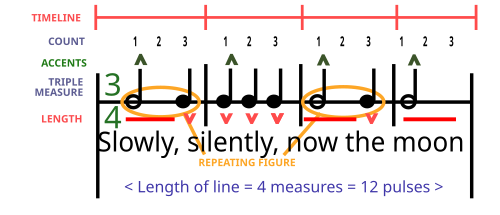
Key Facts
- Metre vs. Rhythm: Metre is the implied structural grid; rhythm is the actual pattern of durations and sounds.
- Simple Metre: Beats that divide naturally into two equal parts.
- Compound Metre: Beats that divide naturally into three equal parts.
- Polymetre: The simultaneous use of different bar sizes while maintaining a constant beat.
- Ametric Music: Music without a defined metre, such as certain chants or senza misura (without measure) compositions.
Metric Structure and Levels
Metric structure organizes pulses into groups. For instance, a 4/4 metre consists of four quarter-note beats. These bars can further group into larger units, such as musical phrases or melodies. In some cases, music is ametric, meaning it lacks a steady beat. This is common in prose-like chants, certain non-European traditions like the Honkyoku repertoire for shakuhachi, or modern graphically scored works.
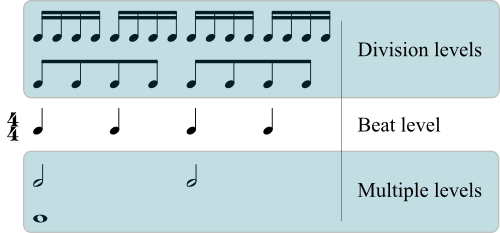
Hypermetre
Beyond the individual bar lies hypermetre. Coined by Edward T. Cone, this term describes larger-scale rhythmic patterns where multiple bars form a "hypermeasure." This creates a broader sense of tension and release, similar to an extended upbeat followed by a downbeat.
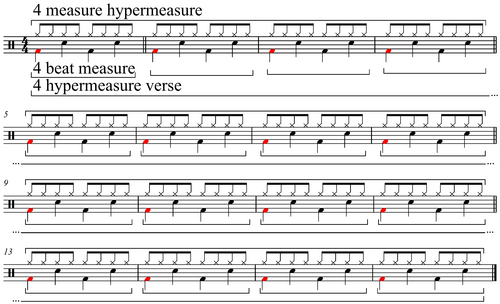
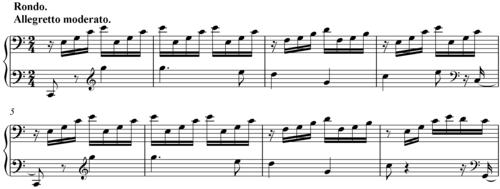
Common Types of Metre
Metres are primarily classified by the number of beats per measure and how those beats are subdivided.
Classification by Beat Count
- Duple and Quadruple Metre: These contain two or four beats per bar. For example, 2/4 time has two quarter-note beats, while 6/8 time can be felt as two dotted-quarter-note beats.
- Triple Metre: Each bar is divided into three beats (or a multiple thereof), such as 3/4 or 9/8.
- Complex Metres: Metres with more than four beats are termed quintuple (5), sextuple (6), or septuple (7). In classical theory, these are often perceived as combinations of duple and triple units (e.g., 5/4 as 3+2 or 2+3).
![Typical figures of the waltz rhythm.[24]](/images/23/ca/23ca0a72046d29e081f152868b0c733834780db5c931235403c353918bd07efe.png)
Simple vs. Compound Metre
The distinction between simple and compound metre depends on how the main beat is divided:
- Simple Metre: The beat divides into two equal parts. The top number of the time signature is typically 2, 3, or 4.
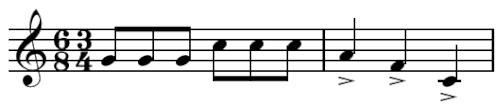
- Compound Metre: The beat divides into three equal parts (a triple pulse). The top number is typically 6, 9, or 12. For example, 6/8 is a compound duple metre (two beats, each divided by three), whereas 3/4 is a simple triple metre (three beats, each divided by two).
| Metre Type | Beats per Bar | Beat Division | Example Signature |
|---|---|---|---|
| Simple Duple | 2 | 2 parts | 2/4 |
| Simple Triple | 3 | 2 parts | 3/4 |
| Simple Quadruple | 4 | 2 parts | 4/4 |
| Compound Duple | 2 | 3 parts | 6/8 |
| Compound Triple | 3 | 3 parts | 9/8 |
| Compound Quadruple | 4 | 3 parts | 12/8 |
Metre in Different Musical Contexts
Songs and Poetry
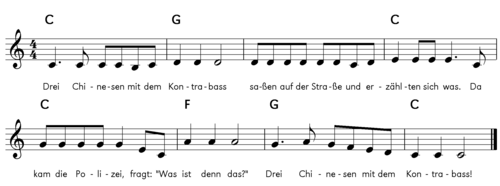
In songwriting, metre often follows the poetic structure of the lyrics. A common example is ballad metre (or common metre), featuring a syllable count of 8–6–8–6 across four lines. Because of this shared structure, melodies can often be interchanged between different songs that share the same metre, such as "Amazing Grace" and "The House of the Rising Sun."
Dance and Regional Music
Dance music relies on recognizable metrical patterns. The waltz is famous for its triple metre, while the tango is typically danced in 4/4 time at approximately 66 beats per minute. In other regions, such as the Balkans, additive metres (or imperfect time) are common, featuring irregular groupings like 3+2+2+3+2.
Advanced Metrical Concepts
Polymetre and Polyrhythm
While they sound similar, polymetre and polyrhythm are distinct concepts:
- Polymetre: Different instruments play in different bar sizes, but the beat remains constant. Eventually, the different metres will align. For example, a 4/4 and 3/4 polymetre will meet every 12 beats.
- Polyrhythm: Different numbers of beats are played within the same fixed bar length. A 4:3 polyrhythm involves playing four beats in the same time span as three.
Modern composers and bands, such as Frank Zappa, King Crimson, and Magma, frequently employ these complex structures to create rhythmic tension.
Aksak Rhythm
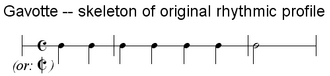
Common in Turkish and Bulgarian music, aksak rhythm (meaning "limping") uses asymmetrical additive metres, such as 2+2+3, where the stress falls at the beginning of each unit.

Frequently Asked Questions
What is the difference between metre and rhythm?
Metre is the underlying, recurring structural grid of beats and accents that the listener expects. Rhythm is the actual sequence of notes and durations that may align with or deviate from that grid.
What is the difference between simple and compound metre?
In simple metre, the main beat is divided into two equal parts. In compound metre, the main beat is divided into three equal parts.
What does "senza misura" mean?
Senza misura is Italian for "without metre." It instructs the performer to play without a steady beat, sometimes using elapsed time (seconds) to determine the length of a section.
How does polymetre differ from polyrhythm?
In polymetre, the beat is the same but the bar lengths differ. In polyrhythm, the bar length is the same but the number of beats within that bar differs.
What is hypermetre?
Hypermetre is a large-scale metrical organization where groups of measures are treated as a single unit, creating a higher-level pulse that spans multiple bars.