Time Signatures: The Foundation of Musical Meter and Rhythm
In the world of music notation, a time signature (also referred to as a meter, metre, or measure signature) serves as the rhythmic roadmap for a performer. It specifies how many note values of a particular type fit into each measure, or bar, effectively defining the meter of a musical movement.
Visually, a time signature appears as two stacked numerals immediately following the clef or key signature. For example, a 4/4 time signature indicates that there are four quarter notes per measure. When a time signature appears mid-score, usually following a barline, it signals a change in meter.

Key Facts
- Top Number: Indicates the number of beats per measure.
- Bottom Number: Indicates the note value that represents one beat (a power of 2).
- Common Time: Represented by 4/4 or the symbol
C. - Cut Time: Represented by 2/2 or the symbol
Cwith a vertical line through it (alla breve). - Simple vs. Compound: Simple meters group notes in pairs; compound meters group them in threes.
Understanding Time Signature Notation
The mechanics of a time signature rely on the relationship between the two stacked numbers. The lower numeral defines the note value being counted. This is almost always a power of 2, such as 2, 4, 8, or 16 (the latter being more common in Baroque music).
Note Value Correspondences
- 2: Half note (minim)
- 4: Quarter note (crotchet)
- 8: Eighth note (quaver)
- 16: Sixteenth note (semiquaver)
For instance, 2/4 means two quarter-notes per bar, whereas 4/8 means four eighth-notes per bar. While these may be mathematically interchangeable, they often imply different performance styles.
Simple and Compound Meters
Most music falls into one of two primary categories: simple or compound meter.
Simple Meter
In simple meter, the note values are grouped in pairs. Common examples include 4/4, 2/4, and 3/4. In these signatures, the beat is naturally divided into two equal parts.
Compound Meter
In compound meter, the note values specified by the bottom number are grouped into threes. Consequently, the upper number is always a multiple of 3 (such as 6, 9, or 12). The most frequent denominator for compound meter is 8, as seen in 6/8 or 9/8.
| Type | Time Signature | Meter Category | Common Use |
|---|---|---|---|
| Simple | 4/4 or C | Quadruple | Standard pop, rock, classical |
| Simple | 2/4 | Duple | Marches |
| Simple | 3/4 | Triple | Waltzes |
| Compound | 6/8 | Duple | Jigs, lullabies |
| Compound | 9/8 | Triple | Compound triple time |
| Compound | 12/8 | Quadruple | Blues, slow rock |
Tempo Giusto and Performance
While 3/4 and 6/8 might be mathematically equivalent (both containing three beats), they are not performed the same way. This convention is known as tempo giusto, meaning the tempo of each note remains within a "normal" range. Generally, larger numbers in the denominator correspond to faster tempi, while smaller numbers correspond to slower tempi.
Complex and Irregular Meters
Beyond simple and compound meters lie complex, mixed, and additive meters. These are less common in traditional Western music but are staples of non-Western traditions and 20th-century classical music.
Irregular and Additive Meters
Irregular meters use numbers like 5, 7, or 11. These are frequent in Balkan music, such as Bulgarian dances. Romanian musicologist Constantin Brăiloiu described these as aksak (Turkish for "limping"), where measures are composed of a mix of short and long beats (e.g., 2+2+3).
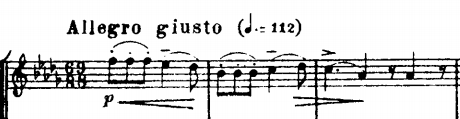
In Western classical music, composers like Tchaikovsky (in the "limping waltz" of the Pathétique Symphony) and Stravinsky have utilized these irregular signatures to create tension and unique rhythmic profiles.
Irrational Meters
An irrational time signature occurs when the denominator is not a power of two (e.g., 4/3 or 10/7). These indicate that the bar length is a fraction of a whole note based on a tuplet. For example, a 4/3 signature implies four "third-notes" (triplet half-notes) per measure. These are primarily used in contemporary music by composers like Brian Ferneyhough and Thomas Adès to manage event density without changing the base tempo.

Historical Evolution: Mensural Notation
Before the modern system of barlines and time signatures, 14th to 16th-century music used mensural notation. Instead of time signatures, they used mensuration signs to indicate the ratio of duration between notes. The relationship between the breve and semibreve was called tempus, while the relationship between the semibreve and minim was called prolatio.
Frequently Asked Questions
What is the difference between 4/4 and 2/2 time?
While both contain the same amount of music per bar, 4/4 (common time) is felt in four beats, whereas 2/2 (cut time or alla breve) is felt in two beats per measure, typically resulting in a faster perceived tempo.
What does the bottom number of a time signature represent?
The bottom number indicates which note value receives one beat. For example, a 4 means the quarter note is the beat, and an 8 means the eighth note is the beat.
What is an irregular bar?
An irregular bar is a temporary change in time signature for a single measure. For example, a song in 4/4 might suddenly have one bar of 5/4 or 3/4 to shift the rhythmic feel.
What is aksak rhythm?
Aksak is a type of irregular bichronic rhythm found in Turkish and Balkan music, characterized by a "limping" feel created by combining beats of different lengths, such as two short beats and one long beat.
Why are irrational time signatures used?
Irrational time signatures allow composers to precisely indicate a change in the speed relationship between notes (like triplets or quintuplets) across a whole measure without needing to write out complex tuplet brackets for every note.