Mount Athos: A History of the Holy Mountain
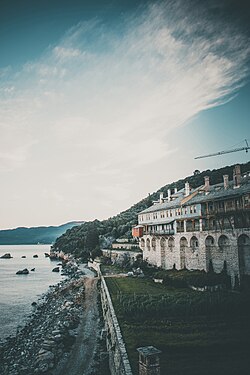
Rising dramatically from the Aegean Sea, Mount Athos is more than just a geographical landmark; it is a living museum of Eastern Orthodox spirituality. Known as the Holy Mountain, this autonomous monastic state has evolved from a site of ancient Greek mythology and classical city-states into one of the most significant religious centers in the world. Today, it stands as a UNESCO World Heritage Site, preserving centuries of tradition, architecture, and faith.
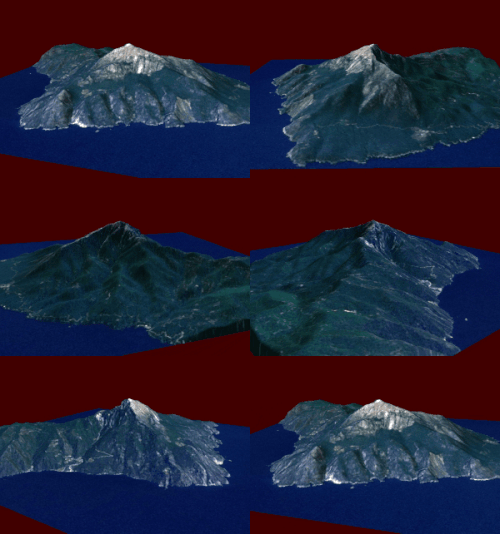
Key Facts
- Status: An autonomous monastic community within the modern Greek state.
- Access: Restricted to men only; requires a special permit called a diamonitirion.
- Foundational Monastery: The Great Lavra, founded in 963 by Athanasius the Athonite.
- Global Recognition: Designated as a UNESCO World Heritage Site.
- Ancient Name: Formerly known as Akte during the Classical period.
Ancient Origins and Mythology
The origins of Mount Athos are steeped in Greek mythology. One legend tells of the Gigantomachia (the battle between the gods and the giants), where a giant named Athos threw a massive rock at Poseidon; the rock fell into the Aegean Sea, creating the mountain. An alternative version suggests Poseidon used the mountain to bury the defeated giant.
Historically, the peninsula—then called Akte—was a hub of activity. Herodotus recorded that in 492 BC, a strong North wind wrecked the fleet of Persian commander Mardonius, resulting in the loss of 300 ships and 20,000 men. The region was populated by Pelasgians from Lemnos, who established cities such as Sane, Kleonai, Thyssos, Olophyxos, and Akrothoon. Other settlements included Dion and Akanthos, some of which minted their own currency.
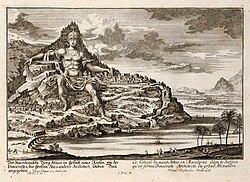
The peninsula's strategic location made it a target for conquerors. In 483 BC, Xerxes I spent three years excavating the Xerxes Canal across the isthmus to facilitate his invasion fleet. Later, following the death of Alexander the Great, the architect Dinocrates proposed a grand vision: carving the entire mountain into a colossal statue of Alexander.
Curiously, Pliny the Elder noted in 77 AD that the local inhabitants allegedly lived to be 400 years old, attributing this longevity to a diet that included viper skin. However, much of the later ancient history remains obscure, as archaeologists have struggled to locate the cities mentioned by Strabo, suggesting they were deserted before the arrival of monks.
The Transition to Early Christianity
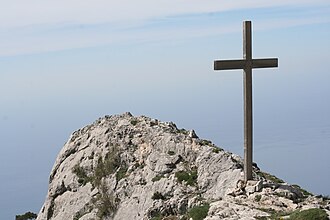
Athonite tradition holds that the Blessed Virgin Mary, while sailing from Joppa to Cyprus with John the Evangelist, was blown off course to the then-pagan shores of Athos. Overwhelmed by the natural beauty, she requested the mountain as her garden. A divine voice responded, designating the place as her inheritance and a haven of salvation. Consequently, the mountain was consecrated as the garden of the Mother of God, establishing a rule that remains today: the peninsula is out of bounds to all women.
While tradition provides a spiritual narrative, historical records show a gradual Christianization. Monks were present by the fourth century, and possibly as early as the third. During the reign of Constantine I (324–337), Christians coexisted with followers of traditional Greek religion. This peace was interrupted under Emperor Julian (361–363), when churches were destroyed and Christians were forced into hiding. Later, under Theodosius I (379–395), the traditional Greek temples were destroyed, though Hesychius of Alexandria noted that a statue of "Zeus Athonite" persisted into the fifth century.
The seventh-century Islamic conquest of Egypt drove many Orthodox monks from the Egyptian desert to seek refuge on the Athos peninsula. These early settlers lived simply, building straw-roofed wooden huts and sustaining themselves on wild fruits.
The Byzantine Era and Monastic Expansion
The 9th century marked a turning point as the area attracted hermits and ascetics. By the 10th century, these isolated practitioners evolved into organized communities. A pivotal moment occurred in 963 when Athanasius the Athonite, with the support of Emperor Nikephoros II Phokas, founded the Great Lavra. This shifted the monastic landscape from scattered hermitages to cenobitic monasteries (communities where monks live together under a common rule).
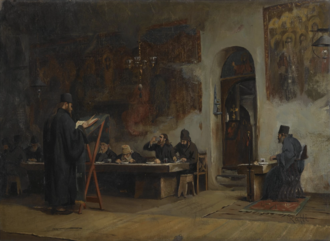
Throughout the Byzantine era, the peninsula became a multicultural monastic republic, receiving patronage from the Byzantine Empire, the Kingdom of Georgia, and various Slavic states. This international support helped establish a diverse array of monasteries representing different Orthodox traditions.
Following the fall of Constantinople in 1453, Mount Athos fell under Ottoman rule. Despite economic hardships and political instability, the community maintained a significant degree of autonomy. A revival occurred in the 19th century, fueled by donations from Russia, Serbia, and Romania. In the 20th century, the peninsula was incorporated into the Greek state while retaining its unique autonomous status.
Summary of Mount Athos History
| Period | Key Events / Characteristics | Notable Figures/Entities |
|---|---|---|
| Antiquity | Classical cities, Persian invasion, and mythological origins. | Xerxes I, Herodotus, Dinocrates |
| Early Christianity | Transition from paganism; arrival of Egyptian monks. | Constantine I, Theodosius I |
| Byzantine Era | Establishment of cenobitic monasticism and imperial patronage. | Athanasius the Athonite, Nikephoros II Phokas |
| Ottoman & Modern | Autonomy under Ottoman rule; integration into Greece. | UNESCO, Greek State |
Accessing the Holy Mountain
Due to its sacred status and strict regulations, access to Mount Athos is highly restricted. Visitors must be male and must obtain a diamonitirion, a special entry permit issued by the monastic authorities and the Greek state. The primary gateway to the community is the town of Ouranoupoli, from which visitors travel by boat to reach the monasteries.
Frequently Asked Questions
Why are women not allowed on Mount Athos?
According to Athonite tradition, the mountain was consecrated as the garden of the Mother of God, making it out of bounds to all other women to preserve its spiritual character.
What is a diamonitirion?
A diamonitirion is a special permit required for male visitors to enter the autonomous monastic community of Mount Athos.
Who founded the first major monastery on the mountain?
Athanasius the Athonite founded the Great Lavra in 963, with the support of the Byzantine emperor Nikephoros II Phokas.
What is the difference between a hermitage and a cenobitic monastery?
A hermitage is a place for isolated religious devotion by a single monk or a few individuals, whereas a cenobitic monastery is a large, organized community where monks live and work together under a common rule.
How did the Persian invasion affect Mount Athos?
In 492 BC, the fleet of Persian commander Mardonius suffered a catastrophic loss of 300 ships and 20,000 men due to a strong North wind while attempting to round the coast near the mountain.