Montane Ecosystems: Life and Biodiversity Across Mountain Altitudes
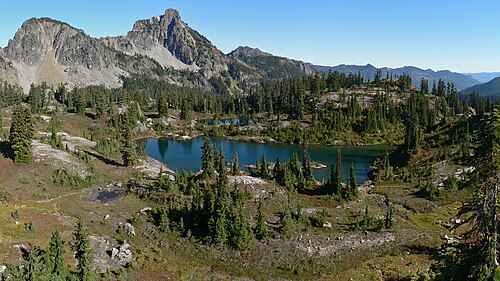
Found on the slopes of mountains, montane ecosystems are defined by their dramatic verticality. As elevation increases, the climate shifts significantly, creating a phenomenon known as stratification. This layering of different environments is a fundamental driver of plant communities, biodiversity, and metabolic processes within mountain ranges.
Because temperature decreases as one climbs higher, mountains host a variety of distinct life zones. These zones are not merely changes in scenery; they represent profound shifts in how life survives, from dense, lush forests at moderate elevations to the harsh, wind-swept expanses of the alpine tundra.
Key Facts
- Stratification: Ecosystems change in distinct bands called life zones based on elevation.
- Climate Correlation: In middle latitudes, climbing 100 meters is roughly equivalent to moving 80 kilometers toward a pole.
- Endemism: Unique climate conditions lead to a high number of endemic species (species found nowhere else).
- The Tree Line: The specific elevation where environmental conditions become too harsh for trees to grow.
- Ecosystem Services: Montane regions are critical for water supply and carbon storage.
Understanding Life Zones and Altitudinal Zonation
The concept of altitudinal zonation explains why different plants and animals live at different heights. As atmospheric pressure decreases, airmasses undergo adiabatic cooling, causing temperatures to drop. This temperature gradient creates predictable bands of ecosystems.
In middle latitudes, the climate change experienced by moving up 100 meters on a mountain is approximately equivalent to traveling 80 kilometers (45 miles) toward the nearest pole. This predictable shift allows characteristic flora and fauna to settle into specific elevation-dependent niches.
![Treeline elevation by latitude[6]](/images/ff/ae/ffae1559abd4287225d87c450c731f8cf4b48274a380b0892b21dc7fd3eecfb4.gif)
The Montane Forest Zone
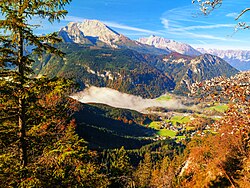
At moderate elevations, the combination of temperate climates and sufficient rainfall supports dense montane forests. These forests are situated between the submontane and subalpine zones. The upper limit of this forest is the tree line, where species often become hardier and less dense.
The specific climate of a montane forest can be defined by its biotemperature—the mean temperature where values below 0°C are treated as 0°C. For montane forests, this typically ranges between 6°C and 12°C (43°F to 54°F).
The Subalpine Zone
Immediately below the tree line lies the subalpine zone. Here, the climate is more severe, with biotemperatures between 3°C and 6°C (37°F to 43°F). In this zone, trees often struggle against high winds, resulting in krummholz—trees with twisted, stunted trunks and branches.
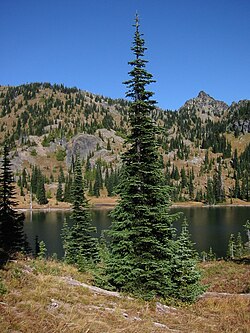
The species found in the subalpine zone vary by geography. For instance, the snow gum is found in Australia, while subalpine larch and mountain hemlock are characteristic of western North America. This zone may also feature subalpine meadows, such as Tuolumne Meadows in California.
Alpine Grasslands and Tundra
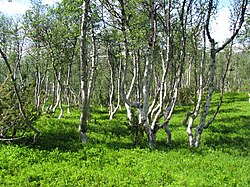
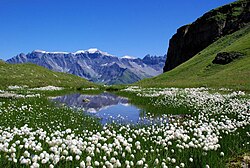
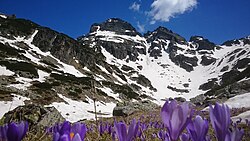
Above the tree line, the ecosystem transitions into the alpine zone, also known as alpine tundra. This region is dominated by grasses, sedges, forbs, mosses, and lichens. The biotemperature here is low, typically between 1.5°C and 3°C (34.7°F to 37.4°F). If temperatures fall below 1.5°C, the landscape often consists purely of rock and ice.
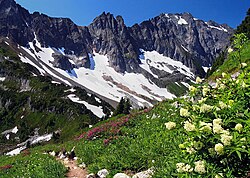
Plants in the alpine tundra have developed remarkable adaptations to survive intense ultraviolet radiation, dryness, and short growing seasons. These include:
- Cushion plants: Low-growing, ground-hugging clumps that escape high winds.
- Rosette structures and hairy leaves: Physical traits that provide protection and warmth.
- Pigmentation: Red-colored pigments that help convert sunlight into heat.
- Lichens: Non-flowering organisms that can photosynthesize at temperatures as low as −10°C (14°F).
Global Variations in Montane Climates
Montane ecosystems are not uniform; they are heavily influenced by their broader climatic context.
Temperate and Mediterranean Climates
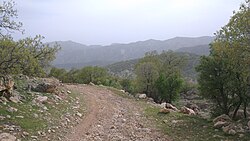
Temperate montane forests, common in Europe and North America, consist of coniferous or mixed broadleaf forests. In the Mediterranean Basin, North Africa, and parts of the Middle East, montane forests exist under Mediterranean climatic conditions.
Tropical Montane and Cloud Forests
In tropical regions, montane forests can include both broadleaf and coniferous species. A specialized type is the cloud forest (or mossy forest), which derives moisture from settling clouds and fog. These forests are often found on mountain saddles where moisture is effectively retained.
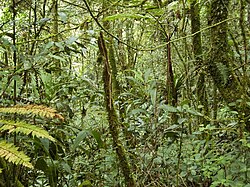
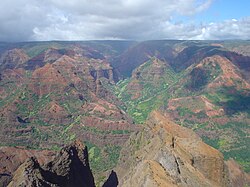
Tropical montane forests are highly sensitive to climate change. Changes in temperature and humidity can lead to biodiversity loss and shifts in species ranges. For example, reduced cloudiness is already impacting the Monteverde cloud forest in Costa Rica.
Summary of Montane Life Zones
| Zone | Typical Biotemperature | Primary Vegetation | Key Characteristics |
|---|---|---|---|
| Montane Forest | 6°C to 12°C | Dense coniferous or broadleaf forests | Moderate rainfall; located below subalpine zone |
| Subalpine Zone | 3°C to 6°C | Sparse trees, krummholz, and meadows | Located immediately below the tree line |
| Alpine Tundra | 1.5°C to 3°C | Grasses, shrubs, cushion plants, lichens | Harsh winds; above the tree line |
| Ice/Rock Zone | Below 1.5°C | Minimal to none | Dominated by rock and ice |
Frequently Asked Questions
What is the tree line?
The tree line is the specific elevation above which environmental conditions, such as low temperatures and high winds, become too harsh to support the growth of trees.
How do alpine plants survive such harsh conditions?
Alpine plants use various adaptations, including growing in low cushion shapes to avoid wind, using hairy leaves for protection, and employing specialized pigments to convert sunlight into heat.
What is a cloud forest?
A cloud forest is a type of tropical montane forest that receives much of its moisture from clouds and fog, often resulting in vegetation covered in thick layers of moss.
Why are montane ecosystems important for humans?
Montane ecosystems provide essential ecosystem services, including significant carbon storage and the regulation of vital water supplies.
What is krummholz?
Krummholz refers to trees that have become stunted and twisted due to the intense wind and harsh climatic conditions found in subalpine zones.