Molybdenum: Properties, Industrial Applications, and Biological Importance
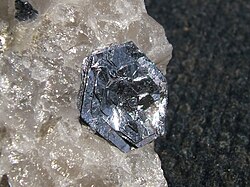
Molybdenum is a gray metallic transition metal that plays a critical role in both heavy industry and biological systems. Located in group 6 and period 5 of the periodic table, this element is prized for its high melting point and its ability to enhance the strength and corrosion resistance of steel alloys.
Historically, molybdenum was often confused with lead, which is reflected in its name derived from the Greek word Mόλυβδος. It was discovered by Carl Wilhelm Scheele in 1778 and first isolated by Peter Jacob Hjelm in 1781. Today, it is recognized as a primordial element essential for various high-tech applications and metabolic processes.

Key Facts
- Atomic Number: 42
- Symbol: Mo
- Standard Atomic Weight: 95.95 ± 0.01
- Melting Point: 2896 K (2623 °C)
- Primary Use: Metallurgy (approximately 86% of production)
- Biological Role: Essential cofactor for various enzymes
Physical and Atomic Properties
Molybdenum is characterized by its exceptional thermal and mechanical stability. It possesses a body-centered cubic (bcc) crystal structure and is paramagnetic in nature. One of its most striking physical attributes is its extremely high melting point of 2623 °C, making it suitable for high-temperature environments.
At the atomic level, molybdenum has an electron configuration of [Kr] 4d 5s. It exhibits a wide range of oxidation states, commonly appearing as +4 and +6, though states ranging from −4 to +6 are possible. This versatility allows it to form a diverse array of compounds, including chlorides and carbonyls.
Technical Specifications Summary
| Property | Value |
|---|---|
| Density (at 20 °C) | 10.223 g/cm³ |
| Boiling Point | 4912 K (4639 °C) |
| Mohs Hardness | 5.5 |
| Thermal Conductivity | 138 W/(m·K) |
| Electrical Resistivity | 53.4 nΩ·m (at 20 °C) |
| Young's Modulus | 329 GPa |
Chemical Behavior and Compounds
Molybdenum's chemistry is defined by its ability to form complex structures. For example, it can form quadruple bonds, as seen in [Mo₂Cl₈]. It also forms polyoxometalates, which are complex anions consisting of metal-oxygen frameworks.
![Keggin structure of the phosphomolybdate anion (P[Mo12O40]3−), an example of a polyoxometalate](/images/6d/2a/6d2a09d354a74d31a7bcdbb19f16321cc2bf0d53c08656d06d09ed060ec4776b.png)
The element reacts with oxygen to form molybdenum trioxide (MoO₃), which can be further processed into ammonium molybdate using aqueous ammonia. Pure metallic molybdenum is typically produced by reducing this oxide with hydrogen.
Industrial Applications and Production
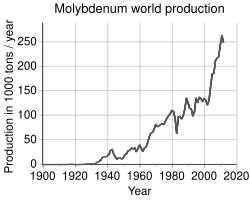
The vast majority of molybdenum is utilized in metallurgy. It is a key additive in high-strength steel alloys, where it typically comprises 0.25% to 8% of the composition. These alloys are essential for structural integrity in demanding environments.
The global distribution of molybdenum use is broken down as follows:
- Structural Steel: 35%
- Stainless Steel: 25%
- Chemicals: 14%
- Tool & High-Speed Steels: 9%
- Cast Iron: 6%
- Elemental Metal: 6%
- Superalloys: 5%
Beyond steel, molybdenum is used in the form of molybdenum copper alloys for specialized electrical and thermal applications.

Biological Role and Human Health
In biological systems, molybdenum is an essential trace element. It serves as a critical component of Mo-containing enzymes, such as nitrogenase, which is vital for nitrogen fixation. In humans, it is necessary for the function of enzymes like sulfite oxidase.
Dietary requirements for molybdenum have been updated over time. For U.S. food labeling, the Daily Value (%DV) was revised on May 27, 2016, from 75 μg to 45 μg. While essential, an excess of molybdenum can lead to copper antagonism, where the body's ability to absorb copper is impaired.
Frequently Asked Questions
What is the primary industrial use of molybdenum?
Approximately 86% of molybdenum is used in metallurgy, specifically to create high-strength alloys for structural steel, stainless steel, and superalloys.
Why is molybdenum important for human health?
Molybdenum is a necessary cofactor for several enzymes that catalyze critical metabolic reactions, including the processing of sulfur-containing amino acids.
How is metallic molybdenum produced?
It is produced by the reduction of molybdenum oxide using hydrogen gas, often following the extraction of ammonium molybdate from the ore.
What is the relationship between molybdenum and copper?
Molybdenum and copper exhibit an antagonistic relationship; excessive intake of molybdenum can interfere with the absorption and utilization of copper in the body.
What are the most common oxidation states of molybdenum?
The most common oxidation states are +4 and +6, although the element is chemically versatile enough to exist in states ranging from −4 to +6.