DPPH: The Stable Radical Used in Antioxidant Assays and EPR Spectroscopy
In the complex world of chemical research, certain molecules serve as indispensable tools for measuring and monitoring reactivity. One such compound is 2,2-Diphenyl-1-picrylhydrazyl, commonly known as DPPH. As a stable free radical, DPPH possesses unique chemical properties that make it a cornerstone in laboratory settings, particularly for studying antioxidants and calibrating advanced spectroscopic equipment.

Key Facts
- Chemical Formula: C18H12N5O6
- Primary Use: Antioxidant assays and Electron Paramagnetic Resonance (EPR) standards.
- Visual Indicator: Deep violet in solution; turns colorless or pale yellow when neutralized.
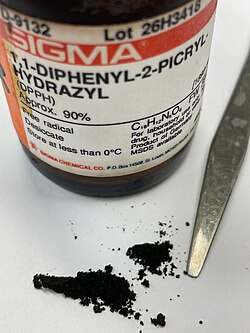
- Physical Form: Black to green powder.
- Solubility: Insoluble in water; soluble in methanol (10 mg/mL).
Chemical Properties and Crystalline Forms
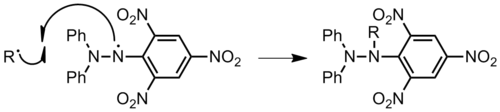
DPPH is an organic compound characterized by its ability to exist as a stable radical. Because it is a radical, it is highly reactive toward other free radicals, acting as a "scavenger" or trap. This reactivity is a primary reason for its widespread use in scientific research.
Interestingly, DPPH can exist in several different crystalline forms, which vary based on their lattice symmetry and melting points. The commercial powder typically used in labs is a mixture of these phases, melting at approximately 130 °C. The specific forms include:
- DPPH-I: An orthorhombic structure with a melting point of 106 °C.
- DPPH-II: An amorphous structure with a melting point of 137 °C.
- DPPH-III: A triclinic structure with a melting point between 128–129 °C.
Major Laboratory Applications
1. Antioxidant Assays and Radical Scavenging
One of the most common uses of DPPH is in antioxidant assays. Because DPPH is a potent radical trap, researchers can monitor the rate of chemical reactions by adding DPPH to a sample. If a substance is an antioxidant, it will neutralize the DPPH radical, causing a visible change.
This process is easily monitored through colorimetry. DPPH has a strong absorption band centered at approximately 520 nm, which gives it a deep violet color in solution. When the radical is neutralized by an antioxidant, the solution becomes colorless or pale yellow. By measuring the change in optical absorption at 520 nm, scientists can quantify the antioxidant capacity of a substance.
2. Electron Paramagnetic Resonance (EPR) Standard
DPPH is a widely recognized standard for Electron Paramagnetic Resonance (EPR), a technique used to study materials with unpaired electrons. It is used to calibrate both the position (g-marker) and the intensity of EPR signals.
The EPR splitting factor for DPPH is calibrated at g = 2.0036. Because the radicals are relatively dilute (one unpaired spin per 41 atoms), the signal produces a relatively small linewidth, typically between 1.5 and 4.7 G. This makes it a highly reliable and well-characterized source for researchers performing spectroscopic measurements.
3. Polymerization Inhibition
Beyond antioxidant research, DPPH serves as a strong inhibitor of radical-mediated polymerization. In this context, it acts to stop the growth of polymer chains by capturing the radicals that drive the polymerization process.
Summary of Physical and Chemical Data
| Property | Value/Description |
|---|---|
| CAS Number | 1898-66-4 |
| Molar Mass | 394.323 g/mol |
| Density | 1.4 g/cm³ |
| Melting Point | 135 °C (decomposes) |
| Water Solubility | Insoluble |
| Methanol Solubility | 10 mg/mL |

Frequently Asked Questions
What does the color change in a DPPH assay indicate?
The change from a deep violet color to a colorless or pale yellow state indicates that the DPPH radicals have been neutralized, typically by the presence of an antioxidant.
Why is DPPH used as an EPR standard?
It is used because it is a stable, well-characterized solid radical source with a known g-factor (2.0036), allowing for precise calibration of signal position and intensity.
Is DPPH soluble in water?
No, DPPH is insoluble in water but is soluble in methanol at a concentration of 10 mg/mL.
What happens to DPPH at extremely low temperatures?
While normally paramagnetic, DPPH transforms into an antiferromagnetic state when cooled to very low temperatures, specifically around 0.3 K.
How does DPPH affect polymer chains?
DPPH acts as an inhibitor in radical-mediated polymerization by trapping the radicals required for the chain to grow, thereby stopping the process.