Aconitine: Chemistry, Toxicity, and Synthetic Challenges of a Potent Alkaloid
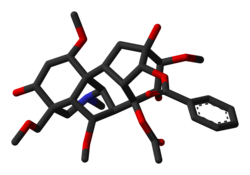
Aconitine is a complex norditerpenoid alkaloid known for its extreme potency and intricate chemical structure. Found naturally in plants of the Aconitum genus, this compound has long fascinated chemists and toxicologists alike due to its high toxicity and the structural complexity that makes it a formidable target for laboratory synthesis.
Chemically, aconitine is characterized as a solid with a molar mass of 645.73708 g/mol. It is sparingly soluble in water (0.3 g/L) but significantly more soluble in ethanol (35 g/L). Its structure features a basic nitrogen atom within a six-membered ring, which allows it to form salts and ions. This property gives the molecule an affinity for both polar and lipophilic environments, enabling it to cross the blood-brain barrier—the protective membrane that regulates which substances enter the brain from the bloodstream.

Key Facts
- Chemical Formula: C34H47NO11
- Toxicity: Extremely high; LD50 in mice is as low as 0.1 mg/kg (intravenous).
- Metabolism: Primarily processed in the human liver by CYP3A4, CYP3A5, and CYP2D6 enzymes.
- Synthesis: While simpler related alkaloids have been synthesized, the total synthesis of aconitine remains an elusive goal for organic chemists.
- Physical State: A bitter, amorphous solid with a melting point between 203 and 204 °C.
Chemical Structure and Reactivity
The reactivity of aconitine is largely defined by its functional groups. For instance, the acetoxyl group at the C8 position can be replaced by a methoxy group when the compound is heated in methanol, resulting in 8-deacetyl-8-O-methyl derivatives. Furthermore, heating aconitine in its dry state leads to pyrolysis (chemical decomposition caused by high temperatures), forming pyroaconitine (C32H43NO9).
The Challenge of Total Synthesis
Aconitine represents a rare example of a well-known natural product that has not yet been fully synthesized in a laboratory. This difficulty stems from its interlocking hexacyclic (six-ring) core and the dense arrangement of oxygenated functional groups on its periphery.
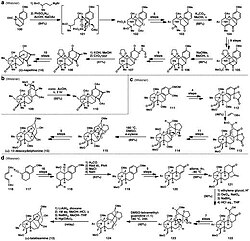
However, chemists have successfully synthesized simpler members of the aconitine family. The Wiesner group made significant strides in the 1970s, achieving the total synthesis of several C19-norditerpenoids:
- Talatisamine: Synthesized from diene 116 and nitrile 117 through a complex process involving a photoadduct and a racemic relay synthesis.
- Napelline: Created via a multi-step process starting with aldehyde 100, involving the formation of the A-ring and a lactone ring before closing the final sixth ring via aldol condensation.
- 13-Deoxydelphonine: Synthesized using a conjugated dienone and a benzyl vinyl ether, followed by a rearrangement involving DMSO and o-xylene.
Metabolism in the Human Liver
In the human body, aconitine is metabolized by cytochrome P450 isozymes (CYPs), which are essential enzymes for detoxifying foreign substances. Research indicates that the metabolism of aconitine requires the presence of NADPH to initiate.
The process is primarily driven by three enzymes: CYP3A4, CYP3A5, and CYP2D6. Other enzymes, such as CYP2C8 and CYP2C9, play a minor role, while CYP1A2, 2E1, and 2C19 do not contribute to its metabolism.
| Metabolite | Name | Involved CYPs |
|---|---|---|
| M1 | O-Demethyl-aconitine | CYP3A4, CYP3A5, CYP2D6, CYP2C8 |
| M2 | 16-O-Demethyl-aconitine | CYP3A4, CYP3A5, CYP2D6, CYP2C9 |
| M3 | N-deethyl-aconitine | CYP3A4, CYP3A5, CYP2D6, CYP2C9 |
| M4 | O-didemethyl-aconitine | CYP3A5, CYP2D6 |
| M5 | 3-Dehydrogen-aconitine | CYP3A4, CYP3A5 |
| M6 | Hydroxyl-aconitine | CYP3A5, CYP2D6 |
Toxicity and Clinical Effects
Aconitine is a potent toxin that affects multiple systems in the body. Its effects are categorized as follows:
- Neurological: Paresthesia (tingling sensation), numbness of the face and limbs, and muscle weakness.
- Gastrointestinal: Nausea, vomiting, abdominal pain, and diarrhea.
- General: Dizziness, hyperventilation, sweating, confusion, headache, and difficulty breathing.
The lethal dose varies by species and route of exposure. In humans, the lowest published lethal dose (LDLo) is approximately 0.028 to 0.029 mg/kg via oral ingestion. In mice, the LD50 is 1 mg/kg orally, but drops to 0.1 mg/kg when administered intravenously.

Cultural and Legal Significance
Due to its toxicity, aconitine has appeared in both criminal history and literature. In 2009, a murder case in West London involved the use of aconitine to poison food, resulting in a life sentence for the perpetrator. In fiction, it appears in Oscar Wilde's "Lord Arthur Savile's Crime," James Joyce's "Ulysses," and the series "Twin Peaks."
Frequently Asked Questions
What makes aconitine so difficult to synthesize in a lab?
The difficulty lies in its intricate interlocking hexacyclic ring system and the complex arrangement of oxygenated functional groups on its periphery, which challenge current synthetic organic chemistry techniques.
How does the body break down aconitine?
Aconitine is metabolized in the liver by cytochrome P450 enzymes, specifically CYP3A4, CYP3A5, and CYP2D6, which convert it into various metabolites such as O-Demethyl-aconitine.
What are the primary symptoms of aconitine poisoning?
Symptoms include neurological issues like numbness and tingling (paresthesia), gastrointestinal distress such as vomiting and diarrhea, and respiratory difficulties including hyperventilation.
Is aconitine soluble in water?
Aconitine has very low solubility in water (0.3 g/L) but is much more soluble in organic solvents like ethanol (35 g/L).
What is the difference between aconitine and pyroaconitine?
Pyroaconitine is a product of the pyrolysis of aconitine; it is formed when aconitine is heated in its dry state, resulting in a change in chemical formula to C32H43NO9.