Nitrogen: The Essential Element of Life and Industry
Nitrogen is a fundamental element that plays a critical role in both the natural world and modern industrial processes. Making up approximately 78.1% of the Earth's atmosphere by volume, it is the most abundant pure element in our air. While it often exists as a stable, colorless, and odorless gas, nitrogen's chemical versatility allows it to form an immense variety of compounds that are essential for life, food production, and advanced technology.
Key Facts
- Atomic Number: 7
- Common Form: Colorless, odorless, and tasteless gas (N2)
- Atmospheric Abundance: 78.1% by volume
- Key Chemical Feature: A very strong N≡N triple bond
- Discovery: Identified by Daniel Rutherford in 1772
- Primary Industrial Use: Production of fertilizers via the Haber–Bosch process
The History and Discovery of Nitrogen
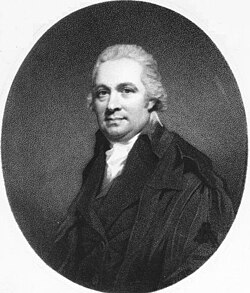
The history of nitrogen is closely tied to the evolution of chemistry. The element was discovered in 1772 by Daniel Rutherford.
The name "nitrogen" was later coined in 1790 by the French chemist Jean-Antoine Chaptal. The term is derived from the French word nitre (potassium nitrate or saltpetre) and the suffix -gène, meaning "producing." Chaptal’s naming reflected the idea that nitrogen was an essential component of nitric acid, which could be produced from nitre.
Atomic and Physical Properties
Nitrogen is located in group 15 of the periodic table, a group known as the pnictogens. It belongs to the p-block and has an atomic number of 7, meaning it has seven protons in its nucleus. Its electron configuration is [He] 2s2 2p, with electrons distributed in shells of 2 and 5.
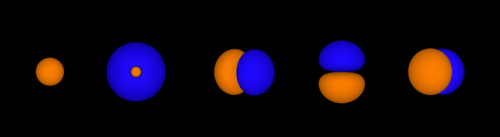
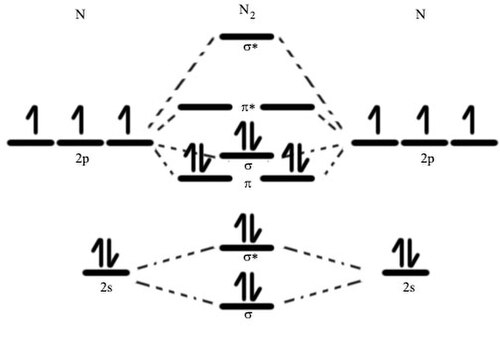
In its most common form, dinitrogen (N2), nitrogen exists as a diatomic molecule. This molecule is characterized by a unique triple bond, which is exceptionally strong with a dissociation energy of 945.41 kJ/mol. This high energy requirement explains why dinitrogen is largely unreactive at room temperature.
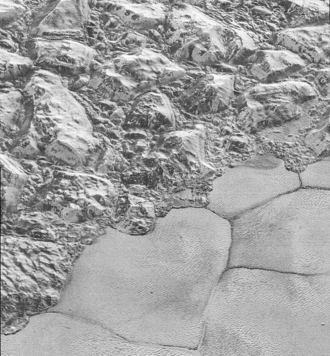
Nitrogen also exhibits different allotropes—different structural forms of the same element. At standard conditions, it is a gas, but it can be cooled into a liquid or a solid. For example, at extremely low temperatures, it can form different crystalline structures, such as the alpha phase (cubic) or the beta phase (hexagonal close-packed).
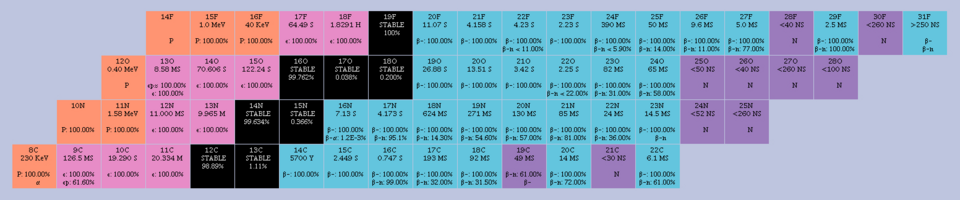
Nitrogen's identity is also defined by its isotopes, which are variants of the element with different numbers of neutrons. The most abundant isotope is N-14, making up 99.6% of natural nitrogen, while N-15 makes up the remaining 0.4%.
Scientists can identify nitrogen through its unique spectral lines, which are specific patterns of light emitted or absorbed by the element.

Chemical Diversity and Compounds
Nitrogen is chemically versatile, bonding with almost every element in the periodic table except for the first two noble gases (helium and neon). These combinations result in a wide array of compounds, including nitrides, hydrides, halides, and oxides.
Nitrides and Hydrides
Nitrides are binary compounds formed when nitrogen reacts with other elements, often metals. These can range from ionic "salt-like" structures to covalent or metallic forms. One notable group is the group 13 nitrides, which are often semiconductors. For instance, borazine is sometimes referred to as "inorganic benzene" because its structure is similar to the organic molecule benzene.

Among the most important nitrogen compounds is ammonia (NH3), a colorless, alkaline gas with a pungent smell. Ammonia is a vital precursor for fertilizers and is produced on a massive scale. Another significant hydride is hydrazine (N2H4), a colorless liquid used frequently as rocket fuel due to its ability to burn exothermically (releasing significant heat) in air.
Oxides and Oxoacids
Nitrogen forms nine different molecular oxides, including nitrous oxide (N2O), nitric oxide (NO), and nitrogen dioxide (NO2). Some of these oxides are highly reactive or unstable. For example, nitrogen dioxide (NO2) is a reddish-brown gas that can convert into the colorless dinitrogen tetroxide (N2O4) at low temperatures.
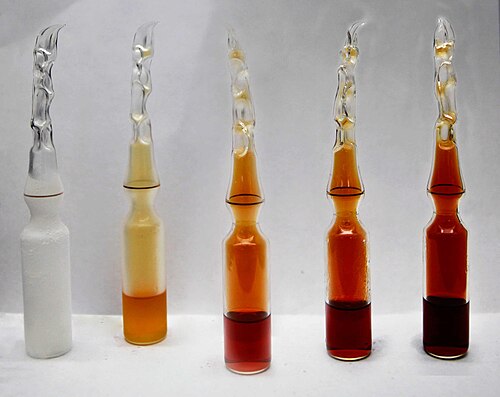
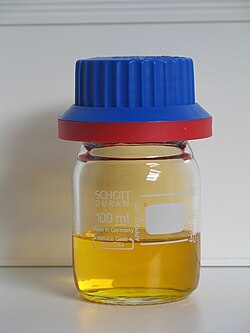
Nitrogen also forms various oxoacids, such as nitric acid (HNO3). Concentrated nitric acid can appear yellow if it is contaminated with nitrogen dioxide.
The chemical behavior of these oxides and acids can be understood through their standard reduction potentials, which measure the tendency of a species to gain electrons.
![Standard reduction potentials for nitrogen-containing species. Top diagram shows potentials at pH 0; bottom diagram shows potentials at pH 14.[57]](/images/9d/95/9d958213030f3ad65379dd2229fda408bf8a68ce8f244fc87a0a5cf8340a7550.webp)
Explosive Halides
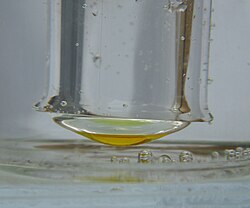
When nitrogen reacts with halogens, it can create highly unstable and explosive compounds. Nitrogen trichloride (NCl3) is a volatile, explosive liquid. Other examples include nitrogen tribromide and nitrogen triiodide, the latter of which is so sensitive that it can be detonated by the touch of a feather.
Dinitrogen Complexes
In advanced inorganic chemistry, nitrogen can form complexes with transition metals. The first dinitrogen complex discovered was [Ru(NH3)5(N2)]2+.
![Structure of [Ru(NH3)5(N2)]2+ (pentaamine(dinitrogen)ruthenium(II)), the first dinitrogen complex to be discovered](/images/46/2a/462abff181ffa734a1b6f4a52af8372cb5e7e4e2bc0256f267d9778e288ebc88.png)
Natural Occurrence and Industrial Importance
While nitrogen is abundant in the atmosphere, it is relatively scarce in the Earth's crust. In nature, nitrogen moves through the environment via the nitrogen cycle, involving biological processes and atmospheric reactions.
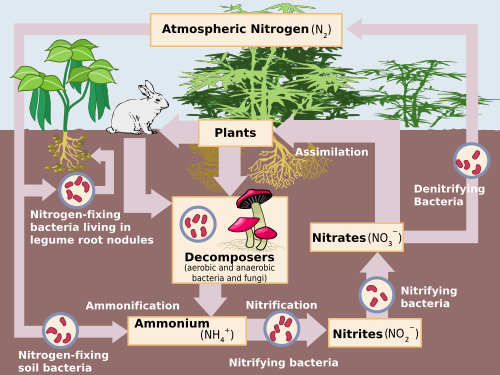
Historically, nitrogen compounds were limited to biological sources or natural nitrate deposits. However, the development of the Haber–Bosch process revolutionized the world by allowing the industrial fixation of nitrogen. This process enables the mass production of synthetic nitrogen fertilizers, which currently support approximately half of the global food production.
Safety and Liquid Nitrogen
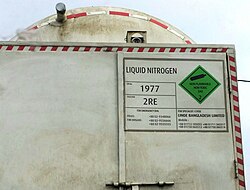
Liquid nitrogen is a common cryogen (a substance used to produce very low temperatures) used in various scientific and industrial applications. However, it must be handled with extreme care. Because liquid nitrogen expands by a ratio of 1:694 when it vaporizes into a gas at 20 °C, it can cause catastrophic pressure buildup if contained in a sealed space.
Summary of Physical Properties of Nitrogen (N2)
| Property | Value |
|---|---|
| Atomic Weight (Standard) | 14.007 ± 0.001 u |
| Melting Point | 63.23 K (−209.92 °C) |
| Boiling Point | 77.355 K (−195.795 °C) |
| Density (Gas at 0 °C, 1013 mbar) | 1.2506 g/L |
| Density (Liquid at boiling point) | 0.808 g/cm³ |
Frequently Asked Questions
What is the most common isotope of nitrogen?
The most common isotope is Nitrogen-14 (14N), which makes up approximately 99.6% of all natural nitrogen.
Why is nitrogen gas so unreactive at room temperature?
Nitrogen gas (N2) is unreactive because the two nitrogen atoms are held together by an extremely strong triple bond, which requires a massive amount of energy to break.
How much nitrogen is in the Earth's atmosphere?
Nitrogen makes up about 78.1% of the volume of the Earth's atmosphere.
What is the main use of the Haber–Bosch process?
The Haber–Bosch process is used to industrially fix nitrogen to produce ammonia, which is the primary ingredient in synthetic fertilizers used for global food production.
Is liquid nitrogen dangerous?
Yes, it must be handled carefully. It is a powerful cryogen, and because it expands significantly (1:694 ratio) when turning from a liquid to a gas, it can cause explosions if it vaporizes inside a sealed container.