Meridians in Astronomy: Mapping the Celestial Sphere
In the study of the stars, navigating the vast expanse of the sky requires a reliable frame of reference. One of the most critical tools for this is the meridian, a great circle on the celestial sphere that allows astronomers to determine the position and timing of celestial objects relative to a specific location on Earth.
At its most basic level, the celestial meridian is the great circle that passes through the celestial poles, as well as the observer's zenith (the point directly overhead) and nadir (the point directly below the observer). Because of this alignment, the meridian is perpendicular to both the horizon and the celestial equator, effectively slicing the sky into eastern and western halves.
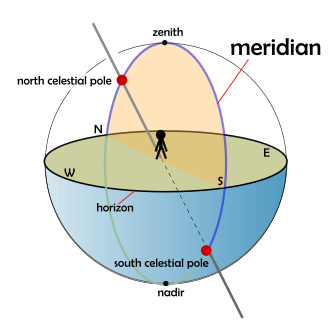
The Geometry of Meridians
Meridians are defined by a pencil of planes—a collection of planes that all intersect along a single line—passing through the Earth's rotation axis. For any location not situated directly on the axis, there is a unique meridian plane. This single plane creates two distinct intersections:
- Geographical Meridians: The intersection of the plane with the Earth's surface, resulting in two meridians (typically one east and one west of the prime meridian, or the prime meridian and its anti-meridian).
- Celestial Meridian: The intersection of the plane with the celestial sphere, which defines the meridian for that specific location and time.
Dividing the Meridian
Depending on the astronomical method being used, the meridian can be divided into semicircles in different ways:
The Polar Approach
In one system, the meridian is split into an upper meridian and a lower meridian. The upper meridian extends from one celestial pole, passes through the zenith, and reaches the opposite pole. Conversely, the lower meridian passes through the nadir to connect the two poles.
The Horizontal Coordinate System
In the horizontal coordinate system, the division is based on the observer's horizon. The local meridian is the semicircle containing the zenith and the north and south points of the horizon. The opposite semicircle contains the nadir and the north and south points of the horizon.
Culmination and Transit
Because the meridian is fixed to the local horizon, celestial objects appear to drift across it as the Earth rotates. This movement is known as transit. When a celestial object crosses the upper meridian, it reaches its culmination, which is the highest point the object will reach in the sky during that sidereal day.
Astronomers can calculate the exact time of culmination by using the object's right ascension (the celestial equivalent of longitude) and the local sidereal time (a time scale based on the Earth's rotation relative to fixed stars).
Key Facts
- The term "meridian" is derived from the Latin meridies, meaning "midday" or "south".
- The celestial meridian is always perpendicular to the celestial equator and the observer's horizon.
- Culmination occurs when an object intersects the upper meridian.
- The meridian plane is determined by the Earth's axis of rotation.
| Term | Definition | Relationship to Meridian |
|---|---|---|
| Zenith | Point directly above the observer | Contained in the upper meridian |
| Nadir | Point directly below the observer | Contained in the lower meridian |
| Celestial Poles | Points where Earth's axis intersects the celestial sphere | The meridian passes through both poles |
| Culmination | The highest point of an object's path | Occurs at the intersection with the upper meridian |
Frequently Asked Questions
What is the difference between a geographical and a celestial meridian?
A geographical meridian is the intersection of the meridian plane with the Earth's physical surface, while a celestial meridian is the intersection of that same plane with the imaginary celestial sphere surrounding Earth.
Why is the meridian associated with the word "south"?
The etymology comes from the Latin meridies. In the Northern Hemisphere, the celestial equator appears to tilt southward, linking the concept of midday (when the sun is highest) with the southern direction.
What happens during an object's culmination?
Culmination occurs when a celestial object transits the observer's upper meridian, marking the moment the object reaches its maximum altitude in the sky for that day.
How is the time of culmination determined?
The time of culmination is determined by comparing the object's right ascension with the local sidereal time, often expressed through the hour angle.