Mendoza Province: Argentina's Hub of Wine and Andean Majesty
Located in the west-central part of Argentina within the Cuyo region, the Province of Mendoza is a land of dramatic contrasts. From the towering peaks of the Andes to the sprawling vineyards of its fertile valleys, Mendoza serves as a vital economic and cultural pillar for the nation. Bordering Chile to the west, San Juan to the north, and La Pampa, Neuquén, and San Luis to the south and east, it is a region defined by its rugged geography and resilient spirit.
Covering 148,827 square kilometers, Mendoza is the seventh largest province in Argentina. With a population of over 2 million people as of the 2022 census, it ranks as the fifth most populated region, blending urban sophistication in its capital city with the rustic charm of its agricultural heartlands.
Key Facts
- Highest Point: Aconcagua, the highest mountain in the Americas (6,959 meters).
- Economic Engine: Produces 70% of Argentina's total wine production.
- Human Development: Boasts a very high HDI of 0.848 (ranked 6th in Argentina).
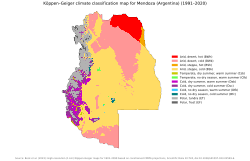
- Climate: Continental, characterized by sunny, dry conditions and significant temperature swings.
- Administrative Structure: Divided into 18 departments and 205 districts.
A Journey Through History
Pre-Columbian and Colonial Eras
Human presence in Mendoza dates back to the Holocene, with sites like Agua de la Cueva and Gruta del Indio estimating occupation between 12,000 and 13,000 years ago. By 300 BC, the Atuel River basins were home to early farmers cultivating maize, pumpkins, and beans, leading to the rise of the Agrelo culture—the ancestors of the Huarpes. This region later came under the influence of the Inca Empire in the 15th century.
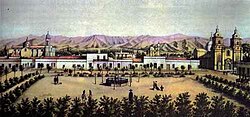
Spanish colonization began around 1550, and the city of Mendoza was officially founded by Pedro del Castillo in 1561. For two centuries, the area was part of the Captaincy General of Chile before transitioning to the Viceroyalty of the Río de la Plata in 1776.
The Path to Independence and Growth
Mendoza played a pivotal role in South American liberation. In 1813, José de San Martín became the first Governor of the Province of Cuyo. He utilized Mendoza as a strategic base to organize the Army of the Andes, which crossed the mountains in 1817 to end Spanish rule in Chile.
The 19th century brought both devastation and progress. A massive earthquake in 1861 nearly leveled the capital city, necessitating a total reconstruction. However, the arrival of the railway in 1885 revolutionized the local economy by connecting Mendoza's burgeoning wine industry to the trade hub of Buenos Aires.
Modern Political Evolution
The 20th century was marked by political volatility, shifting between conservative Democratic Party influence and Peronist policies. The province saw periods of repression under Governor Francisco Gabrielli in the early 1970s and later navigated the return to democracy in 1983. In recent decades, Mendoza has maintained a streak of political independence, often electing centrist Radical Civic Union (UCR) or Justicialist Party representatives.

Geography and Climate
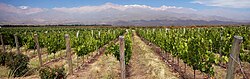
Mendoza's landscape is a descending gradient from the 6,960.8-meter summit of Aconcagua to the semi-flat eastern plains. The region is carved by longitudinal valleys and fed by several critical rivers, including the Mendoza, Tunuyán, Diamante, and Atuel rivers.
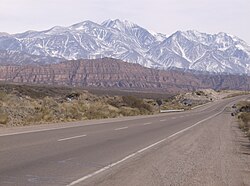
The climate is continental—sunny and arid with warm summers and cold winters. Annual precipitation is low (150mm to 350mm), making the soil naturally dry. This aridity, combined with the temperature variance between day and night, creates an ideal environment for xerophytes (plants adapted to dry conditions) and world-class viticulture, though hail remains a constant threat to the crops.
Regional Variations
- Lowlands: Experience hot summers (up to 33°C) and cool winters. The region is influenced by the Zonda (a warm downslope wind) and the Pampero (a cold wind).
- Highlands (Malargüe): Located at 1,400 meters, this area is significantly colder, with winter temperatures often dropping to -12°C and frequent snowfall.
- Andean Slopes: Precipitation increases toward the Chilean border, with winter snow providing excellent conditions for skiing at resorts like Las Leñas.
Economic Profile
While globally famed for its wine, Mendoza possesses a diversified economy. It is the fifth largest economy in Argentina, with significant contributions from several sectors:
Viticulture and Agriculture
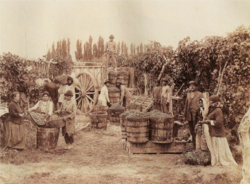
Mendoza is the heart of Argentine wine, with 1,200 wineries producing the vast majority of the nation's output. Beyond grapes, the province produces apples, pears, olives, and cherries. Apiculture is also a growing industry, supported by the dry climate.
Mining and Manufacturing
Mining is a powerhouse for the province, accounting for 22% of output as of 2005. Mendoza holds 14% of Argentina's petroleum reserves and is a major source of uranium and lime. Manufacturing, including cement and canned fruits, further stabilizes the economy.
Tourism and Services
Tourism has surged since the 2002 peso devaluation. Visitors are drawn to enotourism (wine tourism), the Aconcagua mountain, and the Atuel Canyon. The annual Fiesta de la Vendimia (Grape Harvest Festival) in late February or early March is a major cultural draw.
| Category | Detail |
|---|---|
| Total Area | 148,827 km² |
| Population (2022) | 2,014,533 |
| GDP (2019) | 571 billion pesos (US$12.2 billion) |
| HDI (2021) | 0.848 (Very High) |
| Key Industry | Viticulture (70% of national wine) |
Government and Administration
The provincial government operates under three branches: executive (led by the Governor), legislative (a bicameral body of Deputies and Senators), and judiciary (headed by the Supreme Court). The province is administratively divided into 18 departments, each managed by an elected mayor (intendente) and a deliberative body.
Frequently Asked Questions
What is the significance of Aconcagua in Mendoza?
Aconcagua is the highest mountain in the Americas, reaching an elevation of 6,959 meters. It is a primary geographical landmark and a major attraction for mountaineers and tourists.
Why is Mendoza so famous for wine?
The combination of a sunny, dry continental climate, significant temperature differences between day and night, and fertile river basins makes it ideal for grape cultivation. It produces 70% of Argentina's wine.
What is the Zonda wind?
The Zonda is a warm, dry wind that blows downslope from the Andes, capable of causing temperatures to soar rapidly to 30°C.
How is the province administratively organized?
Mendoza is divided into 18 departments, which are further subdivided into 205 districts. Each department is led by a mayor elected every four years.
What are the main tourist attractions besides wineries?
Key attractions include the Las Leñas ski center, the Atuel Canyon, Puente del Inca, and the Christ the Redeemer of the Andes statue on the border with Chile.