Memphis Massacre of 1866: Racial Violence and the Path to Radical Reconstruction
The Memphis Massacre of 1866 was a series of violent events that unfolded from May 1 to May 3, 1866, in Memphis, Tennessee. Occurring during the early stages of Reconstruction—the period following the American Civil War dedicated to reintegrating the Southern states and defining the legal status of formerly enslaved people—the massacre was ignited by deep-seated political and social racism.
The violence began after a shooting altercation between white police officers and black veterans who had recently been mustered out of the Union Army. This spark triggered a rampage by mobs of white residents and police officers through black neighborhoods, resulting in widespread killing, robbery, and arson targeting both black soldiers and civilians.
Key Facts
- Date: May 1–3, 1866.
- Casualties: 46 black people and 2 white people were killed; 75 black people were injured.
- Property Damage: 91 homes, 4 churches, and 8 schools were burned, with losses estimated at over $100,000.
- Perpetrators: Mobs consisting of white residents, police officers (24% of the mob), and firefighters (10% of the mob).
- Political Impact: The violence helped shift U.S. policy from Presidential Reconstruction to Radical Reconstruction.
The Social Climate of Memphis
Between 1860 and 1865, Memphis experienced a dramatic demographic shift. The black population grew from 3,000 to nearly 20,000 as escaped and freed slaves migrated to the city. This rapid growth occurred alongside a significant increase in the Irish immigrant population, which rose to 23% of the city's residents by 1860.
Tensions were high as Irish immigrants, who had faced their own discrimination, began to occupy most positions in the police force and city government. These groups often competed for lower-class jobs, fueling animosity. Furthermore, municipal politics were plagued by corruption, and the local press, specifically The Daily Avalanche, exacerbated racial tensions and opposed federal Reconstruction efforts.
The Outbreak of Violence
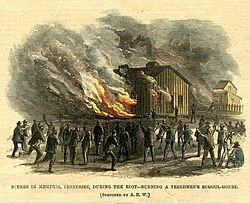
The massacre was characterized by organized brutality. On May 2, the violence intensified as mobs—including small business owners, clerks, and city officials—invaded black communities. Some organizers, such as John Pendergast and his sons, reportedly used their grocery store as a base of operations for the attacks.
Under the pretext of searching for arms, mobs entered homes to beat, rob, and rape inhabitants. The violence was indiscriminate, targeting people regardless of age or sex. Federal troops were eventually sent to quell the riots, and peace was restored by the third day.
Casualties and Economic Loss
The human and material cost of the massacre was devastating. A joint Congressional Committee report detailed the carnage, noting that the black community bore the brunt of the violence. Beyond the deaths and injuries, five black women reported being raped. The destruction of every black church and school in the community aimed to dismantle the social and educational infrastructure of the freedmen.
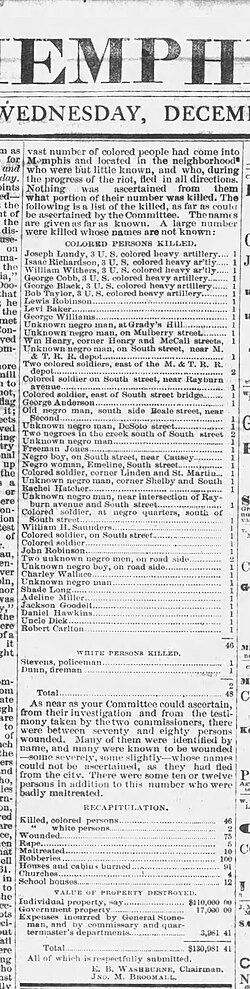
| Category | Impact/Losses |
|---|---|
| Deaths | 48 (46 Black, 2 White) |
| Injuries | 76 (mostly Black) |
| Homes Destroyed | 91 |
| Institutions Burned | 4 Churches, 8-12 Schools |
| Estimated Property Loss | Over $100,000 |
Political Aftermath and Legal Legacy
The Memphis massacre, along with the New Orleans massacre in July 1866, had profound national political consequences. The events discredited President Andrew Johnson's lenient program of Presidential Reconstruction. In response, the Radical Republicans gained a veto-proof majority in the 1866 congressional elections.
This political shift led to the passage of the Reconstruction Acts, the Enforcement Acts, and the Fourteenth Amendment. The Fourteenth Amendment was a landmark piece of legislation that guaranteed citizenship, equal protection of the laws, and due process to former slaves, providing the legal framework for full citizenship rights.
Long-term Impact on Memphis
The hostile environment following the massacre led to a mass exodus of black residents. By 1870, the black population of Memphis had declined by one-quarter compared to 1865, falling to approximately 15,000. Despite this, the community continued to resist; dock workers struck for higher wages in May 1866, and the Sons of Ham fraternal organization demonstrated for black suffrage.
Frequently Asked Questions
What triggered the Memphis Massacre of 1866?
The violence was sparked by a shooting altercation between white police officers and black Union Army veterans who had recently been discharged from service.
Who were the primary perpetrators of the violence?
The mobs consisted of white residents, including a significant number of police officers (24%) and firefighters (10%), as well as small business owners, clerks, and city officials.
How did the massacre affect the black population of Memphis?
Beyond the immediate deaths and injuries, the massacre caused a significant population decline. By 1870, the black population had decreased by 25% as many fled the city permanently.
What was the national political result of the massacre?
The massacre increased support for Radical Reconstruction, leading to the rejection of President Andrew Johnson's policies and the eventual passage of the Fourteenth Amendment to the U.S. Constitution.
What role did the Freedmen's Bureau play?
The Freedmen's Bureau investigated the causes and results of the riots and continued to struggle to protect the remaining black residents in the hostile environment of Memphis.