Homer Plessy and the Legal Battle Against Segregation
Homer Plessy was an American shoemaker and activist whose courage sparked one of the most consequential legal battles in United States history. By intentionally challenging the racial segregation laws of Louisiana, Plessy sought to force the U.S. Supreme Court to rule on the constitutionality of state-mandated separation. While his immediate legal effort failed, his actions highlighted the systemic injustice of the era and set the stage for the civil rights movements of the 20th century.
Key Facts
- Plaintiff: Homer Plessy, a free person of color and shoemaker from New Orleans.
- The Act: Staged an act of civil disobedience by sitting in a "whites only" train car on June 7, 1892.
- The Law: Challenged Louisiana's Separate Car Act.
- The Ruling: The Supreme Court ruled 7–1 against Plessy in 1896.
- The Doctrine: Established the "separate but equal" legal precedent.
- Overturn: The precedent remained until Brown v. Board of Education in 1954.
Early Life and Historical Context
Born into a French-speaking Louisiana Creole family, Homer Plessy (born Homère Patris Plessy) grew up in New Orleans during the Reconstruction era. His family background was diverse; his father was a carpenter and his mother a seamstress, both mixed-race free people of color. His paternal grandfather was a white Frenchman who had fled the Haitian Revolution.
During Plessy's youth, Louisiana experienced a brief period of expanded civil rights where black men could vote, interracial marriage was legal, and schools were integrated. However, these gains began to erode after 1877, when U.S. federal troops were withdrawn from the former Confederate States, allowing white Democrats to regain power and defund education for black citizens.
Plessy was a skilled tradesman, working as a shoemaker in the French Quarter. Beyond his profession, he was deeply engaged in his community as a Freemason and a leader in the Justice, Protective, Educational, and Social Club, which advocated for the reform of public education in New Orleans.
The Orchestration of a Test Case
In the 1890s, the Comité des Citoyens (Citizens' Committee), a civil rights group, sought to challenge the Separate Car Act, which mandated separate railroad accommodations for black and white passengers. The group meticulously planned a test case to bring the issue before the courts.
After an initial attempt with another plaintiff, Daniel Desdunes, failed to reach the Supreme Court, the committee recruited Plessy. On June 7, 1892, Plessy purchased a first-class ticket and boarded a "whites only" coach on the East Louisiana Railroad. When the conductor ordered him to leave, Plessy refused, leading to his forcible removal and arrest by Detective Chris C. Cain.
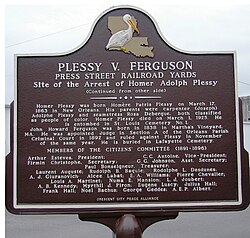
The Legal Journey: Plessy v. Ferguson
The case first went to a state criminal district court, where Judge John Howard Ferguson ruled against Plessy, asserting that Louisiana had the right to regulate railroads within its borders. This decision was unanimously upheld by the Louisiana Supreme Court in December 1892.
The Supreme Court Appeal
Plessy's legal team, led by Albion Tourgée, appealed to the U.S. Supreme Court. Tourgée argued that segregation violated the Thirteenth Amendment (which abolished slavery) and the Fourteenth Amendment, specifically the Equal Protection Clause. He contended that forced segregation inherently branded black citizens as inferior, creating a second-class status.
In 1896, the Supreme Court ruled 7–1 in favor of Louisiana. The Court established the "separate but equal" doctrine, claiming that segregation did not violate the Constitution as long as the facilities provided for both races were putatively equal. This ruling provided the legal justification for the Jim Crow laws that enforced racial segregation across the South for decades.
Later Life and Lasting Legacy
Following the trial, Plessy continued to live in New Orleans. As industrial production caused the decline of the traditional shoemaking trade, he worked various jobs as a clerk, warehouseman, and insurance premium collector for the black-owned People's Life Insurance Company.
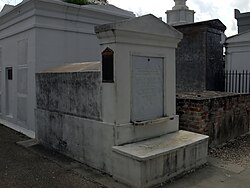
Homer Plessy died on March 1, 1925. He was interred in the Debergue-Blanco family tomb in Saint Louis Cemetery No. 1.
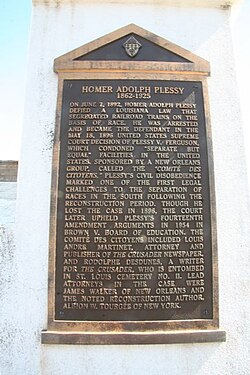
Though he lost his case, Plessy's defiance became a symbol of the struggle for equality. The "separate but equal" doctrine remained the law of the land until 1954, when the landmark decision in Brown v. Board of Education finally declared that separate educational facilities are inherently unequal.
| Detail | Information |
|---|---|
| Plaintiff | Homer Plessy |
| Year of Arrest | 1892 |
| Year of SCOTUS Ruling | 1896 |
| Legal Outcome | 7–1 decision against Plessy |
| Key Legal Doctrine | Separate but Equal |
| Overturning Case | Brown v. Board of Education (1954) |
Frequently Asked Questions
What was the purpose of Homer Plessy's arrest?
Plessy's arrest was a staged act of civil disobedience. He and the Comité des Citoyens intentionally violated the Separate Car Act to create a test case that would force the U.S. Supreme Court to rule on whether segregation laws were constitutional.
What does "separate but equal" mean?
It was a legal doctrine established by the Supreme Court in Plessy v. Ferguson, stating that racial segregation did not violate the Fourteenth Amendment as long as the facilities provided for both black and white people were equal in quality.
How did Plessy's background influence his activism?
Plessy was born a free person of color in a Creole family. Having grown up during the Reconstruction era—a time of temporary gains in voting rights and integrated schooling—he witnessed the erosion of those rights, which motivated his political involvement.
When was the Plessy v. Ferguson decision finally overturned?
The legal precedent set by Plessy v. Ferguson lasted until 1954, when the Supreme Court ruled in Brown v. Board of Education that segregation in public schools was unconstitutional.
What happened to Homer Plessy after the trial?
Plessy returned to New Orleans and worked various jobs, including as a laborer and an insurance premium collector, until his death in 1925.