Megachile rotundata: The Alfalfa Leafcutting Bee as a Pollination Powerhouse
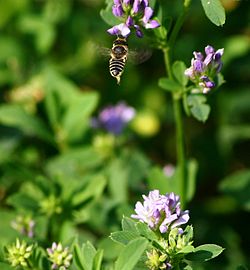
The Megachile rotundata, commonly known as the alfalfa leafcutting bee, is a European bee species renowned for its exceptional efficiency as a pollinator. Unlike the more famous honey bee, M. rotundata is a solitary bee, meaning it does not build colonies or store honey. Instead, each female operates independently, constructing her own nest and providing for her offspring.
Due to their effectiveness in pollinating alfalfa, carrots, and various other fruits and vegetables, these bees are widely utilized by farmers as pollination aids. By distributing prepupae—the dormant stage before pupation—around crops, agriculturalists can significantly boost seed production.
Key Facts
- Nature: Solitary bee (no colonies or honey storage).
- Primary Use: Commercial pollination of alfalfa (Medicago sativa) and other legumes.
- Nesting Habit: Lines nests with circular disks cut from plant leaves.
- Distribution: Found on all continents except Antarctica.
- Behavior: Generally non-aggressive; sting is roughly half as painful as a honey bee's.
Taxonomy and Physical Characteristics
Megachile rotundata belongs to the family Megachilidae and the subfamily Megachilinae, the second-largest bee family. It is part of the genus Megachile, a group characterized by the habit of cutting leaf pieces to line their nests.
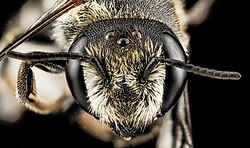
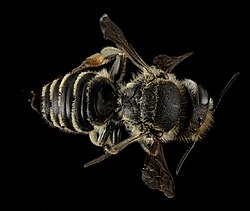
These bees are small, measuring between 6 and 9 mm in length, and are dark grey in color. They exhibit sexual dimorphism, where males and females differ in appearance. Females are larger and covered in white hairs, including on their scopae (specialized pollen-carrying hairs). Males are smaller and feature distinct white and yellow spots on their abdomens.
Distribution and Habitat
Originally from Europe, M. rotundata has been introduced globally to support agriculture. In North America, they were imported in the 1940s and have since become widespread and feral. They were also introduced to New Zealand in 1971 and Australia in 1987 specifically to assist in the pollination of lucerne (alfalfa).
The Art of Nest Construction
The name "leafcutter" comes from the female's use of her mandibles to cut circular disks from leaves. She uses approximately 15 leaves to create a concave bottom and overlapping walls, forming a thimble-shaped cell.
Inside these cells, the female stores a mixture of nectar and pollen. She regurgitates nectar first, then adds pollen from her scopa, maintaining a 2:1 nectar-to-pollen ratio. Completing a single cell requires 15 to 20 foraging trips. Once the egg is laid, the cell is sealed with more leaf pieces.
Nest Dimensions and Sex Ratios
The female strategically manages the sex of her offspring based on cell position and size. Female eggs are typically placed in inner cells, while male eggs are placed in outer cells. Larger provisions generally correlate with female offspring. Additionally, the diameter of the nesting tunnel influences the sex ratio; for instance, a 5.5 mm tunnel often results in a 3:1 male-to-female ratio, whereas a 6.0 mm tunnel results in a 2:1 ratio.
Life Cycle and Development
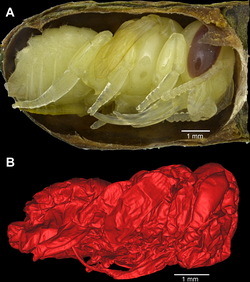
M. rotundata is haplodiploid (a system of sex determination where males develop from unfertilized eggs) and partially bivoltine, meaning they can produce two generations per year under optimal conditions.
- Larval Stage: The larva passes through four instar stages, consuming the pollen ball.
- Diapause: After consuming the provisions, the larva spins a silk cocoon and enters diapause (a period of suspended development).
- Pupation: In the spring, the larva pupates for 3 to 4 weeks.
- Emergence: The adult bee chews through the cocoon and the nest wall to emerge.
Mating and Chemical Communication
Females attract males using sexual pheromones released from epicuticular waxes. These pheromones consist primarily of alkenes. The composition of these chemicals changes with age: young females produce higher concentrations of 7-pentacosene or 9-pentacosene, while older females produce 5-monoene compounds. Males can detect these differences and preferentially mate with younger females.
Diet, Predators, and Disease
While they can feed on various plants, their preference is Medicago sativa. They use a proboscis to reach nectar, brushing pollen onto their scopae in the process.
Predators and Parasites
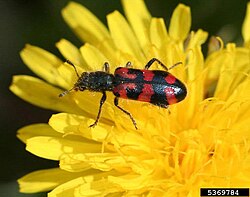
The species faces threats from 28 known predator species. Trichodes ornatus is particularly formidable, as its larvae kill host bee larvae and consume their provisions. Parasitoid wasps, such as Pteromalus venustus, paralyze larvae or pupae to lay their own eggs on the host's surface.
Health Challenges
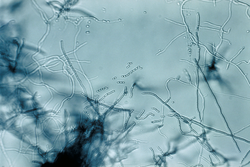
A significant disease is chalkbrood, caused by the fungus Ascosphaera aggregata. This fungus is introduced via contaminated pollen and nectar, causing larvae to develop a milky appearance and fungal cysts under the cuticle.
Agricultural Importance and Management
Farmers manage M. rotundata by keeping prepupae at a constant 7 °C (45 °F) to maintain dormancy. When the crop blooms, they are moved to an incubator at 27 °C (81 °F), and adults typically emerge after 25 days.
| Target Plant Species | Common Name | Management State |
|---|---|---|
| Medicago sativa | Alfalfa | Prepupal (Dormant) |
| Brassica napus | Rapeseed/Canola | Prepupal (Dormant) |
| Trifolium spp. | Clovers | Prepupal (Dormant) |
| Vaccinium angustifolium | Wild Blueberry | Prepupal (Dormant) |
Frequently Asked Questions
Do alfalfa leafcutting bees live in hives?
No, they are solitary bees. Each female builds her own nest in old trees or log tunnels and does not cooperate with other bees or store honey.
Are these bees dangerous to humans?
They are generally not dangerous. While they can bite or sting if threatened or harmed, they are not aggressive, and their sting is described as being half as painful as that of a honey bee.
How do they differ from honey bees in agricultural use?
Unlike honey bees, which are managed in colonies, M. rotundata are often supplied to farmers in a dormant prepupal state and are highly specialized for pollinating legumes like alfalfa.
What is the purpose of the leaf-cutting behavior?
The bees cut circular disks from leaves to line the walls of their nesting cells, creating a protective, thimble-shaped environment for their eggs and food provisions.
How does the sex of the offspring be determined?
The female controls the sex ratio based on the size of the cell provisions and the position of the cell in the nest, with larger inner cells typically producing females.