Understanding Andrena: The Diverse World of Mining Bees
In the vast world of pollinators, few groups are as prolific or widespread as the genus Andrena. Commonly known as mining bees, these insects represent one of the largest genera in the animal kingdom, comprising over 1,500 species. From their ancient origins in the Late Oligocene to their current global presence, mining bees play a critical role in various ecosystems through their specialized pollination habits.
Unlike the more famous honeybees, Andrena are primarily solitary creatures. They are organized into 104 subgenera, forming a strongly monophyletic group—meaning they all share a single common ancestor—which makes them a fascinating subject for entomologists studying evolution and biodiversity.
Key Facts
- Common Name: Mining bees.
- Species Count: Over 1,500 species across 104 subgenera.
- Nesting Habit: Solitary, ground-nesting bees.
- Distribution: Found worldwide, excluding South America and Oceania.
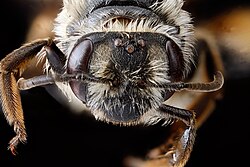
- Defining Feature: Presence of a subgenal coronet (a ring of hairs on the underside of the face).
- Temporal Range: Existing from the Late Oligocene to the present day.
Physical Characteristics and Identification
Mining bees are generally medium-sized, with body lengths typically ranging between 8 and 17 mm. Within the genus, males are usually smaller and more slender than females. Most species exhibit a black body adorned with white to tan hair, and their wings typically feature either two or three submarginal cells.
To transport pollen, Andrena use femoral scopal hairs (specialized pollen-carrying hairs on the legs). Some species also possess a propodeal corbicula, which allows them to carry additional pollen on their thorax.
Identifying Andrena requires looking for specific anatomical markers. They possess facial foveae, which are broad, velvety areas located between the antennal bases and the compound eyes. While other bees in the Andrenidae family may have foveae, the most distinct identifying feature unique to the Andrena genus is the subgenal coronet, a specialized ring of hairs found on the underside of the face.
Life History and Nesting Behavior
The name "mining bee" stems from their ground-nesting lifestyle. These solitary bees show a strong preference for sandy soils. While they are not social or parasitic, some species may nest in aggregations or communally.
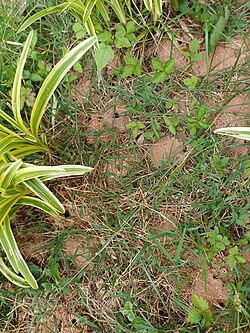
The nesting process is a meticulous operation. After mating, the female excavates a burrow containing a series of small chambers known as cells. She lines these cells with a shiny secretion and provisions each one with a firm, round mass of nectar and pollen to nourish the developing larvae. A byproduct of this excavation is the tumulus, a small mound of soil that forms around the nest entrance.
The life cycle of the mining bee is typically annual. Larvae do not spin cocoons and instead overwinter as adults. Once they emerge, the adults are active for only a few weeks each year. However, their nests are often targeted by predators and parasites, including blister beetles, parasitic flies, Strepsiptera, and brood parasitic bees.
Dietary Specialization and Evolution
Many Andrena species are oligolectic, meaning they are host-plant specialists that visit only one or a few closely related plant species. This specialization often leads to morphological adaptations. For instance, bees in the subgenus Callandrena specialize in pollen from the Asteraceae family and have evolved highly branched, fluffy scopal hairs specifically designed to hold aster pollen.
Research suggests that oligolecty was the basal (original) trait for the genus, and that generalist diets evolved multiple times later in their evolutionary history.
Global Distribution
Mining bees are most prevalent in the temperate regions of North America, Asia, and Europe, with the highest diversity found in Mediterranean climates. While a small number of species exist in sub-Saharan Africa, they are entirely absent from South America, Madagascar, Australia, and nearby islands.
Summary of Andrena Classification and Traits
| Category | Details |
|---|---|
| Scientific Classification | Family: Andrenidae; Subfamily: Andreninae |
| Type Species | Apis helvola (Linnaeus, 1758) |
| Body Length | 8 mm to 17 mm |
| Nesting Type | Solitary, ground-nesting (sandy soils) |
| Geographic Range | Global (except South America and Oceania) |
| Key Identifier | Subgenal coronet and facial foveae |
Frequently Asked Questions
What makes a bee a "mining bee"?
Bees in the genus Andrena are called mining bees because they are solitary insects that dig burrows into the ground, typically in sandy soil, to create nests for their larvae.
How can you tell an Andrena bee apart from other bees?
The most reliable unique identifier is the subgenal coronet, which is a ring of hairs on the underside of the face. They also feature facial foveae (velvety areas between the eyes and antennae), though these can appear in other genera within the Andrenidae family.
Do mining bees live in colonies?
No, Andrena are solitary bees. While some may nest in aggregations (groups of nests close together) or communally, they do not have the complex social structures or castes found in honeybees.
What is oligolecty in mining bees?
Oligolecty is a dietary specialization where a bee species collects pollen from only one specific plant family or genus. This often results in physical adaptations, such as specialized hairs, to better collect that specific type of pollen.
Where in the world are mining bees NOT found?
Mining bees are distributed nearly worldwide, but they are not found in South America, Oceania (including Australia and nearby islands), or Madagascar.