The Rocky Mountain Columbine: A Guide to Aquilegia coerulea
High in the rugged peaks of the American West, one of the most striking wildflowers captures the essence of the alpine wilderness: the Rocky Mountain columbine (Aquilegia coerulea). Known for its elegant, nodding flowers and distinctive spurred petals, this perennial—a plant that lives for several years—is more than just a botanical wonder; it is a cultural icon of the Rocky Mountains.
Botanical Description
Aquilegia coerulea is a herbaceous plant characterized by flowering stems that reach between 15 and 80 centimeters in height. These plants typically live for four to six years, regrowing from a rootstock that may be simple or branched and is often covered in the bases of old petioles (the stalks that support the leaves).
The plant's basal leaves, which grow from the base, are shorter than the flowering stems, typically ranging from 9 to 37 centimeters. These leaves are usually biternate, meaning they are divided into three groups of three leaflets, though they can occasionally be trifoliate (three leaflets) or tripinnate (divided to three levels with 21 leaflets). The leaflets are thin and three-lobed, appearing glabrous (smooth and hairless) on the upper side, while the undersides may be glabrous or pubescent (covered in fine, minute hairs).
![Illustrated by O.V. Kirkton, 1909[57]](/images/fe/b6/feb6bbed2926fc6528242290f03064f689b28e7d63bd9b81b5a43b40ae37517c.png)
The flowers are the plant's most celebrated feature. Large and showy, they typically measure 5 to 10 centimeters in diameter, though some can reach 15 centimeters. The blooms open in sequence, starting from the top of the stem and moving downward. Each flower features five petals with long, tapered spurs—ranging from 2.5 to 7.2 centimeters—that curve slightly outward and end in a small knob.
While the petals are generally white or cream at the front, the sepals provide the vivid color. These flowers are scented, releasing more volatile molecules during the day to attract pollinators.
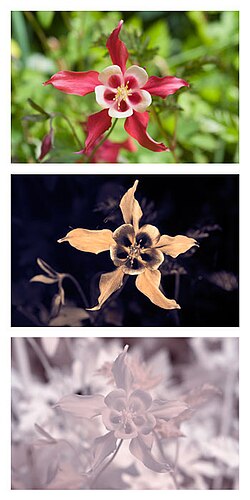
Varieties of the Rocky Mountain Columbine
The species Aquilegia coerulea is divided into several varieties, distinguished primarily by their color, size, and geographic range.
| Variety | Sepal Color | Typical Spur Length | Primary Range |
|---|---|---|---|
| var. alpina | Pale blue | Not specified | Wyoming |
| var. coerulea | Medium to deep blue | 3.4–4.8 cm | CO, NM, WY |
| var. ochroleuca | White, light blue, or pink | 3.6–5.4 cm | ID, MT, NV, UT, WY |
| var. pinetorum | White, pale blue, or pink | 4.5–7.2 cm | AZ, UT |
Aquilegia coerulea var. coerulea
This is the autonymic variety, most common in Colorado, New Mexico, and Wyoming at elevations between 2,100 and 3,500 meters. It is distinguished by its medium to deep blue sepals and is found in open woodlands, rocky slopes, and herb-dominated meadows.
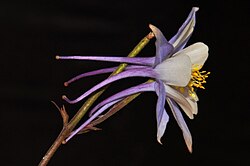
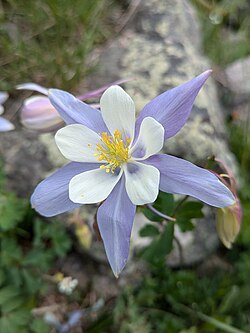
Aquilegia coerulea var. alpina
Known as the Colorado alpine columbine, this variety grows on open rocky slopes in Wyoming. It is characterized by smaller petal blades (1.3–1.7 cm) and pale blue sepals. It typically blooms from June to August.
Aquilegia coerulea var. ochroleuca
Commonly called the white Colorado columbine, this variety features lighter blue, white, or occasionally pink sepals. It has shorter stamens and spurs than var. pinetorum and is found across Idaho, Montana, Nevada, Utah, and Wyoming.
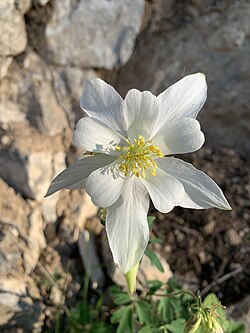
Aquilegia coerulea var. pinetorum
Found in Arizona and Utah, this variety is noted for having the longest petal spurs (up to 7.2 cm) and longer stamens. It often intergrades with the golden columbine (Aquilegia chrysantha) north of the Grand Canyon, making it difficult to distinguish in dried specimens.
Aquilegia coerulea var. daileyae
This variety is a spurless mutant of the species.
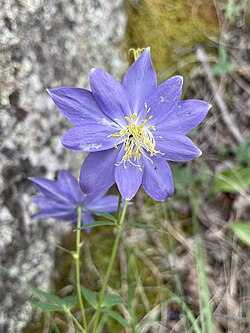
Range, Habitat, and Ecology
The Rocky Mountain columbine thrives in mountainous regions, ranging from lower elevations associated with the Rocky Mountain Douglas-fir to the alpine tundra above the timberline. Its natural range extends from 1,800 meters (var. pinetorum) up to 3,600 meters (var. coerulea).
The species prefers moist environments and is frequently found in quaking aspen groves, open coniferous forests, and clearings. While it can thrive on rocky outcrops when water is sufficient, it grows poorly in heavy soils that lack proper drainage.
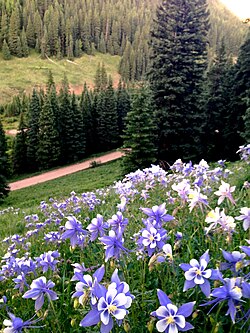
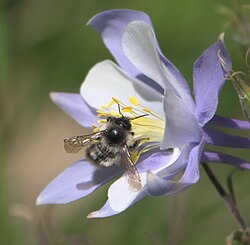
Ecologically, the plant relies on pollinators to ensure reproductive success. Bumblebees and other insects are frequently observed visiting the flowers to collect nectar.
Conservation Status
According to NatureServe, Aquilegia coerulea is considered globally secure (G5) because it is widespread. However, its status varies by region. It is rated as apparently secure (S4) in Colorado and Wyoming, but vulnerable (S3) in Montana and Nevada, and imperiled (S2) in Arizona.
Historically, some declines in population have been attributed to overgrazing by cattle and sheep.
Cultural Significance and Symbolism
The Colorado blue columbine holds a place of honor as the official state flower of Colorado, designated on April 4, 1899. The colors of the flower are said to represent the state's identity: blue for the skies, white for the snowy mountain ranges, and yellow for the gold that drew settlers to the region in 1858.
![Blue columbine painted by Mary Emily Eaton, 1917[26]](/images/ac/5d/ac5dd0cdcd3da794154ba85206aa99ad85771fb3d5f970a8ea90cd5523ce69c6.jpg)
Due to its importance, the plant is protected by law in Colorado. It is illegal to uproot the plants on public lands or to pick more than 25 flowers, buds, or stems in a single day.
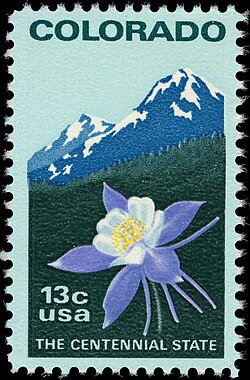
The flower's influence extends beyond botany. Two of the airplanes used by President Dwight D. Eisenhower were named Columbine II and Columbine III. Additionally, the species was once proposed as a candidate for the national flower of the United States before the rose was selected in 1986.
Cultivation and Gardening
For those looking to grow the Rocky Mountain columbine, seed treatment can significantly impact success. Treating seeds with gibberellic acid and planting them at 21°C (70°F) can result in a 93% germination rate within three weeks. Alternatively, seeds can be cold stratified at 4.5°C (40°F) to achieve roughly 40% germination.
In a garden setting, these plants typically last three to four years and are sometimes treated as biennials by gardeners. When seeding large areas, a rate of 112 ounces per acre is recommended.