The Elegant Siberian Iris (Iris sibirica): A Complete Guide
The Siberian iris, scientifically known as Iris sibirica and often referred to as the Siberian flag, is a stunning flowering plant prized for its graceful form and vivid colors. As a rhizomatous herbaceous perennial—meaning it grows from a creeping underground stem and is a non-woody plant that returns year after year—it brings a touch of wild elegance to both natural landscapes and curated gardens.
Key Facts
- Common Names: Siberian Iris, Siberian Flag.
- Flower Colors: Primarily violet-blue and blue, occasionally white.
- Hardiness: Extremely hardy, tolerant down to −20 °C (−4 °F) (USDA Zones 2–8).
- Native Range: Europe and Central Asia.
- Preferred Habitat: Damp woodlands, wet meadows, and grasslands.
- Chromosome Count: Typically diploid (2n=28), meaning it has two sets of chromosomes.
Botanical Description
Iris sibirica is often mistaken for Iris sanguinea, another blue Asian iris. However, they can be distinguished by their stems: I. sibirica features branched stems, whereas I. sanguinea has unbranched stems.
Foliage and Stems
The plant forms dense clumps via a creeping rhizome, which measures approximately 0.9–1.2 cm in diameter and is often covered in brown remnants of old leaves. Its leaves are green, ribbed, and grass-like, reaching lengths of 25–80 cm and widths of 0.4–0.6 cm. Some leaves may exhibit a pink tinge at the base. These leaves typically turn yellow in autumn and die back during winter, re-emerging in the spring.
The stems are hollow, slender, and can branch one to three times, growing up to 50–120 cm tall. Between May and June, these stems produce two to five flowers (most commonly three) at their terminal ends.
The Anatomy of the Flower
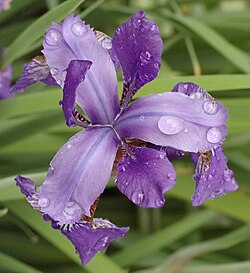
The flowers of the Siberian iris are approximately 6–7 cm in diameter and are protected by three brown, paper-like spathes (modified leaves that enclose the flower bud) that are reddish at the base.
The bloom consists of two pairs of petals:
- Falls: Three large, drooping outer sepals (5–7 cm long) featuring a wide white blade or "signal" with dark-blue to violet veining.
- Standards: Three smaller, narrow, upright inner petals (4.5–5 cm long).
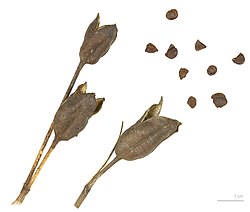
Following the bloom, the plant produces a roundly triangular seed capsule (3–4.5 cm long). Inside, the seeds are dark brown, thin, flat, and shaped like a capital 'D'.
Natural Distribution and Habitat
Iris sibirica has the widest distribution of any species in the Siberian iris series. It is native to temperate regions across Europe—including France, Germany, Poland, Ukraine, and northern Turkey—as well as Central Asia, including Siberia and the Caucasus regions of Armenia and Azerbaijan. It is also found in the Altai-Sayan region, where Russia, China, Mongolia, and Kazakhstan meet.
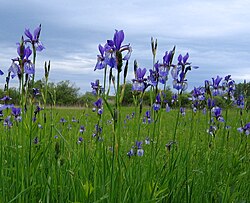
In its native environment, the plant thrives in damp woodlands, wet meadows, pastures, and reed swamps near lakes or streams, often benefiting from mountain snow-melt. It has also become naturalized in several North American states and provinces, including New York, California, and Ontario, where it is frequently found in damp roadside ditches.
Growing and Cultivating the Siberian Iris
Because of its resilience, the Siberian iris is a popular ornamental plant in temperate regions. It is highly hardy, surviving temperatures as low as −20 °C (−4 °F), and can withstand even colder temperatures if mulched during winter.
Soil and Light Requirements
For optimal growth, the iris should be planted in fertile, well-drained soil that is neutral to slightly acidic (pH above 5.6). In soils with high clay or sand content, adding organic matter like compost or well-rotted manure is recommended.
While the plant prefers full sun, it can tolerate partial shade. In very hot or arid climates, providing some shade, regular watering, and mulching is essential to prevent the plant from drying out. It requires significant moisture during the spring and early summer growing season; however, it should not be planted in standing water.
Garden Placement
Due to its love for moisture, Iris sibirica is an ideal choice for bog gardens or locations beside ponds and streams. Its sturdy nature means it does not require staking and works well in herbaceous borders or mixed with grasses to create a naturalized meadow look.
Propagation Methods
The most effective way to propagate the Siberian iris is through division, ideally performed from mid-summer to early autumn. Because the plant dislikes root disturbance, division should only occur when the center of the clump dies out. To prevent drying, divisions should be stored in water before transplanting.
Alternatively, the plant can be grown from seed. Mature pods should be allowed to dry on the plant before the seeds are collected and sown outdoors in the fall. Seedlings are susceptible to transplant shock, which can be mitigated by placing a small plastic pot over the new plant for 3–5 days.
In laboratory settings, the plant can also be propagated via somatic embryogenesis (a process of creating embryos from somatic cells).
Hybrids and Popular Cultivars
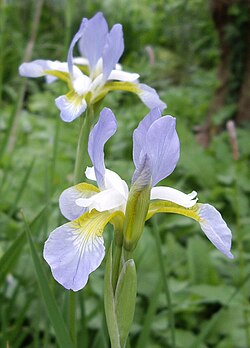
Since the 1970s, breeders have crossed Iris sibirica with other species in the Siberian group to create hundreds of hybrids. These cultivars vary in color from pure white to deep violet-blue. Some newer Japanese hybrids feature six pendant falls, resembling the Japanese Iris (Iris ensata).
Notable cultivars include:
- 'Summer Sky' and 'Heavenly Blue' (shades of blue).
- 'Butter and Sugar' (white top petals with yellow falls).
- 'Sultan’s Ruby' (deep magenta blooms).
- 'King of Kings' and 'Snow Queen' (white blossoms).
Toxicity and Traditional Uses
Caution is advised when handling or planting Iris sibirica. The rhizomes and leaves are poisonous if ingested, potentially causing vomiting and stomach pain. Contact with the plant may also cause skin irritation or allergic reactions in some individuals.
Despite its toxicity, the plant has several historical and traditional uses:
- Industrial: The Tara Tartars of Russia used the flowers to dye cloth yellow.
- Medicinal: It has been used to create emetics (substances that induce vomiting), laxatives, and expectorants. In China, an edible starch is extracted from the plant.
- Traditional: In Poland, cooked seeds were traditionally eaten by girls before their wedding night as a form of contraception.
Siberian Iris Summary
| Feature | Details |
|---|---|
| Plant Type | Rhizomatous herbaceous perennial |
| Flower Colors | Violet-blue, blue, white |
| Hardiness Zones | USDA 2–8 |
| Ideal Soil | Fertile, well-drained, pH > 5.6 |
| Bloom Time | May to June |
| Conservation Status | Vulnerable (Czech Republic, Hungary, Ukraine); Extinct in the Wild (Slovakia) |
Frequently Asked Questions
How do I tell the difference between a Siberian Iris and an Asian Iris?
The primary way to distinguish Iris sibirica from Iris sanguinea is by looking at the stems. Iris sibirica has branched stems, while Iris sanguinea has unbranched stems.
Can Siberian Irises grow in full shade?
While they can tolerate partial shade, they prefer full sun to produce the best blooms. In very hot regions, some shade is actually beneficial to protect the plant from extreme heat.
How often should I divide my Siberian Iris?
You should only divide the plant when the center of the clump dies out, as they do not like root disturbance. The best time for division is between mid-summer and early autumn.
Are Siberian Irises safe for pets and children?
No, most parts of the plant, specifically the rhizomes and leaves, are poisonous if ingested and can cause stomach distress. Additionally, the plant may cause skin irritation upon contact.
Do Siberian Irises need to be staked?
No, Iris sibirica is a sturdy plant and generally does not require staking to support its flowering stems.