Mediterranean Middle Ages: The Clash and Commerce of Islamic and Christian Worlds
The Middle Ages in the Mediterranean were defined by a volatile yet symbiotic relationship between rising Islamic powers and the established Christian empires. This era saw the collapse of old boundaries, the birth of legendary maritime republics, and a constant tension between religious warfare and the pragmatic necessity of trade.
The Rise of Islamic Power and Early Conquests
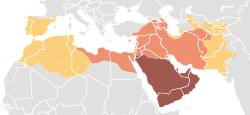
While the Eastern Roman (Byzantine) and Sassanid Persian empires were exhausted by centuries of stalemate warfare, a new force emerged from the east. Driven by the faith of Islam and led by the Caliphs and brilliant military strategists like Khalid ibn al-Walid, Arab armies launched a series of rapid conquests. These campaigns completely engulfed Persian lands and reduced Byzantine territories by more than half.
At its zenith, the Arab Empire controlled three-quarters of the Mediterranean coast, creating a vital economic bridge between the Indian Ocean and the Mediterranean. While North Africa often served as a periphery to the Middle Eastern centers, regions like Morocco and Al Andalus (Islamic Spain) evolved into highly advanced, independent societies.
Regional Resistance and Shifts
The Muslim expansion was not unchecked. In Anatolia, the Byzantines successfully blocked the advance with assistance from Tervel of Bulgaria. Similarly, the Franks halted the Arab advance in southern France after the conquest of Visigothic Hispania. Meanwhile, the Bulgarian Empire emerged as a dominant European rival in the Balkan peninsula from the 7th to the 14th centuries, leaving a lasting cultural and religious legacy.
Trade Disruptions and Adaptations
The initial Arab invasions severely disrupted traditional trade routes between Eastern and Western Europe. However, this forced a shift in commerce; grain exports from Egypt were rerouted eastward, while Jewish merchants and sailors carried luxury goods like silk and spices from Egypt to Constantinople and Venice.
Further instability was introduced by Viking raids in Western Europe. Despite this, the Norsemen established their own trade networks from Norway to the White Sea, dealing in Mediterranean and Spanish luxury goods. By the 9th century, Venice began arming its ships to protect its growing monopoly on oriental goods from Arab harassment.
The Role of Sicily and the Fatimids
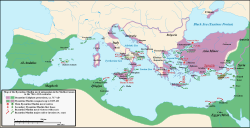
Between 831 and 1071, the Emirate of Sicily served as a primary hub for Islamic culture. Following its conquest by the Christian Normans, the island became a unique cultural fusion of Latin and Byzantine influences, with Palermo remaining a commercial powerhouse.
Evidence from the Cairo Geniza documents reveals that the Fatimid Caliphate maintained strong ties with Italian city-states. Records from 996 AD mention Amalfian merchants in Cairo, and later, Caliph al-Mustansir permitted Amalfian merchants to reside in Jerusalem around 1060.
The Era of the Crusades and Rivalry
As European states became more centralized, religious fervor and territorial ambition led to the Crusades. While these campaigns failed to permanently retake the Holy Land, they significantly weakened the Byzantine Empire, leaving it vulnerable to the Seljuk and later Ottoman Turks.
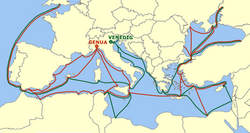
Paradoxically, the Crusades stimulated trade. The cities of Genoa, Venice, and Pisa established colonies in the outremer (overseas) regions, securing direct access to Eastern markets. Despite papal bans on trading with Muslim states, commerce continued due to its immense profitability.
Power Shifts in the Maghreb
In the Western Maghreb, the Almoravids and Almohads rose to power, leveraging control over Trans-Saharan trade to develop cities like Fez and Marrakesh. In the east, the collapse of the Zirid state in the 12th century left Ifriqiya fragmented and open to external influence.
Slavery in the Medieval Mediterranean
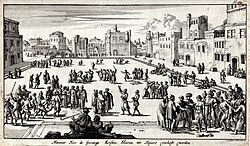
Slavery was a strategic pillar of all Mediterranean societies. The fear of abduction was a constant reality for coastal populations. Captives were typically handled in three ways:
- Trade: Peasants and fishermen were often abducted by Corsairs (pirates) and sold on international slave markets for profit.
- Ransom: Wealthy captives with influential backers were often ransomed, providing a faster financial return for the captors.
- Labor: Some captives were kept as ship labor or taken as prisoners of war.
Capturing large numbers of prisoners was also a tool of political theater; emperors would parade captives through capitals to signal victory to diplomats and citizens.
The Late Middle Ages and the Ottoman Ascent
The later period saw the rise of the Repubbliche Marinare (Maritime Republics), including Venice, Genoa, Pisa, Amalfi, Gaeta, Ancona, and Ragusa. These city-states filled the naval vacuum left by Islamic states, with Venice dominating the eastern Mediterranean after the Fourth Crusade.
In the west, the Crown of Aragon dominated through possessions in Sicily, Naples, Sardinia, and the Balearic Islands. A complex struggle for the Strait of Gibraltar (1275–1344) involved shifting alliances between the Marinid Sultanate, the Nasrid Kingdom of Granada, and the crowns of Castile, Aragon, and Portugal.
The Fall of Constantinople and New Horizons
The 14th century brought the devastation of the Black Death (1347), which spread from Constantinople. By 1453, the Byzantine Empire finally fell to the Ottomans, who then expanded into the Balkans and North Africa.
The decline of North African power was accelerated by the Portuguese. Using the caravel—a new ship design capable of navigating rough Atlantic waters—the Portuguese bypassed Saharan trade routes by trading directly with West Africa. This economic blow made North Africa an easier target for Ottoman conquest.
Contraband and Forbidden Trade
Despite official prohibitions from both Popes and Ottoman Sultans regarding the export of weaponry and strategic goods (memnu eşya), smuggling flourished. European merchants continued illegal trade, often during the winter when the Ottoman Navy was stationed at the Istanbul Arsenal and unable to patrol the seas.
Key Facts
- Maximum Extent: The Arab Empire once controlled 75% of the Mediterranean coastline.
- Naval Power: Italian Maritime Republics (like Venice and Genoa) dominated sea trade as Islamic states lacked major naval power.
- Technological Shift: The invention of the caravel allowed Portugal to bypass Saharan trade, weakening North African states.
- Turning Point: The fall of Constantinople in 1453 marked the end of the Byzantine Empire.
- Economic Hubs: Palermo and Cairo served as critical intersections for Latin, Byzantine, and Islamic commerce.
| Power/Entity | Primary Influence/Contribution | Key Region |
|---|---|---|
| Arab Caliphates | Rapid expansion, Indian Ocean-Mediterranean trade link | North Africa, Middle East, Al Andalus |
| Byzantine Empire | Cultural preservation, resistance in Anatolia | Eastern Mediterranean, Balkans |
| Maritime Republics | Naval dominance, oriental luxury trade | Italy (Venice, Genoa, Pisa) |
| Ottoman Empire | Final conquest of Byzantium, North African expansion | Balkans, Anatolia, North Africa |
| Crown of Aragon | Western Mediterranean naval dominance | Sicily, Sardinia, Balearic Islands |
Frequently Asked Questions
How did the Arab conquests affect European trade?
The conquests initially disrupted trade between Western and Eastern Europe and cut off routes to the Orient. However, this led to new trade paths across the Caspian Sea and increased the importance of ports like Venice and Constantinople for silk and spice imports.
What were the Maritime Republics?
The Maritime Republics (Repubbliche Marinare) were independent city-states such as Venice, Genoa, and Pisa that built naval empires. They dominated the transport of goods from the East to Europe, profiting from the lack of a major Islamic naval power.
Why was the caravel significant for the Portuguese?
The caravel was a new type of ship designed for rough Atlantic waters. It allowed the Portuguese to trade directly with West Africa, bypassing the traditional Trans-Saharan trade routes and economically weakening the North African states.
How was slavery handled in the medieval Mediterranean?
Slavery was a constant threat. Captives were either sold in international markets for profit, used as forced labor on ships, or, if they were wealthy or influential, ransomed back to their families and supporters.
Did the Crusades succeed in their primary goal?
No, the Crusades were unsuccessful in permanently rolling back Muslim power or retaking the Holy Land. However, they did weaken the Byzantine Empire and fostered increased trade between Europe and the outremer regions.