Mecklenburg-Strelitz: The History of a Northern German Grand Duchy
The Grand Duchy of Mecklenburg-Strelitz was a sovereign territory in Northern Germany, governed by the younger line of the House of Mecklenburg. Based in the capital of Neustrelitz, this state navigated the complex political shifts of the 19th and early 20th centuries, evolving from a member of the German Confederation to a federal state of the German Empire.
Throughout its existence, Mecklenburg-Strelitz was characterized by its distinct geography and a deeply rooted feudal social structure that often placed it at odds with the modernization sweeping across Europe.
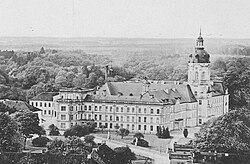
Key Facts
- Capital: Neustrelitz
- Period of Grand Duchy: 1815–1918
- Government: Monarchy (Grand Duke)
- Languages: German and Low German
- Successor State: Free State of Mecklenburg-Strelitz
- Modern Location: Germany
Geography and Administration
The Grand Duchy was unique in that it consisted of two detached territories within the Mecklenburg region. The larger portion was the Lordship of Stargard, which contained the residence of Neustrelitz and was located southeast of the neighboring Grand Duchy of Mecklenburg-Schwerin. This area was bordered by the Prussian provinces of Brandenburg and Pomerania.
The second, smaller portion was the Principality of Ratzeburg to the west, which bordered the territory of the Free City of Lübeck and the Duchy of Lauenburg. Beyond the capital, other significant towns included Neubrandenburg, Friedland, Woldegk, Stargard, Fürstenberg, and Wesenberg. The state also included the former commandries of the Knights Hospitaller in Nemerow and Mirow.
Political Evolution and History
From Duchy to Grand Duchy
Established by the Treaty of Hamburg in 1701, the state originally existed as a duchy. During the Napoleonic Wars, Duke Charles II managed to avoid French occupation through diplomatic efforts. While he initially joined the French-led Confederation of the Rhine in 1808, he shifted alliances in 1813 to join the Sixth Coalition against Napoleon.
Following the Congress of Vienna in 1815, the state was elevated to a Grand Duchy. Charles II assumed the title of Grand Duke and joined the German Confederation. While the Congress offered him land compensation in the Saar region, Charles opted to cede this land to Prussia in exchange for a monetary payment.
Integration into the German Empire
Mecklenburg-Strelitz maintained a close relationship with Prussia, providing troops during the Austro-Prussian War (1866) and the Franco-Prussian War (1870-71). Consequently, it became a member of the North German Confederation and, eventually, a federal state of the German Empire upon its unification in 1871.
A Feudal Stronghold
Despite its status within the Empire, the internal government of Mecklenburg-Strelitz remained antiquated. The Grand Dukes ruled through ministers and a feudal diet representing social classes. This diet met only briefly each year, with daily representation handled by the Ritterschaft (proprietors of knights' estates) and the Landschaft (selected town burgomasters).
This rigid structure led Imperial Chancellor Otto von Bismarck to mock the duchy, suggesting that everything there happened "50 years later" than in the rest of the world. Although Grand Duke Adolphus Frederick V promised a new constitution in 1907, the nobility successfully blocked these democratic reforms.
The End of the Monarchy and Legacy
The dynasty faced a crisis during World War I. By 1918, only two male dynasts remained: Grand Duke Adolphus Frederick VI and his cousin Charles Michael. Charles Michael, who was in Russian service, had renounced his German citizenship in 1914. When Adolphus Frederick VI committed suicide on February 23, 1918, the succession became complicated. Charles Michael eventually renounced his rights to the throne, and the monarchy ended during the German Revolution of 1918–19, leading to the creation of the Free State of Mecklenburg-Strelitz.
The House of Mecklenburg-Strelitz continues today through the descendants of Duke George, the morganatic son of Duke George Alexander. The current head of the house is Borwin.
Interestingly, the legacy of the duchy extends to the United States; Mecklenburg County in North Carolina (including Charlotte) was named after the duchy, as Queen Charlotte was born a princess of Mecklenburg-Strelitz.
Summary of State Status (1815–1918)
| Period | Political Status |
|---|---|
| 1815–1848 | State of the German Confederation |
| 1848–1849 | State of the German Empire |
| 1849–1850 | Independent State |
| 1850–1866 | State of the German Confederation |
| 1867–1871 | State of the North German Confederation |
| 1871–1918 | Federal State of the German Empire |
Frequently Asked Questions
Who were the rulers of Mecklenburg-Strelitz?
The state was ruled by Grand Dukes of the House of Mecklenburg, including Charles II, George, Frederick William, Adolphus Frederick V, and Adolphus Frederick VI.
Why was the government of Mecklenburg-Strelitz considered outdated?
It maintained a feudal system where power was exercised through an antiquated diet of social classes and the Ritterschaft, rather than a modern democratic constitution.
How did the Grand Duchy end?
The monarchy collapsed during the German Revolution of 1918–19 following the suicide of Grand Duke Adolphus Frederick VI and the renunciation of succession rights by Charles Michael.
What is the connection between Mecklenburg-Strelitz and North Carolina?
Mecklenburg County in North Carolina was named after the duchy because Queen Charlotte, for whom the city of Charlotte is named, was a princess of Mecklenburg-Strelitz.
What were the two main geographical parts of the state?
The state consisted of the Lordship of Stargard (containing Neustrelitz) and the Principality of Ratzeburg.