Grand Duchies: History, Titles, and the Legacy of Luxembourg
A grand duchy (or grand dukedom) is a sovereign country or territory ruled by a monarch holding the title of grand duke or grand duchess. Historically, this rank served as a critical distinction in the complex hierarchy of European nobility, bridging the gap between a standard duchy and a full kingdom.
While the title was once common across Central and Eastern Europe, the political landscape has shifted dramatically over the centuries. Today, only one such state remains in existence: the Grand Duchy of Luxembourg.
Key Facts
- Current Status: Luxembourg is the only extant grand duchy in the 21st century.
- First Official Instance: Tuscany became the first official grand duchy in 1569 via a papal bull.
- Rank: A sovereign grand duke historically ranked above a prince-elector and below a king.
- Peak Prevalence: During the 19th century, as many as 14 grand duchies existed simultaneously in Europe.
- Terminology: In Slavic languages, the term is often a translation of "grand prince" (Veliky Knyaz).
The Evolution of the Grand Ducal Title
The term "grand duchy" was created to solve a problem of status inflation. By the late Middle Ages, the title of "duke" had become overly common, applied to small fiefs and mid-sized towns. To distinguish truly powerful regional players—those with significant military, economic, or political weight but lacking the size to be recognized as kingdoms—the title of grand duke was introduced.
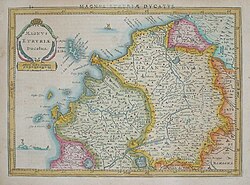
Early examples include the dukes of Burgundy, who used the title unofficially while attempting to form a new kingdom in the region of Lotharingia. However, the first official recognition occurred in 1569 when Pope Pius V issued a papal bull granting the title to the Medici family in Tuscany.
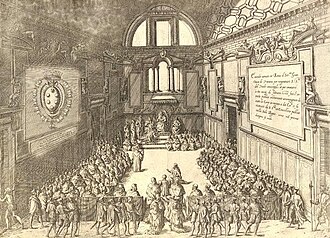
Throughout the 17th and 18th centuries, the title was occasionally used as a political tool. For instance, the Duchy of Savoy was elevated to a grand duchy in 1696 by the emperor, largely as a strategic bribe to ensure Savoy's alignment during the Nine Years War against France.
The Napoleonic Era and the 19th Century Expansion
The number of grand duchies surged during the reign of Napoléon I. Napoleon frequently established grand duchies as satellite states for his generals and relatives. Many of these were part of the Confederation of the Rhine, often expanding their territories at the expense of powers like Prussia.
Following Napoleon's defeat at the Battle of Waterloo, the Congress of Vienna (1815) reorganized Europe. While some Napoleonic states were abolished, the Congress recognized or restored several grand duchies in Central Europe, including Baden, Hesse, and Oldenburg. These states varied in their level of independence: some were fully sovereign, some were client states, and others existed in a personal union with larger realms.
Luxembourg: The Sole Surviving Grand Duchy
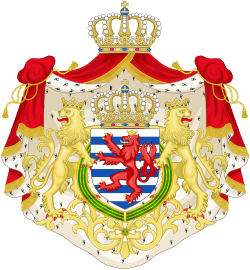
Luxembourg regained its independence from Napoleonic France in 1815. To create a strategic counterbalance to France, the Congress of Vienna granted the title of grand duke of Luxembourg to the monarch of the newly formed United Kingdom of the Netherlands.
This personal union lasted until 1890. When King William III died without a male heir, the Dutch throne passed to his daughter, Wilhelmina. However, under the semi-Salic law established by the Congress of Vienna, the grand ducal throne of Luxembourg could only be inherited by a male dynast. Consequently, the title passed to a distant cousin, Adolphe of the House of Nassau-Weilburg. The current monarch is Guillaume V, who ascended on October 3, 2025.
Grand Duchies vs. Grand Principalities
In English, the term "grand duchy" is often used to translate titles from Slavic languages that literally mean "grand prince" (such as the Russian Veliky Knyaz). While these are often interchangeable in historical texts, there are distinct differences:
- Grand Principalities: States like Kiev, Lithuania, and Moscow were historically grand principalities. The Grand Duchy of Finland (1809–1917) was also a grand principality in its native languages.
- Russian Empire: In the Russian Empire, "grand duke" was a non-sovereign honorific given to the children and grandchildren of the emperor, carrying the style of Imperial Highness (HIH).
- Germanic Distinction: In German, a clear distinction exists between Großherzog (grand duke) and Großfürst (grand prince).
| Type | Characteristics | Examples |
|---|---|---|
| Sovereign | Nominally independent states | Baden, Tuscany, Luxembourg |
| Personal Union | Ruled by a monarch of another realm | Finland, Luxembourg (pre-1890) |
| Client State | Dependent on a more powerful realm | Cleves and Berg |
| Titular/Nominal | Boundaries were nominal; title was symbolic | Frankfurt |
Frequently Asked Questions
What is the difference between a duchy and a grand duchy?
A grand duchy is a higher rank than a standard duchy. Historically, the "grand" prefix was added to denote territories of greater political, military, or economic importance that were not quite large enough to be recognized as kingdoms.
Why is Luxembourg the only grand duchy left?
Most other grand duchies were abolished during the Napoleonic Wars, absorbed into larger nations (like the unification of Italy and Germany), or transitioned into republics during the early 20th century. Luxembourg maintained its sovereign status through its unique legal and diplomatic history.
What is semi-Salic law?
Semi-Salic law is a system of inheritance that prioritizes male heirs. In the case of Luxembourg, it dictated that the throne must pass to a male dynast; if no male heirs existed in one branch of the family, the throne would move to the next available male in a different branch of the dynasty.
Is a grand duke the same as a grand prince?
In English translation, they are often used interchangeably, especially regarding Russian and Slavic history. However, technically, a "grand prince" (like the rulers of Kievan Rus') is a different title from the Western European "grand duke." In German, the two titles (Großherzog and Großfürst) remain distinct.