Confederation of the Rhine: Napoleon's German Client State System
The Confederation of the Rhine (also known as the Rheinische Bundesstaaten or États confédérés du Rhin) was a strategic alliance of German client states established by Napoleon Bonaparte. Formed in the wake of his victory over Austria and Russia at the Battle of Austerlitz, this confederation served as a critical buffer zone between the French Empire and the major powers of Prussia and Austria.
Existing from 1806 to 1813, the Confederation fundamentally altered the map of Central Europe. Its creation directly led to the dissolution of the Holy Roman Empire, marking the end of a thousand-year political entity and replacing it with a system designed to serve French imperial interests.
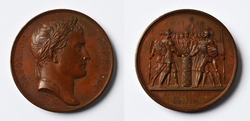
Key Facts
- Duration: 1806–1813.
- Protector: Napoleon Bonaparte, Emperor of the French.
- Capital: Free City of Frankfurt.
- Population: Over 15 million people at its peak.
- Primary Purpose: To act as a military buffer for France and provide manpower for Napoleon's armies.
- Outcome: Dissolved following the Battle of Leipzig in November 1813.
Historical Background and Formation
The path to the Confederation began with the Treaty of Lunéville and the Final Imperial Recess of 1803. These events triggered a radical transformation of the Holy Roman Empire, where 112 immediate territories were absorbed by larger states—a process known as mediatisation. This period also saw the secularisation of nearly all ecclesiastical territories, stripping the Holy Roman Emperor of vital political support.
By 1805, during the War of the Third Coalition, states like Bavaria, Baden, and Württemberg allied with Napoleon. Following the Peace of Pressburg, Napoleon elevated these allies to kingdoms and grand duchies, laying the groundwork for a formal confederation.
The Forced Treaty of 1806
The formal establishment of the Confederation was not entirely voluntary. On July 12, 1806, French Foreign Minister Talleyrand compelled the envoys of various German princes to sign the Treaty of the Confederation of the Rhine under duress. The terms were far more restrictive than expected, most notably stripping member states of their independent foreign policy and placing it in the hands of Napoleon, the "Protector of the Confederation."
On August 1, 1806, the member states formally seceded from the Holy Roman Empire. Shortly after, on August 6, Emperor Francis II dissolved the Holy Roman Empire entirely.
Governance and Structure
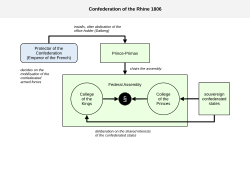
While the treaty suggested the existence of common constitutional bodies, the Confederation functioned primarily as a military alliance. The individual states sought sovereignty, but in reality, they were more subordinated to Napoleon than they had been to the Habsburgs.
Leadership and Administration
- Protector: A hereditary office held by the Emperor of the French.
- Prince-primate: The highest internal office, held by Karl Theodor Anton Maria von Dalberg, who presided over the Diet.
- The Diet: A parliament-like body intended for legislation, though it never actually assembled.
The Cost of Status
Napoleon rewarded loyal rulers by elevating their titles—turning Bavaria and Württemberg into kingdoms and Baden, Hesse, Cleves, and Berg into grand duchies. However, this prestige came with a heavy price: member states were required to maintain large armies for mutual defense and provide significant numbers of troops for Napoleon's campaigns.
Types of Member States
The level of French influence and internal reform varied across the three main types of states within the Confederation:
- Model States: Often ruled by Napoleon's relatives (e.g., the Kingdom of Westphalia under Jérôme Bonaparte). These states implemented the Napoleonic Code to serve as legal and social examples for others.
- Reform States: Including Bavaria, Württemberg, Baden, and Hesse-Darmstadt. These were true allies who adopted French-inspired reforms but maintained a degree of independent policy based on their own reasons of state.
- Later Adherents: Smaller northern and central German territories that joined after 1806. In these states, internal changes were minimal, and old structures often remained intact, with a few exceptions like the Duchy of Nassau.
Summary of Major Member Monarchies
| Member Monarchy | Year Joined | Status/Notes | Troop Contribution |
|---|---|---|---|
| Kingdom of Bavaria | 1806 | Co-founder; former Electorate | 30,000 |
| Kingdom of Saxony | 1806 | Former Electorate | 20,000 |
| Kingdom of Westphalia | 1807 | Napoleonic creation | 25,000 |
| Kingdom of Württemberg | 1806 | Co-founder; former Electorate | 12,000 |
| Grand Duchy of Baden | 1806 | Co-founder | 8,000 |
| Grand Duchy of Berg | 1806 | Co-founder | 5,000 |
Collapse and Aftermath
The Confederation's stability was tied directly to Napoleon's military success. Following the disastrous invasion of Russia, the alliance began to crumble. After the Battle of Leipzig in October 1813, many member states defected to the Coalition forces. The Confederation was officially dissolved on November 4, 1813.
The subsequent Congress of Vienna (1814–1815) redrew the map of Europe. While Napoleonic creations like the Kingdom of Westphalia were abolished, many of the southern and central German states survived. These states, along with Prussia and Austria, eventually formed the German Confederation in 1815, which lasted until 1866.
Frequently Asked Questions
What was the primary purpose of the Confederation of the Rhine?
Its primary purpose was to serve as a military buffer zone for the French Empire on its eastern frontier and to provide Napoleon with a steady supply of soldiers for his wars.
How did the Confederation lead to the end of the Holy Roman Empire?
The treaty of the Confederation required its members to formally secede from the Holy Roman Empire. This loss of support, combined with Napoleon's ultimatum, led Emperor Francis II to dissolve the Empire on August 6, 1806.
Who was the Prince-primate of the Confederation?
The office of Prince-primate was held by Karl Theodor Anton Maria von Dalberg, who served as the President of the College of Kings and presided over the Diet.
What was the Napoleonic Code's role in the Confederation?
The Napoleonic Code was implemented in the "Model States" (such as the Kingdom of Westphalia) to modernize legal and social policies and serve as a blueprint for other member states.
What happened to the member states after 1813?
Following the dissolution of the Confederation, the Congress of Vienna reinstated some suppressed states and abolished Napoleonic creations. Most surviving members joined the newly formed German Confederation in 1815.