Napoleon BonaparteFrench EmpireNapoleonic CodeBattle of WaterlooFirst Consul

Napoleon Bonaparte: The Rise and Fall of the French Emperor

Napoleon Bonaparte: The Rise and Fall of the French Emperor Napoleon Bonaparte remains one of history's most polarizing and influential figures. From his humble beginnings on the island o...

Napoleon Bonaparte: The Rise and Fall of the French Emperor

Napoleon Bonaparte remains one of history's most polarizing and influential figures. From his humble beginnings on the island of Corsica to his ascent as the Emperor of the French, his life was a whirlwind of military genius, political ambition, and sweeping legal reforms that reshaped the modern world.

Born as Napoleone di Buonaparte on August 15, 1769, in Ajaccio, Corsica, he entered a world of political instability. His father, Carlo Buonaparte, had fought for Corsican independence before becoming a representative to the court of Louis XVI.
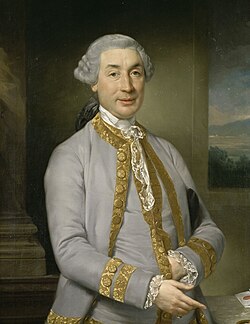
Half-length portrait of a wigged middle-aged man with a well-to-do jacket. His left hand is tucked inside his waistcoat.
Napoleon's father, Carlo Buonaparte, fought for Corsican independence under Pasquale Paoli. After their defeat, he eventually became the island's representative to Louis XVI's court.

Key Facts

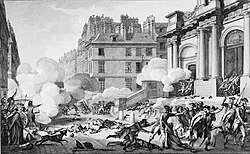
Etching of a street, there are many pockets of smoke due to a group of republican artillery firing on royalists across the street at the entrance to a building
Journée du 13 Vendémiaire, artillery fire in front of the Church of Saint-Roch, Paris, Rue Saint-Honoré
  • Full Name: Napoleone di Buonaparte.
  • Primary Titles: First Consul of the French Republic, Emperor of the French, King of Italy.
  • Major Legal Legacy: The Code Civil (Napoleonic Code), which standardized law across France and influenced many global legal systems.
  • Military Peak: The Battle of Austerlitz (1805) is often cited as one of his greatest tactical victories.
  • Final Exile: Spent his last years on the remote island of Saint Helena.
  • Death: May 5, 1821, at the age of 51.

The Ascent to Power
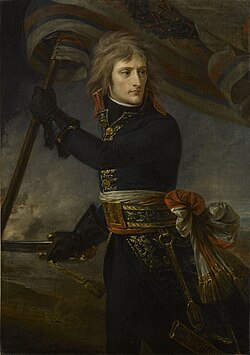
A three-quarter-length depiction of Bonaparte, with black tunic and leather gloves, holding a standard and sword, turning backwards to look at his troops
Bonaparte at the Pont d'Arcole, by Baron Antoine-Jean Gros, (c. 1801), Musée du Louvre, Paris

Napoleon's military career began in earnest during the French Revolution. He first gained significant attention during the Siege of Toulon in 1793, where his artillery skills proved decisive.
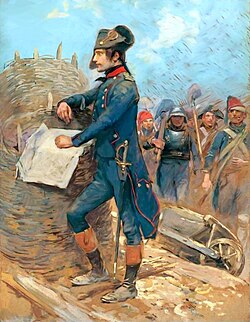
Bonaparte at the Siege of Toulon, 1793, by Édouard Detaille

His reputation grew further after suppressing royalist uprisings in Paris during the 13 Vendémiaire. By age 23, he was already a lieutenant-colonel of Corsican Republican volunteers.
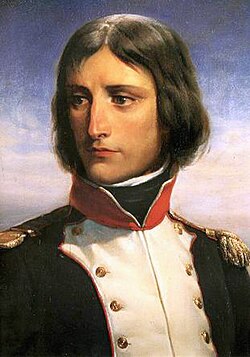
Bonaparte, aged 23, as lieutenant-colonel of a battalion of Corsican Republican volunteers. Portrait made in 1835 by Henri Félix Emmanuel Philippoteaux.

Following successful campaigns in Italy and a high-profile expedition to Egypt, Napoleon returned to France to seize political control. Through the coup of 18 Brumaire, he established himself as the First Consul of the French Republic on December 13, 1799.
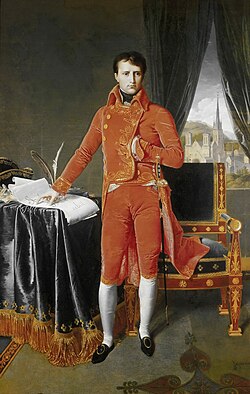
Bonaparte, First Consul, by Jean-Auguste-Dominique Ingres. Posing the hand inside the waistcoat was often used in portraits of rulers to indicate calm and stable leadership.

The French Empire and European Dominance
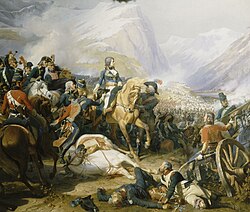
Napoleon at the Battle of Rivoli by Henri Félix Emmanuel Philippoteaux, 1844

On May 18, 1804, Napoleon transitioned from Consul to Emperor, crowning himself Napoleon I. His reign was characterized by a series of conflicts known as the Napoleonic Wars, where he expanded French influence across Europe.
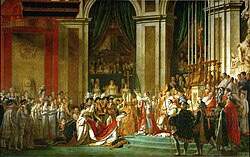
Colored painting depicting Napoleon crowning his wife inside of a cathedral
The Coronation of Napoleon by Jacques-Louis David (1804)

Military Triumphs and Territorial Expansion

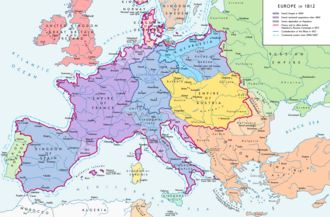
Napoleon's strategic brilliance was on full display at the Battle of Austerlitz in 1805. He also secured the surrender of Austrian General Mack at the Battle of Ulm. His empire reached its greatest extent in 1812, controlling vast swaths of the continent.
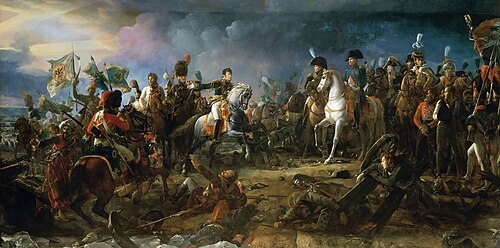
Napoleon at the Battle of Austerlitz, by François Gérard, 1805

Beyond Europe, Napoleon's influence reached the Americas. In 1803, he orchestrated the Louisiana Purchase, selling 2,144,480 square kilometers of land to the United States, effectively doubling the size of the young nation.
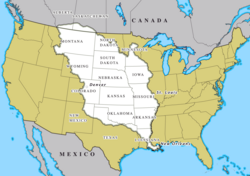
The 1803 Louisiana Purchase totalled 2,144,480 square kilometres (827,987 square miles), doubling the size of the United States.

Civil Reforms and Administration

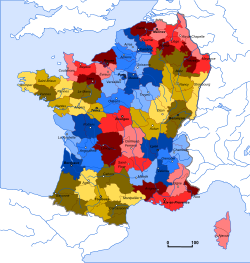
Napoleon was not merely a conqueror; he was a prolific administrator. He established the Napoleonic Code in 1804, a civil legal system that replaced fragmented feudal laws. He also reorganized the religious landscape of France through the Concordat of 1801, dividing the country into 59 dioceses.
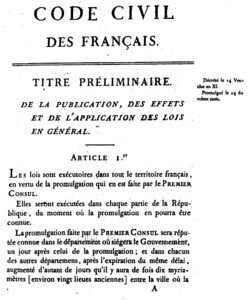
Page of French writing
First page of the 1804 original edition of the Code Civil

The Turning Point and Downfall

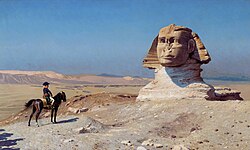
Person on a horse looks towards a giant statue of a head in the desert, with a blue sky
Bonaparte Before the Sphinx (c. 1886) by Jean-Léon Gérôme, Hearst Castle

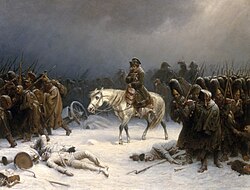
The tide began to turn with the invasion of Russia in 1812. The brutal winter and scorched-earth tactics led to a catastrophic withdrawal, decimating the Grande Armée.
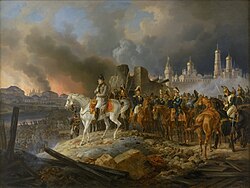
Napoleon watching the fire of Moscow in September 1812, by Adam Albrecht (1841)

Following a series of defeats, including the Battle of Leipzig, Napoleon was forced to abdicate on April 4, 1814. He was exiled to the island of Elba, but his story did not end there.
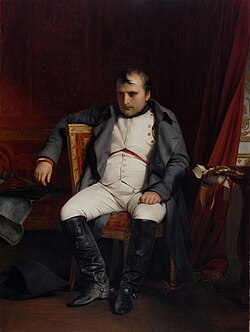
Napoleon after his abdication in Fontainebleau, 4 April 1814, by Paul Delaroche

The Hundred Days and Waterloo

In a daring move, Napoleon escaped Elba and returned to France in 1815, initiating a period known as the Hundred Days. However, his final bid for power ended at the Battle of Waterloo on June 22, 1815.
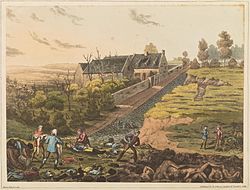
A mass grave of soldiers killed at the Battle of Waterloo

This time, the defeat was absolute. He was exiled to the remote island of Saint Helena in the South Atlantic, where he lived under British captivity at Longwood House until his death in 1821.
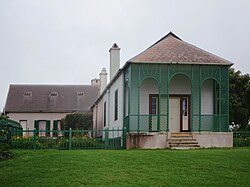
Longwood House, Saint Helena, site of Napoleon's captivity

Summary of Napoleon's Career

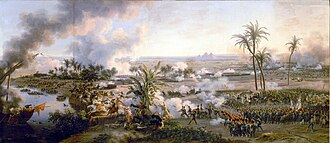
Cavalry battlescene with pyramids in background
Battle of the Pyramids on 21 July 1798 by Louis-François, Baron Lejeune, 1808
Chronology of Napoleon's Key Roles and Events
Period Role/Event Key Significance
1793 Siege of Toulon First major military success
1799–1804 First Consul Established political control of France
1804–1814 Emperor (1st Reign) Peak of the French Empire
1804 Napoleonic Code Standardization of civil law
1812 Invasion of Russia Beginning of the military decline
1815 Battle of Waterloo Final defeat and permanent exile

Frequently Asked Questions
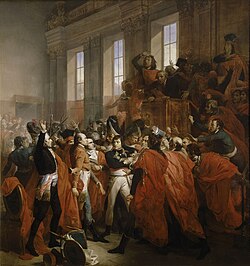
Bonaparte in a simple general uniform in the middle of a scrum of red-robbed members of the Council of Five Hundred
Bonaparte at the Council of Five Hundred at Saint-Cloud by François Bouchot, 1840
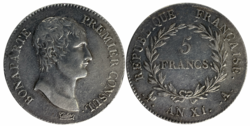
Silver 5 francs coin depicting Napoleon as First Consul from AN XI, 1802
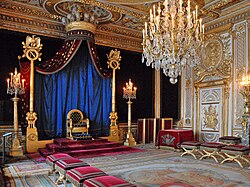
Napoleon's throne room at Fontainebleau
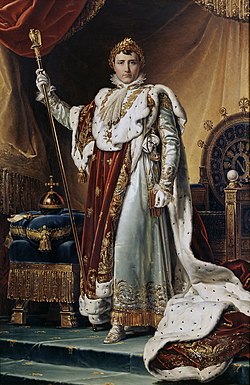
Napoleon in his coronation robes by François Gérard, c. 1805
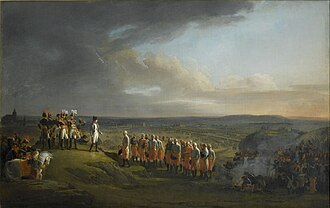
Colored painting depicting Napoleon receiving the surrender of the Austrian generals, with the opposing armies and the city of Ulm in the background
Napoleon and the Grande Armée receive the surrender of Austrian General Mack after the Battle of Ulm in October 1805.
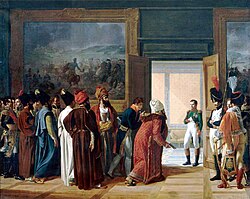
The Iranian envoy Mirza Mohammad-Reza Qazvini meeting with Napoleon at the Finckenstein Palace in West Prussia, 27 April 1807, to sign the Treaty of Finckenstein.
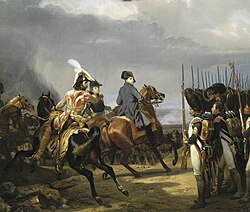
Napoleon reviewing the Imperial Guard before the Battle of Jena, 14 October 1806
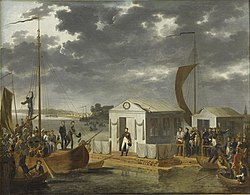
The Treaties of Tilsit: Napoleon meeting with Alexander I of Russia on a raft in the middle of the Neman River, 7 July 1807.
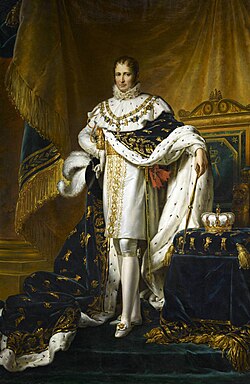
Portrait of Joseph Bonaparte by François Gérard, 1808, depicting Napoleon's elder brother as King of Spain
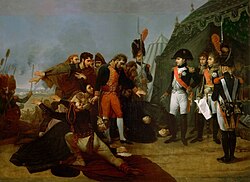
Napoleon Accepting the Surrender of Madrid, 4 December 1808
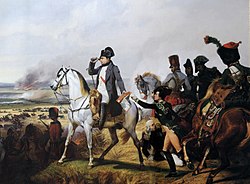
The Battle of Wagram by Horace Vernet, 1836
Map of Europe. French Empire shown as bigger than present day France as it included parts of present-day Netherlands and Italy.
The French Empire at its greatest extent in 1812: French Empire
Napoleon's withdrawal from Russia, painting by Adolph Northen
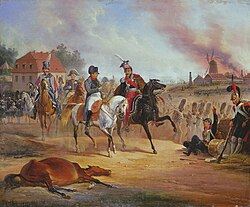
Napoleon and Prince Józef Poniatowski at Leipzig, painting by January Suchodolski
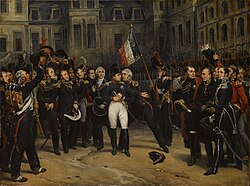
Napoleon's farewell to his Imperial Guard, 20 April 1814, by Antoine-Alphonse Montfort
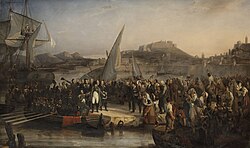
Napoleon's Departure from Elba by Joseph Beaume, 1836
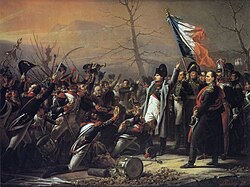
Napoleon's Return from Elba, by Charles de Steuben, 1818
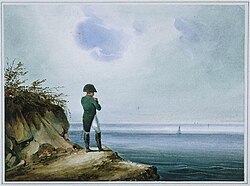
Napoleon on Saint Helena, watercolour by Franz Josef Sandmann, c. 1820
Reorganisation of the religious geography: France is divided into 59 dioceses and 10 ecclesiastical provinces.
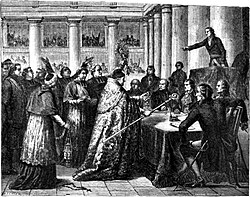
Leaders of the Catholic Church taking the civil oath required by the Concordat of 1801
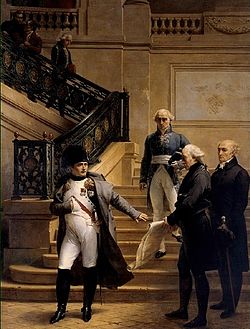
Napoleon visiting the Tribunat
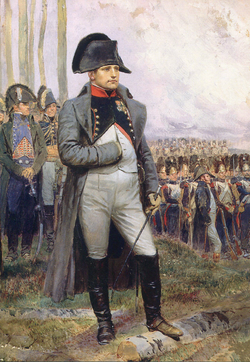
Napoleon is often represented in his green colonel uniform of the Chasseur à Cheval of the Imperial Guard, the regiment that often served as his personal escort, with a large bicorne and a hand-in-waistcoat gesture.
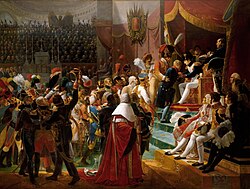
First remittance of the Legion of Honour, 15 July 1804, at Saint-Louis des Invalides, by Jean-Baptiste Debret (1812)
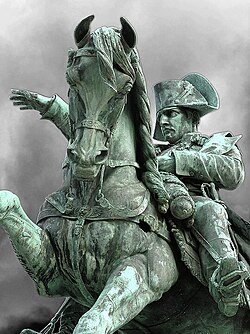
Photo of a grey and phosphorous-coloured equestrian statue. Napoleon is seated on the horse, which is rearing up, he looks forward with his right hand raised and pointing forward; his left hand holds the reins.
Statue in Cherbourg-Octeville unveiled by Napoleon III in 1858. Napoleon I strengthened the town's defences to prevent British naval incursions.
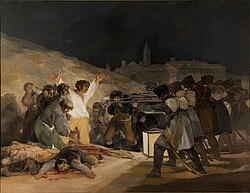
The Third of May 1808 by Francisco Goya, showing Spanish resisters being executed by French troops
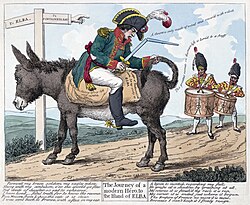
1814 English caricature of Napoleon being exiled to Elba: the ex-emperor is riding a donkey backwards while holding a broken sword.
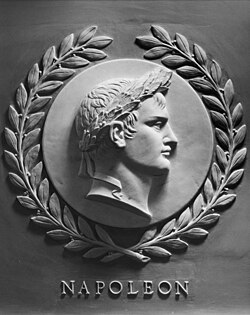
Bas-relief of Napoleon in the chamber of the United States House of Representatives
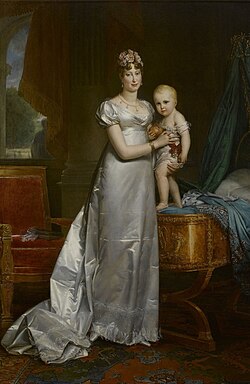
Empress Marie Louise and her son Napoleon, by François Gérard, 1813

Was Napoleon actually short?

While often depicted as short in English caricatures, historical records and studies suggest his height was average for the time; the perception of him being short was largely a result of British propaganda and differences in measurement units.

What was the significance of the Napoleonic Code?

The Code Civil replaced a chaotic mix of feudal laws with a single, clear legal framework. It emphasized meritocracy and property rights, influencing the legal systems of numerous countries worldwide.

Why did the invasion of Russia fail?

The failure was primarily due to the extreme Russian winter, a lack of adequate supplies for the Grande Armée, and the Russian strategy of retreating and burning resources to deny the French army sustenance.

Where is Napoleon buried today?

After his death on Saint Helena, his remains were eventually returned to France. He is now buried in a grand tomb at Les Invalides in Paris.
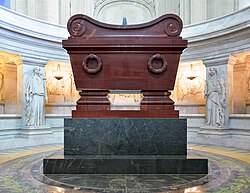
Napoleon's tomb at Les Invalides in Paris