Universal Manhood Suffrage: The Evolution of Male Voting Rights
Universal manhood suffrage is a political system in which all adult male citizens are granted the right to vote. This system removes restrictive qualifications based on income, property ownership, religion, race, or other social status. Often summarized by the slogan "one man, one vote," this concept served as a critical stepping stone toward modern democratic representation.
Key Facts
- Definition: Voting rights for all adult male citizens regardless of wealth or social standing.
- France: Early adoption in 1792, revoked in 1795, and permanently re-established in 1848.
- Australia: South Australia led the way in 1856, introducing the secret ballot.
- United States: Most white males gained suffrage by 1856, though African-American men faced systemic barriers until 1965.
- Japan: Universal manhood suffrage was passed in 1925, which also abolished the poll tax.
- Transition: The movement eventually evolved into universal suffrage as women won the right to vote.
The Global Journey Toward Male Suffrage
The French Experience
France was a pioneer in the struggle for voting rights. In 1789, the country adopted the Declaration of the Rights of Man and of the Citizen. By 1792, the National Convention was elected by all men, marking an early attempt at universal male suffrage. However, this progress was short-lived and revoked by the Directory in 1795. It was not until the French Revolution of 1848 that universal male suffrage was firmly re-established.
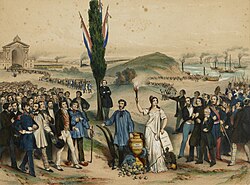
Developments in Australia
The Australian colonies implemented male suffrage in the mid-19th century. South Australia became the first to pass these laws in 1856, followed by Victoria in 1857 and New South Wales in 1858. A significant contribution from this region was the introduction of the secret ballot, a system ensuring that a voter's choice remains private to prevent intimidation.
The United States and Jacksonian Democracy
In the United States, the era of Jacksonian democracy (1820s to 1850s) pushed the country toward a close approximation of universal manhood suffrage for white citizens. By 1856, most states had removed property requirements. While the expansion was largely peaceful—with the exception of the Rhode Island Dorr Rebellion—it was not inclusive.
Tax-paying requirements persisted in five states until 1860, and in Pennsylvania and Rhode Island until the 20th century. Furthermore, African-American men were largely excluded. Although the Fifteenth Amendment, ratified in 1870, legally upheld their right to vote, many were denied this right in practice for another century. This systemic exclusion persisted until the Civil Rights Movement led to the passage of the Voting Rights Act of 1965.
Suffrage in Japan
Japan adopted universal manhood suffrage in 1925. This legislation was notable for removing the poll tax (a fixed tax paid by an adult citizen regardless of income), which had previously acted as a barrier to voting. During this time, the New Women's Society paused its own activism to ensure the male suffrage legislation could pass without interference.
Summary of Suffrage Milestones
| Region/Country | Key Date(s) | Significant Detail |
|---|---|---|
| France | 1792, 1848 | Early adoption in 1792; permanent re-establishment in 1848. |
| Australia | 1856–1858 | Introduced the secret ballot. |
| United States | 1856 (White males) | Fifteenth Amendment (1870) and Voting Rights Act (1965) for African-American men. |
| Japan | 1925 | Removed the poll tax to enable voting. |
Frequently Asked Questions
What is the difference between universal manhood suffrage and universal suffrage?
Universal manhood suffrage grants voting rights specifically to all adult male citizens. Universal suffrage expands this right to all adult citizens regardless of gender, including women.
What was the "one man, one vote" slogan?
It is a summary of the principle that every adult male citizen should have a single vote of equal weight, regardless of their wealth, property, or social status.
How did the secret ballot change voting?
Introduced in the Australian colonies, the secret ballot allowed voters to cast their ballots in private, reducing the risk of coercion or bribery.
Why did African-American men struggle to vote despite the Fifteenth Amendment?
Although the Fifteenth Amendment ratified in 1870 legally protected their voting rights, many local jurisdictions used various methods to deny them the right to vote until the Voting Rights Act of 1965.
What role did the poll tax play in Japan?
The poll tax acted as a financial barrier to voting; its removal in 1925 was a key component of establishing universal manhood suffrage in Japan.