Code Noir: The Legal Framework of Slavery in the French Empire
The Code Noir (French for "Black Code") was a comprehensive decree issued by King Louis XIV of France in 1685. Designed to regulate the conditions of slavery in the French colonies—specifically the Antilles and later Louisiana—this document served as the primary legal authority on slavery conduct until the onset of the French Revolution in 1789. Historian Tyler Stovall has described it as one of the most extensive official documents on race, slavery, and freedom ever produced in Europe.
The decree was not merely a set of rules for enslaved people; it was a tool of social and religious control. It mandated the conversion of all enslaved individuals to Catholicism, restricted the rights of free people of color, and ordered the expulsion of Jewish populations from the colonies.
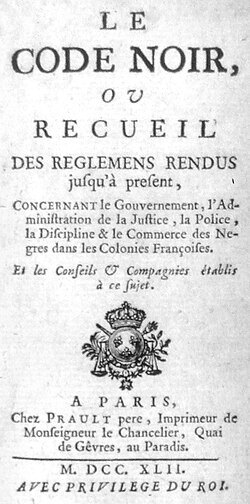
Key Facts
- Promulgated: 1685 by King Louis XIV.
- Primary Purpose: To define the legal status, treatment, and religious obligations of enslaved people in French colonies.
- Religious Mandate: Required all enslaved people to be baptized into the Catholic faith.
- Scope: Applied to the Antilles (Martinique, Guadeloupe, Saint-Domingue) and later to Louisiana and the Mascarene Islands.
- Legal Status: Defined enslaved people as property (chattels) while simultaneously holding them criminally liable.
Historical Context and Inception
The Legal Gap in the Caribbean
Before the Code Noir, legal statutes in colonies like Martinique were fragmented. The Edict of May 1664, which established the French West India Company, focused on French nationals and foreigners but lacked specific rules for enslaved populations. While Indigenous peoples (Caribbean Indians) were viewed as naturalized French subjects upon baptism and were legally protected from enslavement, the growing importation of African populations created a legal void.
Early attempts to fill this gap came from the Sovereign Council of Martinique. Influenced by Jesuit missionaries, the Council ruled in 1652 that slaves should not work on Sundays and in 1664 that they must be baptized and attend catechism.
The Drafting Process
In 1681, King Louis XIV tasked Jean-Baptiste Colbert with creating a formal statute for the black population of the French Caribbean. Colbert gathered memoranda from colonial officials, including Jean-Baptiste Patoulet, Michel Bégon, and Charles de Courbon de Blénac. The final draft was written by the Naval Minister, the Marquis de Seignelay, and promulgated in March 1685.
Interestingly, the original ordinance faced resistance from various French parliaments based on the fundamental principle that any person stepping on French soil is free. Consequently, the Code was instituted only within the colonies: Martinique (August 1685), Guadeloupe (December 1685), Saint-Domingue (May 1687), and eventually Cayenne and Guiana (May 1704).
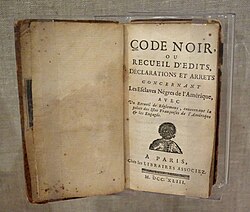
The Provisions of the Code Noir
The Code Noir consisted of 60 articles that meticulously detailed the intersection of property law and human existence. It created a paradoxical legal state where an enslaved person was considered property immune from seizure (Article 44) yet remained criminally liable for their actions (Article 32).
Religion and Social Control
Catholicism was the mandatory faith. The Code also included a strict antisemitic clause (Article 1), which incorporated a 1683 edict expelling Jews from the colonies, specifically targeting the Jewish population in Martinique.
Family and Progeny
- Marriage: Weddings required the master's permission but also the consent of the enslaved individuals.
- Inheritance: Children born to married enslaved people were automatically enslaved, belonging to the master of the mother.
- Family Unity: Article 47 forbade the separation of husbands, wives, and prepubescent children if they served the same master.
Prohibitions and Punishments
The Code imposed severe restrictions on daily life. Enslaved people were forbidden from carrying weapons (unless for hunting with permission), gathering in groups if they belonged to different masters, and selling sugar cane. While masters were prohibited from torture or mutilation, they were permitted to chain and beat their slaves. The penalty for a third attempt to escape was death.
The Path to Freedom
Manumission (the act of freeing a slave) was permitted for slaveowners aged 20 (or 25 without parental consent). Once freed, these individuals became French subjects with the same rights as other French colonial subjects, regardless of their place of birth.
Evolution and Global Application
| Region | Implementation/Status | Key Detail |
|---|---|---|
| Antilles | 1685 (Initial) | The primary target of the original 1685 decree. |
| Louisiana | 1723/1724 | Ratified by Louis XV; remained the basis of law until 1806-1807. |
| Mascarene Islands | Variable | Supplemented by the Code jaune and Nouveau Code Noir. |
| Post-1802 Colonies | Reinstated 1802 | Re-established after the Treaty of Amiens, coexisting with the Napoleonic Code. |
The Code evolved through various editions, most notably the "Saint-Domingue" versions, which became the most widespread. Following the Treaty of Amiens in 1802, the Code was reinstated in several colonies. For over four decades, it coexisted with the Napoleonic Code, despite the two being contradictory. This tension led to a more rigid application of the Code Noir during the 19th century due to increased judicial centralization.
Frequently Asked Questions
What was the primary purpose of the Code Noir?
The Code Noir was designed to regulate the lives of enslaved people in French colonies, ensuring they were converted to Catholicism, defining their status as property, and establishing strict punishments for disobedience or escape.
How did the Code Noir treat the children of enslaved people?
Under Article 12, children born to enslaved parents were also enslaved and became the property of the mother's master.
Were enslaved people given any legal rights?
While they were primarily treated as chattels (personal property), they could testify in court (though their testimony was not considered definitive proof), lodge complaints, and marry with their master's permission.
Did the Code Noir apply to Indigenous peoples?
No. The Edict of 1664 forbade the enslavement of Indigenous peoples (Caribbean Indians), who were instead viewed as naturalized French subjects upon their baptism.
What happened to the Code Noir after the French Revolution?
Although the French Revolution began in 1789, parts of the Code were reinstated in 1802 after the Treaty of Amiens. It continued to influence colonial law until the final abolition of slavery in 1848.