The First French Empire: Napoleon Bonaparte's Rise and Fall
The First French Empire, often referred to as Napoleonic France, was a period of unprecedented French hegemony over continental Europe during the early 19th century. Established by Napoleon Bonaparte, the empire transformed the political and legal landscape of Europe through a combination of military genius and administrative reform. Lasting primarily from 1804 to 1814, with a brief resurgence in 1815, the empire marked the transition from the revolutionary fervor of the French First Republic to an absolute monarchy.
Key Facts
- Duration: May 18, 1804 – April 6, 1814; March 20 – July 7, 1815.
- Leader: Napoleon I (Emperor of the French).
- Peak Territory: Reached its maximum extent in September 1812, covering approximately 2,100,000 km².
- Population: Approximately 44 million people in 1812.
- Capital: Paris.
- Official Language: French.
- Motto: Liberté, Ordre Public (Liberty, Public Order).
The Ascent of Napoleon
The empire's origins lie in the political instability of the late 18th century. In 1799, Napoleon Bonaparte collaborated with Emmanuel Joseph Sieyès and other conspirators to execute a coup d'état—a sudden, violent seizure of power—overthrowing the Constitution of the Year III. This event established the Consulate, with Napoleon as First Consul.
Napoleon quickly consolidated his power, drafting the Constitution of the Year VIII and later the Constitution of the Year X, which named him First Consul for life in 1802. His authority grew through strategic annexations in Italy and the Concordat of 1801, an agreement with the Catholic Church to stabilize religious relations in France.
On May 18, 1804, the Sénat conservateur granted Napoleon the title of Emperor of the French. He was formally crowned on December 2, 1804, in Notre-Dame de Paris, consecrated by Pope Pius VII. While the state was officially called the "French Republic" until 1808, the coronation signaled the definitive end of the First Republic.
Military Supremacy and European Hegemony
Napoleon's empire was forged on the battlefield. Through the War of the Third Coalition, French forces achieved decisive victories, most notably at the Battle of Austerlitz in 1805, establishing French military supremacy in mainland Europe.
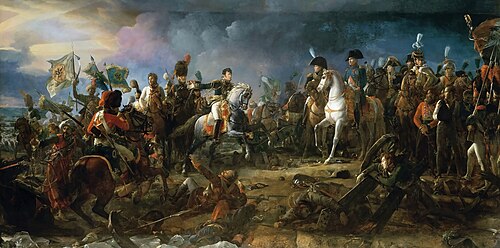
The dominance continued during the War of the Fourth Coalition. Napoleon crushed Prussian forces at the Battle of Jena–Auerstedt in 1806 and defeated the Russians at the Battle of Friedland in 1807. These victories forced Russia and Prussia to sign the Treaties of Tilsit, effectively dividing Europe into French and Russian spheres of influence.

The Peak of Power
By 1812, the empire had reached its territorial zenith. Napoleon had dismantled the Holy Roman Empire, forcing the Habsburgs to abdicate their title in 1806. He further expanded his reach by annexing the Illyrian Provinces and incorporating the domains of the Pope into the empire.

To secure a dynasty, Napoleon divorced Joséphine and married Archduchess Marie Louise of Austria, leading to the birth of his son, the "King of Rome." This period represented the high point of his political and familial ambitions.
The Decline and Fall
The tide began to turn due to overextension and national resistance. The "Spanish Ulcer"—protracted resistance in Spain and Portugal—depleted French manpower and signaled that nationalistic fervor could challenge Napoleon's armies.
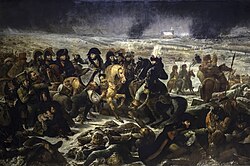
The fatal blow came with the 1812 invasion of Russia. Despite capturing Smolensk and entering Moscow, Napoleon was defeated by the brutal Russian winter and the refusal of Tsar Alexander I to surrender. The subsequent retreat resulted in the near-total loss of the Grande Armée.

Following the disastrous defeat at Leipzig and the loss of Spain to the Duke of Wellington, coalition forces invaded France. Paris capitulated on March 30, 1814, leading to Napoleon's abdication at Fontainebleau on April 11, 1814.
The Hundred Days
Napoleon's exile was briefly interrupted by his return to power from March 20 to July 7, 1815, a period known as the Hundred Days. However, this resurgence ended abruptly with his final defeat at the Battle of Waterloo in June 1815, after which he was exiled to Saint Helena.
Administrative Legacy
Beyond the battlefield, Napoleon's rule was characterized by the implementation of the Napoleonic Code, a civil legal system that streamlined laws and influenced legal frameworks across the globe.

| Category | Details |
|---|---|
| Government Type | Absolute Monarchy |
| Key Treaties | Tilsit (1807), Fontainebleau (1814), Schönbrunn (1809) |
| Major Battles | Austerlitz, Jena-Auerstedt, Friedland, Wagram, Waterloo |
| Currency | French franc |
| Legislature | Tribunat/Chamber of Peers (Upper); Corps législatif/Chamber of Representatives (Lower) |
Frequently Asked Questions
When did the First French Empire officially begin?
The empire began on May 18, 1804, when the Sénat conservateur granted Napoleon the title of Emperor of the French, though he was formally crowned on December 2, 1804.
What was the significance of the Battle of Austerlitz?
The Battle of Austerlitz in 1805 was a decisive victory for Napoleon against Austrian and Russian forces, establishing French military supremacy in mainland Europe.
How did the invasion of Russia contribute to the empire's collapse?
The 1812 invasion resulted in the near-complete loss of Napoleon's army due to the harsh Russian winter and the scorched-earth tactics of the Russians, leaving France vulnerable to a coalition of European powers.
What was the Napoleonic Code?
The Napoleonic Code was a comprehensive system of civil laws established by Napoleon to unify the French legal system, replacing a patchwork of feudal and customary laws.
What were the "Hundred Days"?
The Hundred Days refers to the period between March 20 and July 7, 1815, when Napoleon returned from his first exile to briefly restore the French Empire before his final defeat at Waterloo.