Battle of Leipzig: The Decisive Clash of the Nations
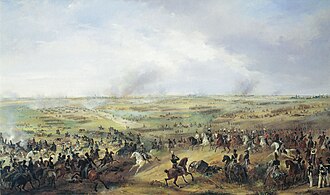
The Battle of Leipzig, widely known as the Battle of the Nations, took place from October 16 to 19, 1813, in the Kingdom of Saxony. It stands as the largest and perhaps most consequential engagement of the Napoleonic Wars, marking a turning point that shattered Napoleon Bonaparte's grip on Europe. The conflict pitted the French Empire and its allies against the Sixth Coalition—a massive alliance comprising Russia, Austria, Prussia, and Sweden.
With approximately 560,000 soldiers involved and 2,200 artillery pieces deployed, the scale of the battle was unprecedented for its time. The resulting Coalition victory led to the dissolution of the Rhine Confederation and forced France to relinquish control of all territories east of the Rhine.
Key Facts
- Date: October 16–19, 1813.
- Location: Leipzig, Kingdom of Saxony.
- Outcome: Decisive Coalition victory.
- Total Casualties: Estimated between 80,000 and 110,000 killed, wounded, or missing.
- Scale: The largest battle of the Napoleonic Wars, involving over half a million troops.
- Strategic Result: France lost all territories east of the Rhine.
The Road to Leipzig: Background and Strategy
The seeds of the battle were sown during Napoleon's disastrous invasion of Russia in 1812. Despite reaching Moscow, the Grande Armée (Napoleon's primary army) was virtually destroyed by the brutal Russian winter, starvation, and constant harassment by Cossacks. Simultaneously, the Duke of Wellington was routing French forces in the Peninsular War, pushing them back toward the Pyrenees.
Seizing the moment, the monarchs of Russia, Prussia, and Sweden developed the Trachenberg Plan. This strategy dictated that Coalition armies would avoid direct confrontation with Napoleon himself, instead targeting his marshals. While the Coalition suffered a setback at the Battle of Dresden in August 1813, the overall momentum shifted against France.
Napoleon attempted to knock Prussia out of the war by targeting Berlin, but failures at the battles of Großbeeren and Dennewitz forced him to withdraw. He eventually organized his remaining forces around Leipzig to protect his supply lines and oppose the converging Allied armies.
Opposing Forces and Strength
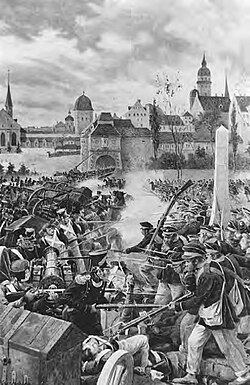
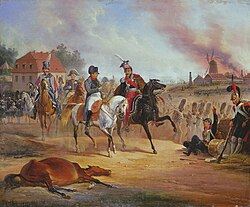
The disparity in manpower was significant. Napoleon commanded a combined force of roughly 198,000 to 225,000 troops, including French soldiers, Poles, Italians, and Germans from the Confederation of the Rhine. The Coalition, however, amassed approximately 380,000 troops and 1,500 guns.
| Belligerent | Estimated Strength | Key Commanders | Estimated Casualties |
|---|---|---|---|
| French Empire & Allies | 198,000 – 225,000 | Napoleon I, Józef Poniatowski | 60,000 – 79,000 |
| Sixth Coalition | ~380,000 | Alexander I, Karl von Schwarzenberg, Gebhard von Blücher | 54,000 – 80,000 |
Chronology of the Battle
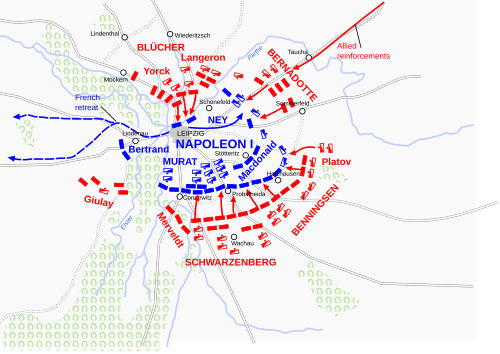
October 16: The Opening Clash
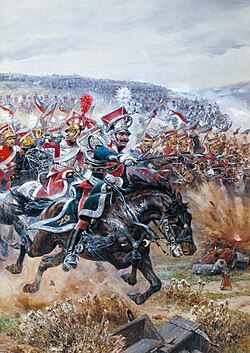
The first day was a bloody draw. French forces saw slight victories at Lindenau and Wachau but suffered a reverse at Möckern. A notable engagement occurred at Liebertwolkwitz, where Napoleon deployed a grand battery—a concentrated mass of 150 guns—to blast the Russian II Corps.
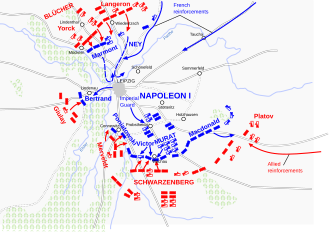
October 17–18: Encirclement and Defection
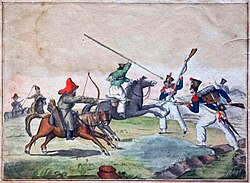
On October 17, the Coalition was heavily reinforced by the arrival of 145,000 troops under Bennigsen and Crown Prince Charles John. By October 18, the Coalition armies had effectively encircled Napoleon. In a critical blow to French morale, the Saxon and Württemberg troops—previously Napoleon's allies—defected to the Coalition.
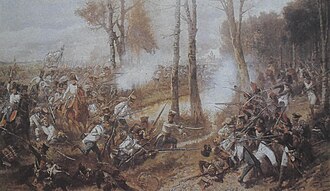
October 19: The Retreat and Urban Combat
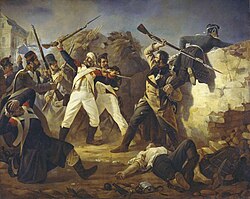
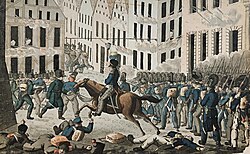
The French began a desperate evacuation on the morning of October 19. As the Allies launched a full-scale assault, the retreat turned into a chaotic struggle. Marshal Oudinot led a ferocious rearguard action, turning the streets of Leipzig into a battlefield of barricades and house-to-house fighting.
Aftermath and Legacy
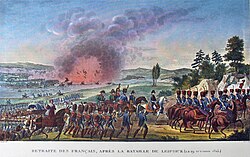
The retreat was catastrophic for Napoleon. Beyond the killed and wounded, the Allies captured 15,000 able-bodied Frenchmen, 21,000 sick or wounded, and 325 guns. The scale of death was so immense that corpses remained visible in the area the following year.
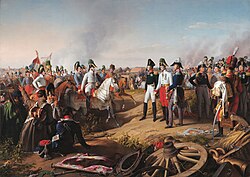
The victory solidified the Coalition's dominance and paved the way for the eventual invasion of France. Today, the battle is commemorated by the 91-metre Völkerschlachtdenkmal (Monument to the Battle of the Nations), completed in 1913, which stands as one of the largest monuments in Europe.
Frequently Asked Questions
Why is it called the Battle of the Nations?
It earned this name because it involved a vast array of different nationalities from across Europe, including French, Russian, Prussian, Austrian, Swedish, Polish, and Italian troops.
What was the Trachenberg Plan?
The Trachenberg Plan was a strategic agreement by the Coalition to avoid fighting Napoleon directly and instead attack his subordinate marshals to wear down the French army.
How did the defection of the Saxons affect the battle?
The defection of the Saxon and Württemberg armies on October 18 significantly weakened Napoleon's numbers and morale, contributing to the collapse of his defensive perimeter.
What were the long-term territorial consequences?
The battle led to the dissolution of the Rhine Confederation and the total loss of French control over all territories east of the Rhine river.
Who were the primary commanders of the Coalition?
The Coalition forces were led by Tsar Alexander I of Russia, Karl von Schwarzenberg (Army of Bohemia), Gebhard von Blücher (Army of Silesia), and Crown Prince Charles John of Sweden (Army of the North).