Battle of Ulm: Napoleon's Strategic Masterpiece
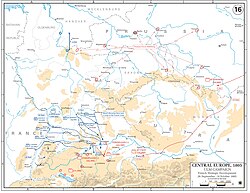
The Battle of Ulm, fought between October 16 and 20, 1805, stands as one of the most remarkable examples of strategic maneuver in military history. Rather than a single, bloody clash, it was a series of skirmishes that culminated in the total entrapment of an Austrian army. Through a brilliant operational movement, Napoleon I forced the surrender of General Karl Freiherr Mack von Leiberich near Ulm in the Electorate of Bavaria, achieving a decisive victory with remarkably few French casualties.
This victory was a cornerstone of the Ulm campaign, a phase of the War of the Third Coalition that demonstrated the lethal efficiency of the Grande Armée (Napoleon's primary imperial army) and set the stage for the subsequent conquest of Vienna.
Key Facts
- Date: October 16–20, 1805
- Outcome: Decisive French victory; France gained control over Bavaria.
- French Strength: 80,000 troops
- Austrian Strength: 40,000 troops (at the time of the final encirclement)
- Austrian Losses: 4,000 killed or wounded; 27,000 captured
- French Losses: 1,500 killed, wounded, or captured
- Primary Commanders: Napoleon Bonaparte and Michel Ney (France); Karl Mack von Leiberich (Austria)
The Road to Ulm: Strategic Miscalculations
In 1805, the Third Coalition—comprising the United Kingdom, Austria, Sweden, and Russia—united to oppose French hegemony in Europe. When Bavaria allied with France, General Karl Mack von Leiberich led an Austrian force of 72,000 men into Bavaria. This move was premature, as the supporting Russian forces were still marching through Poland.
A persistent myth suggests that a discrepancy between the Gregorian calendar used by Austria and the Julian calendar used by Russia caused this timing error. However, modern scholars, including Frederick Kagan, dismiss this as a "bizarre myth," attributing the delay to standard operational challenges rather than calendar confusion.
While the Austrians expected the primary theater of war to be northern Italy, Napoleon had other plans. He pivoted his 177,000 troops from the coast of Boulogne, where they had been prepared for an invasion of England, and marched them south. By September 24, the French crossed the Rhine, executing a massive "right wheel" maneuver to reach the Danube and cut the Austrians off from their Russian allies.
The Encirclement of General Mack
By early October, General Mack realized he was being outflanked. He attempted to reposition his forces, placing his left at Ulm and his right at Rain. However, the French crossed the Danube at Neuburg, Donauwörth, and Ingolstadt, effectively bypassing the Austrian defenses. The Austrian corps under Michael von Kienmayer was forced to abandon its positions and flee toward Munich.
The French tightened the noose through a series of sharp engagements:
- Battle of Wertingen (Oct 8): Joachim Murat's cavalry and Jean Lannes' V Corps devastated the division of Franz Xaver von Auffenberg.
- Battle of Günzburg (Oct 9): Michel Ney's VI Corps defeated Mack's attempt to move north.
- Battle of Haslach-Jungingen (Oct 11): Pierre Dupont de l'Etang blocked Mack's breakout attempt to the north.
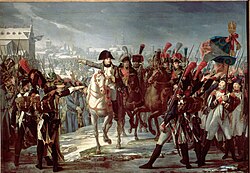
By October 11, Napoleon's corps had formed a wide net. Nicolas Soult's IV Corps cut off the route to Tyrol, while Jean-Baptiste Bernadotte's I Corps and Louis Nicolas Davout's III Corps converged on Munich. Auguste Marmont's II Corps occupied Augsburg, while the Imperial Guard and other units closed in on Ulm.
The Final Collapse
On October 14, Michel Ney crushed the forces of Johann Sigismund Riesch at the Battle of Elchingen, driving the survivors back into Ulm.
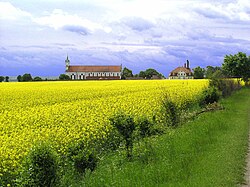
Simultaneously, Murat pursued the corps of Franz von Werneck through a series of actions at Langenau, Herbrechtingen, Nördlingen, and Neresheim, leading to Werneck's surrender on October 18. Only Archduke Ferdinand Karl Joseph and a small cavalry force managed to escape to Bohemia.
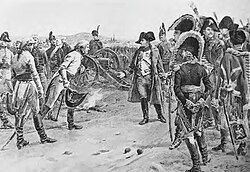
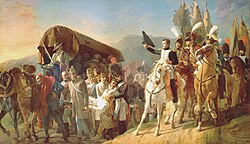
By October 16, the encirclement was complete. On October 20, General Mack surrendered his remaining army. The capitulation included 25,000 men, 18 generals, 65 guns, and 40 standards.
Aftermath and Military Legacy
The surrender at Ulm was a strategic triumph that allowed Napoleon to capture Vienna just one month later. In his official bulletin, Napoleon noted that the "bad combinations of the enemy" allowed him to achieve success without significant risk.
The campaign is studied in military academies today as a model of the turning movement—a maneuver where an army bypasses the enemy's main strength to strike at their lines of communication and retreat. This strategic approach later influenced the Schlieffen Plan used by Germany at the start of World War I.
| Category | French Empire | Austrian Empire |
|---|---|---|
| Commanders | Napoleon Bonaparte, Michel Ney | Karl Mack von Leiberich |
| Troop Strength | 80,000 | 40,000 (at surrender) |
| Casualties | 1,500 killed/wounded/captured | 4,000 killed/wounded |
| Prisoners | Negligible | 27,000 captured |
| Strategic Result | Decisive Victory | Total Capitulation |
Frequently Asked Questions
Why is the Battle of Ulm considered a strategic victory rather than a tactical one?
It is considered a strategic victory because Napoleon won primarily through movement and positioning. By encircling the Austrian army and cutting off its retreat and supply lines, he forced a surrender without having to fight a massive, high-casualty pitched battle.
Did the difference between the Julian and Gregorian calendars cause the Austrian defeat?
No. While this is a popular legend, historians dismiss it as a myth. The delay of the Russian army was due to logistical and operational issues, not a misunderstanding of the date.
What happened to General Karl Mack after the surrender?
General Mack presented himself to Napoleon as "the unfortunate General Mack." He was subsequently court-martialed by the Austrians and sentenced to two years of imprisonment.
How did the victory at Ulm affect the rest of the 1805 campaign?
The victory neutralized a significant portion of the Austrian army (approximately 60,000 men and 30 generals), clearing the path for Napoleon to occupy Vienna and eventually fight the Battle of Austerlitz.
What is a "turning movement" in the context of this battle?
A turning movement is a maneuver where an army moves around the flank of the enemy to seize a position in their rear. At Ulm, Napoleon used this to sever Mack's connection to the Russian army, trapping him against the Danube.