Frederick I of Württemberg: From Prussian Soldier to the First King
Frederick I (1754–1816) was a pivotal figure in German history, navigating the volatile political landscape of the Napoleonic era to transform his domains from a duchy into a kingdom. Known for his complex personal life and strategic political pivots, Frederick served as the ruler of Württemberg for nearly two decades, evolving from a Duke to an Elector, and finally to the first King of Württemberg.
His journey was marked by high-stakes diplomacy, military service across Europe, and a series of royal marriages that linked him to the most powerful houses of Russia, Great Britain, and France.
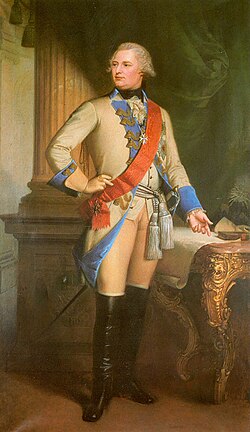
Key Facts
- Reign: 23 December 1797 – 30 October 1816.
- Titles: Last Duke of Württemberg (1797–1803), only Elector of Württemberg (1803–1806), and first King of Württemberg (1806–1816).
- Key Alliance: Rose to kingship through an alliance with Napoleon Bonaparte.
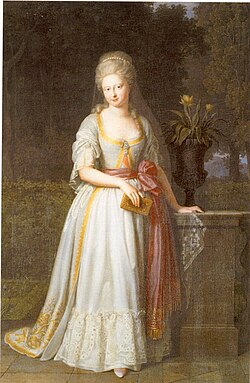
- Family Ties: Married Charlotte, Princess Royal, the eldest daughter of King George III of Great Britain.
- Legacy: Successfully retained expanded territories after the Congress of Vienna.
Early Life and Military Career
The Prussian Influence
Born on 6 November 1754 in Treptow an der Rega, Prussia (now Trzebiatów, Poland), Frederick was the eldest son of Frederick II Eugene and Sophia Dorothea of Brandenburg-Schwedt. As the nephew of the long-reigning Duke Charles Eugene, Frederick's path to power was not immediate. Because his uncle held a tight grip on government affairs, Frederick pursued a military career at the court of Frederick the Great.
He entered the Prussian Army in 1774 as an oberst (colonel) in the Kürassierregiment Lölhöffel and later commanded the 2nd Dragoon Regiment. His time in Prussia established a network of alliances, including his sister Sophie's marriage to the future Emperor Paul I of Russia.
Ventures in Russia
In 1782, Frederick moved to Russia to accompany his sister Sophie and husband Paul. Empress Catherine II, impressed by his confidence, appointed him Governor of Eastern Finland. He also commanded a significant corps in Kherson during the Russo-Turkish War, though his combat involvement was limited.
However, his time in Russia ended in scandal. His relationship with his first wife, Augusta of Brunswick-Wolfenbüttel, was fraught with tension and reports of violence. In 1786, Augusta sought asylum from Empress Catherine, who subsequently ordered Frederick to leave Russia, citing his "abominations." Augusta died in 1788 from complications of amenorrhea.
The Ascent to Power
From Duke to Elector
Frederick succeeded his father as Duke of Württemberg on 23 December 1797. His early reign was disrupted by the French occupation of 1800, forcing him to flee to Vienna. During this period, he ceded the enclave of Montbéliard to the French Republic in exchange for Ellwangen.
The Reichsdeputationshauptschluss—a major reorganization of the Holy Roman Empire following French annexations—elevated Frederick to the rank of Prince-Elector (Kurfürst) in 1803. This transition significantly expanded his territories by granting him control over various free cities and ecclesiastical lands.
The First King of Württemberg
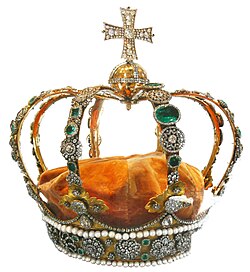
Frederick's ambition culminated in 1806. In exchange for providing Napoleon with a large auxiliary military force, Napoleon allowed Frederick to elevate his state to a kingdom. He was formally crowned King Frederick I on 1 January 1806.
To solidify this alliance, Frederick joined Napoleon's Confederation of the Rhine and married his daughter, Princess Catharina, to Napoleon's youngest brother, Jérôme Bonaparte.
Diplomacy and Later Years
Frederick's position was a delicate balancing act. While allied with Napoleon, he was the son-in-law of George III of Great Britain, having married the Princess Royal, Charlotte, in 1797. This unique position allowed him to act as a diplomatic intermediary between Britain and continental powers.
As the tide of the Napoleonic Wars turned, Frederick strategically switched sides during the German campaign of 1813, joining the Allies. At the Congress of Vienna, he fought tenaciously to retain the territories he had acquired under Napoleon. Despite opposition from dispossessed princes, Austria supported Frederick, allowing him to keep his lands.
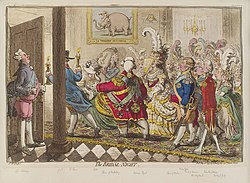
Frederick was known for his imposing physical presence; Napoleon famously remarked on the extent to which his skin could be stretched without bursting, while Frederick privately questioned how so much "poison" could fit in Napoleon's small head.
Summary of Frederick I's Life
| Category | Details |
|---|---|
| Full Name | Friedrich Wilhelm Karl |
| Lifespan | 6 November 1754 – 30 October 1816 |
| Predecessor | Frederick II Eugene |
| Successor | William I |
| Spouses | Augusta of Brunswick-Wolfenbüttel; Charlotte, Princess Royal |
| Religion | Lutheranism |
| Burial Site | Schlosskirche, Ludwigsburg, Germany |
Frequently Asked Questions
How did Frederick I become the King of Württemberg?
Frederick I became king through a strategic alliance with Napoleon Bonaparte. In exchange for providing France with a large auxiliary force, Napoleon permitted the elevation of Württemberg from an electorate to a kingdom in 1805, with the formal coronation occurring on 1 January 1806.
Who were Frederick I's spouses?
Frederick married twice. His first wife was Duchess Augusta of Brunswick-Wolfenbüttel, with whom he had four children. His second wife was Charlotte, Princess Royal, the eldest daughter of King George III of Great Britain.
What was Frederick's relationship with Napoleon?
Their relationship was one of mutual political utility but personal disdain. While Frederick relied on Napoleon to elevate his status to king, the two exchanged insults regarding their physical appearances—Napoleon mocking Frederick's obesity and Frederick mocking Napoleon's temperament.
Did Frederick I keep his lands after Napoleon's fall?
Yes. Despite the efforts of dispossessed princes to reclaim their sovereignty, Frederick successfully navigated the Congress of Vienna. With the support of Austria, he was confirmed as king and allowed to retain the territories he had acquired during the Napoleonic era.
What military roles did Frederick hold before becoming ruler?
Frederick served as a colonel and later a major general in the Prussian Army, fought in the War of the Bavarian Succession, and served as the Governor of Eastern Finland under Empress Catherine II of Russia.