Landtag: The Evolution and Function of German-Speaking Legislatures
In the political landscape of German-speaking nations, the Landtag (literally translated as "State Diet") serves as the legislative assembly or parliament for a federated state or a subnational self-governing entity. Typically organized as a unicameral assembly—meaning it consists of a single chamber—the Landtag exercises legislative authority over matters that do not fall under federal jurisdiction.
Today, Landtage are central to the governance of Germany and Austria, and the term is also used for the legislature of the autonomous province of South Tyrol in Italy. In the Principality of Liechtenstein, the Landtag functions as the nation's sole national parliament due to the country's size.
Key Facts
- Definition: A subnational or state-level legislative body in German-speaking regions.
- Structure: Generally unicameral, focusing on non-federal legislative competence.
- Current Usage: Active in Germany, Austria, Liechtenstein, and South Tyrol (Italy).
- Etymology: Derived from Land (state/territory) and Tag (day), referring to meetings held during daylight.
- Historical Shift: Evolved from class-based "estates of the realm" to democratically elected bodies.
Etymology and Origins
The term Landtag is a compound of the German words Land (meaning state, country, or territory) and Tag (day). This naming convention stems from the word Tagung (meeting), as these assemblies were traditionally held during daylight hours and occasionally spanned several days.
Historical Evolution of the Landtag
The Holy Roman Empire and Feudal Estates
In the feudal era, representative assemblies known as Landstände (estates of the realm) reflected the rigid class system of the time. These were not democratic bodies reflecting public opinion, but rather expressions of established power. Seats were granted based on formal privileges to nobles, prelates, and certain cities, or through electors in specific colleges. In states known as Land, these assemblies were called Landtage, mirroring the Reichstag (Imperial Diet) of the Holy Roman Empire.
Prussia and the German Confederation
Prussian Landtage appeared as early as 1466 in Royal Prussia and 1525 in Ducal Prussia. Following the dissolution of the Holy Roman Empire, the German Confederation (Deutscher Bund) was founded in 1815. Under Section 13 of its constitution (the Bundesakte), member states were required to implement parliaments called Landstände or Landtage. Nassau passed the first such constitution in 1814, and by 1841, nearly all states had established these bodies.
The German Empire and the Weimar Republic
By the founding of the German Empire in 1871, all 25 states and the territory of Alsace-Lorraine utilized Landtage, with the Prussian Landtag being the most influential. This evolved further during the Weimar Republic (1919–1933), where Landtage became democratically elected via universal suffrage.
This democratic era ended with the Nazi seizure of power. Through a process called Gleichschaltung (coordination), the Provisional Law of March 31, 1933, dissolved existing Landtage. By January 30, 1934, the "Law on the Reconstruction of the Reich" formally abolished them, transferring sovereignty to the central government and replacing federalism with a unitary state.
East Germany and Other Regions
The original constitution of East Germany established five Länder (states), each with a Landtag that elected the Chamber of States. However, in 1952, these were replaced by Bezirke (districts), and the Landtage were abolished. They were only restored following the Peaceful Revolution and the subsequent reunification of Germany.
Beyond Germany, the Diet of Finland was known as the lantdag in Swedish until 1919. Similarly, the Baltic regions (Livonia, Courland, and Estonia) maintained Landtags from as early as 1419 until they were eventually replaced by the Riigikogu in Estonia and the Saeima in Latvia after 1918.
Modern Landtage in Europe
Germany
In the modern Federal Republic of Germany, most Bundesländer (federal states) utilize a Landtag. This includes states such as Bavaria, Lower Saxony, and North Rhine-Westphalia.
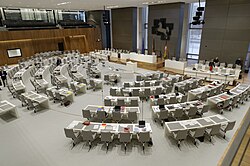
Certain city-states use different terminology. In Bremen and Hamburg, the state parliament is called the Bürgerschaft (municipal assembly). In Berlin, the legislature is known as the Abgeordnetenhaus (House of Representatives), maintaining a tradition linked to the old Prussian Landtag.
Austria
Austria's nine states each have a unicameral Landtag responsible for all matters not assigned to the federal level. Representatives are elected through proportional representation via free, secret, and direct ballots.
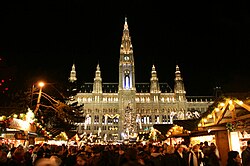
In Vienna, the Gemeinderat (municipal assembly) serves as the state Landtag. While the membership is identical, the city constitution mandates that municipal and state affairs are handled in separate meetings.
Summary of Modern Legislatures
| Region | Legislative Body Name | Scope of Authority | Structure |
|---|---|---|---|
| German States (most) | Landtag | State (Bundesland) | Unicameral |
| Hamburg/Bremen | Bürgerschaft | City-State | Unicameral |
| Berlin | Abgeordnetenhaus | City-State | Unicameral |
| Austrian States | Landtag | State (Bundesland) | Unicameral |
| Vienna | Gemeinderat | City-State/Municipality | Unicameral |
| Liechtenstein | Landtag | National | Unicameral |
| South Tyrol (Italy) | Landtag | Autonomous Province | Unicameral |
Frequently Asked Questions
What is the difference between a Landtag and a Bundestag?
The Bundestag is the national parliament of Germany, whereas a Landtag is the parliament of an individual federal state (Bundesland). The Bundestag handles federal laws, while the Landtag handles state-level legislation.
Why is the legislature in Berlin called the Abgeordnetenhaus instead of the Landtag?
The Abgeordnetenhaus (House of Representatives) was adopted in 1951 to follow the historical tradition of the Prussian Landtag.
How are members of the Austrian Landtage elected?
They are elected through general, free, secret, and direct ballots based on the principle of proportional representation.
What happened to the Landtage during the Nazi regime?
They were first neutralized through Gleichschaltung in 1933 and then formally abolished by the "Law on the Reconstruction of the Reich" in 1934, which shifted power to the central government.
Does Liechtenstein have a federal system with multiple Landtage?
No. Because of its small size, Liechtenstein does not have a federal structure; its Landtag serves as the sole national parliament.