Matter: The Fundamental Substance of the Universe
In the realm of physical science, matter is defined as any substance that possesses mass and occupies space by having volume. From the smallest grain of sand to the largest star, every tangible object in our daily lives is composed of matter. While we often perceive matter as solid and stable, it is actually a complex arrangement of interacting subatomic particles governed by the laws of quantum mechanics.
It is important to distinguish matter from other physical phenomena. While matter has rest mass and volume, massless particles—such as photons (particles of light)—and energy phenomena like heat are not classified as matter.
Key Facts
- Definition: Matter is any substance with mass and volume.
- Composition: Ordinary matter consists of atoms, which are made of protons, neutrons, and electrons.
- Fundamental Building Blocks: At the deepest level, matter is composed of fermions, specifically quarks and leptons.
- Cosmic Distribution: Luminous matter makes up only a tiny fraction (0.40%) of the universe, while dark energy (73.0%) and dark matter (23.0%) dominate.
- States: Beyond solids, liquids, and gases, matter can exist as plasma, Bose-Einstein condensates, and quark-gluon plasma.
The Structure of Matter: From Atoms to Quarks
For centuries, the particulate theory of matter—the idea that everything is built from discrete blocks—was proposed by ancient thinkers, including the Indian philosopher Kaṇāda and Greek philosophers Leucippus and Democritus. Modern science has refined this into a hierarchical understanding of structure.
The Atomic Level
Traditionally, atoms are visualized as a dense nucleus containing protons and neutrons, surrounded by a cloud of orbiting electrons. However, this model is a simplification. Because subatomic particles exhibit quantum nature, they behave as both particles and waves, lacking well-defined sizes or positions in the way everyday objects do.

The Subatomic Level: Fermions
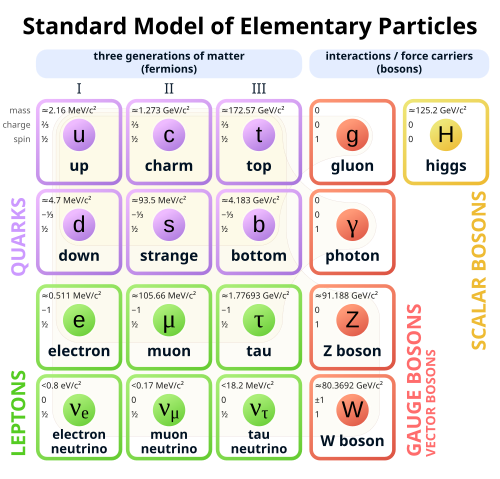
According to the Standard Model of particle physics, the true building blocks of matter are fermions. These include quarks and leptons. Because of the exclusion principle and other fundamental interactions, these point particles are forced to maintain distance from one another, which creates the physical property of "taking up space" that we perceive as volume.
Quarks and Leptons
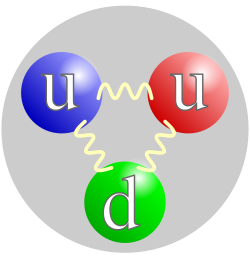
Protons and neutrons are composite particles made of quarks. For example, a proton consists of two up quarks and one down quark. Leptons, the other primary category of fermions, include the electron and neutrinos.
| Particle Type | Examples | Key Characteristics | Comparable Mass |
|---|---|---|---|
| Up-type Quarks | Up, Charm, Top | Positive electric charge (+2/3 e) | Up: ~5 electrons; Top: ~180 protons |
| Down-type Quarks | Down, Strange, Bottom | Negative electric charge (-1/3 e) | Down: ~10 electrons; Bottom: ~5 protons |
| Charged Leptons | Electron, Muon, Tau | Negative electric charge (-1 e) | Electron: 1 electron; Tau: ~2 protons |
| Neutrinos | Electron, Muon, Tau neutrinos | Neutral charge (0) | Extremely low mass (< 40 electrons) |
Phases and States of Matter
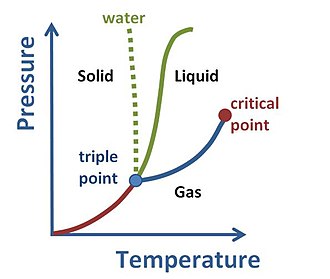
Matter manifests in various states, or phases, depending on conditions like temperature and pressure. The most familiar are the classical phases: solids, liquids, and gases. A single chemical substance, such as water, can transition between these states as ice, liquid water, and steam.

Beyond these, more exotic states exist. Plasma, a high-energy state where electrons are stripped from nuclei, is the most abundant ordinary matter in the universe.

Other advanced states include Bose-Einstein condensates, fermionic condensates, and quark-gluon plasma, the latter of which describes matter at extreme densities and temperatures.
Cosmology and the Mystery of Dark Matter
In the context of general relativity and cosmology, scientists have discovered that the matter we can see (luminous matter) is only a small part of the universe's composition. Observations of galaxy rotation curves show that stars at the edges of galaxies move faster than can be explained by visible mass alone.
![Galaxy rotation curve for the Milky Way. The vertical axis is the rotation speed about the galactic center. The horizontal axis is the distance from the galactic center. The Sun is marked in yellow. The observed rotation speed curve is marked by data points. The predicted curve based on the stellar mass and gas of the Milky Way is in black. The difference is due to dark matter or possibly a modification of gravity like MOND. The data shown can be found here.[59][60][61][62][63][64][65][66][67][68]](/images/0d/e6/0de6c230764c57751635e13f8e98349df1a16978745cfeb585a66466c729dd07.webp)
This discrepancy suggests the existence of dark matter, a form of matter that does not emit light but exerts gravitational pull. When combined with dark energy, these invisible components make up the vast majority of the universe's energy-mass density.
Frequently Asked Questions
What is the difference between matter and mass?
While often used interchangeably, matter refers to the substance that has mass and volume. Mass is a specific property of matter—a measure of the amount of substance it contains and its resistance to acceleration.
Are photons considered matter?
No. Photons are massless particles and are classified as gauge bosons (force carriers) rather than fermions. Because they lack rest mass and volume, they are not considered matter.
What is antimatter?
Antimatter consists of particles that have the same mass as ordinary matter particles but opposite electric charges and quantum numbers (such as negative baryon or lepton numbers). When matter and antimatter meet, they annihilate each other.
Why does matter "take up space" if subatomic particles are point-like?
The perception of volume arises from the exclusion principle and fundamental interactions that prevent fermions (like electrons) from occupying the same space, effectively forcing them to maintain a distance from one another.
What is the most common state of matter in the universe?
Plasma is the most abundant state of ordinary matter in the universe, as it makes up the bulk of the stars and the interstellar medium.