Gravitational Lensing: How Massive Objects Bend Light Across the Universe
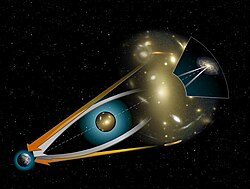
Imagine a telescope the size of a galaxy cluster, capable of magnifying the most distant reaches of the cosmos. This is not a man-made invention, but a natural phenomenon known as gravitational lensing. It occurs when a massive object—such as a cluster of galaxies or a point particle—possesses enough density to bend the path of light from a distant source as it travels toward an observer.
This cosmic illusion is a direct consequence of the general theory of relativity, Albert Einstein's description of how mass warps the fabric of spacetime. While Newtonian physics also predicts that light (treated as corpuscles) would bend, it only predicts half the deflection that general relativity describes.
Key Facts
- Mechanism: Massive objects warp spacetime, causing light to follow a curved path.
- Three Types: Strong lensing, weak lensing, and microlensing.
- First Discovery: The "Twin QSO" (SBS 0957+561) was the first gravitational lens observed in 1979.
- Cosmic Magnification: Lensing allows astronomers to see galaxies and quasars that would otherwise be too faint to detect.
- Modern Surveys: New telescopes like Euclid and the Vera C. Rubin Observatory are expected to find hundreds of thousands of new lenses.
The Evolution of a Theory
The idea that gravity could influence light dates back to Isaac Newton in 1704. Later, in 1801, Johann Georg von Soldner published calculations on the deflection of starlight. However, it was Albert Einstein who revolutionized the field. In 1911, using the equivalence principle, Einstein initially calculated a value similar to Soldner's, but by 1915, he realized that the correct value was double that amount due to the curvature of spacetime.
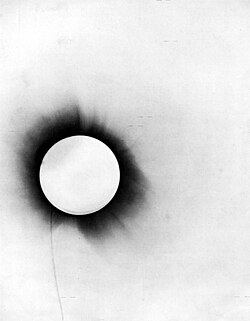
While Orest Khvolson (1924) and Frantisek Link (1936) were among the first to discuss the effect in print, the concept is most closely linked to Einstein. In 1937, Fritz Zwicky proposed that entire galaxy clusters could act as lenses, a theory that remained unconfirmed until the late 1970s.
Types of Gravitational Lensing
Depending on the mass of the lens and the alignment of the objects, astronomers categorize lensing into three distinct classes:
Strong Lensing
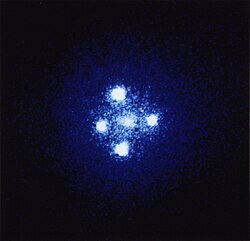
Strong lensing occurs when the lens is so massive and the alignment so precise that the light is visibly distorted. This can result in multiple images of the same object, arcs, or a complete circle known as an Einstein ring.

A famous example is the Einstein Cross, where a foreground galaxy creates four separate images of a single distant quasar.
Weak Lensing
Weak lensing is more common but harder to detect. It does not produce multiple images or rings but slightly distorts the shapes of background galaxies. By measuring these subtle distortions across millions of stars and galaxies, scientists can map the distribution of dark matter.
Microlensing
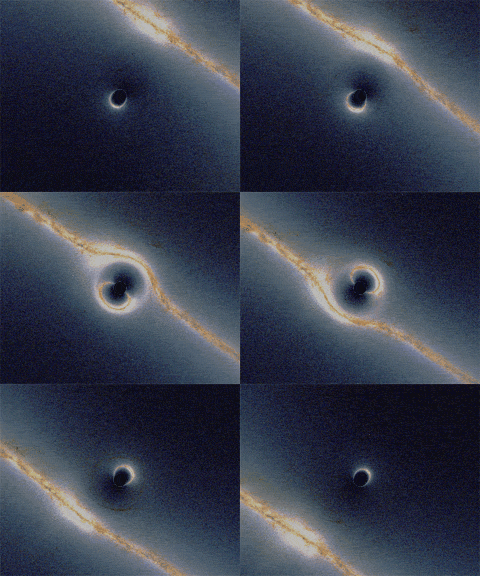
Microlensing happens when a smaller object, like a star or a planet, passes in front of a background source. Instead of distorting the shape, the lens causes a temporary increase in the brightness of the source. This technique has been instrumental in finding exoplanets; a study between 2002 and 2007 suggested that most stars in the Milky Way host at least one planet within 0.5 to 10 AU.
Pushing the Boundaries of the Observable Universe
Modern technology has turned gravitational lensing into a powerful tool for discovery. The Hubble Space Telescope identified J1000+0221 as the most distant quad-image lensing galaxy in 2013, followed by the discovery of the IRC 0218 lens in 2014.
The James Webb Space Telescope (JWST) has pushed these limits even further. In 2023, astronomers identified JWST-ER1, a massive galaxy at redshift z = 2. Located approximately 17 billion light-years away, it creates a complete Einstein ring by lensing an even more distant background galaxy. This discovery provides critical data on the density of dark matter halos in the early universe.
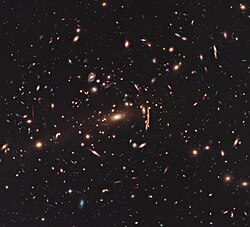
![Galaxy cluster SDSS J0915+3826 helps astronomers to study star formation in galaxies.[30]](/images/28/9d/289d7e3df47dea1ece228a2c38f5e557dbd4569f6d8987e4ec8288ce0711beeb.jpg)
![Galaxy cluster MACS J2129-0741 and lensed galaxy MACS2129-1.[48]](/images/19/55/19555e90653ffa7dc4aad47faecfd025611370ab8a978647974bcaff444a6c27.jpg)
The Future of Lensing Surveys
We are entering a golden age of lensing discovery. Several upcoming and recently launched missions are set to increase the number of known lenses by orders of magnitude:
| Telescope / Observatory | Launch/Start Date | Expected Strong Lenses | Survey Duration |
|---|---|---|---|
| Euclid Space Telescope | 2023 | ~100,000 | 6 Years |
| Vera C. Rubin Observatory (LSST) | 2025 | 62,000 – 120,000 | 10 Years |
| Nancy Grace Roman Space Telescope | 2026/2027 | ~160,000 | Planned HLWAS |
Frequently Asked Questions
What is the difference between an Einstein ring and an Einstein cross?
An Einstein ring occurs when the source, the lens, and the observer are perfectly aligned, creating a complete circle of light. An Einstein cross occurs when the lens is typically an elliptical galaxy, splitting the light into four distinct images around the center.
How does microlensing help find planets?
When a star passes in front of another star, it acts as a lens. If that foreground star has a planet orbiting it, the planet's own gravity creates a secondary, smaller spike in brightness, revealing the planet's presence.
Why is gravitational lensing useful for studying dark matter?
Dark matter does not emit light, making it invisible to traditional telescopes. However, it does have mass. By observing how light bends around "empty" space, astronomers can calculate the mass and location of the dark matter causing the lensing.
Who first observed a gravitational lens in space?
The first gravitational lens, known as the Twin QSO (SBS 0957+561), was discovered in 1979 by Dennis Walsh, Bob Carswell, and Ray Weymann using the Kitt Peak National Observatory.